‘The Institutional Erosion of the Lokpal of India’
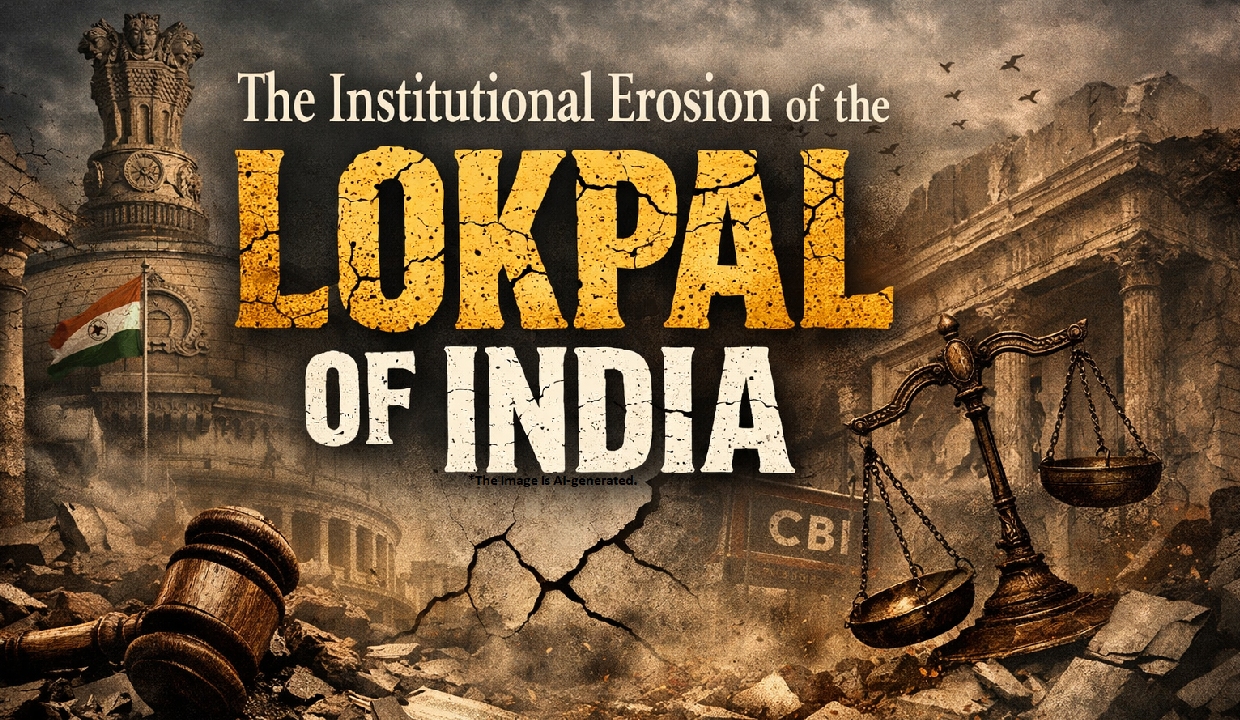
Corruption, in its myriad forms such as bribery, fraud and embezzlement, has universally plagued public and private institutions alike. The concept of the Lokpal, which literally means “caretaker of the people”, is borrowed from the Swedish model of ombudsman, an independent, parliamentary-appointed official established in 1809 to protect citizen rights by overseeing government administration and investigating abuses of power.
India’s long and arduous battle against corruption reached a defining moment with the passage of the Lokpal and Lokayuktas Act, 2013. Born out of unprecedented public pressure and widespread frustration against entrenched institutional corruption, the legislation was envisioned as a powerful, independent watchdog to hold the highest offices accountable. Yet, nearly a decade later, the reality of the Lokpal stands in stark contrast to its founding promise. What was meant to be a sturdy and steadfast pillar of transparency risks becoming a symbolic institution, impaired by neglect, structural weaknesses, and a lack of political and institutional support.
Its Traceable Origins in Public Anger and Political Compulsion
The Lokpal legislation did not emerge in a vacuum. It was the inevitable product of a powerful nationwide movement that galvanized citizens across social and political spectrums. Public outrage against corruption scandals had reached a veritable tipping point, forcing the then United Progressive Alliance (UPA) government to act decisively. The subsequent National Democratic Alliance (NDA) government valiantly carried forward the implementation, reflecting a rare bipartisan acknowledgment of public sentiment. The Act was thus less a voluntary reform and more a political necessity-an attempt to restore the sinking public faith in governance. It represented the collective demand for an efficacious mechanism that could function independently of political influence and interference and investigate corruption at the highest levels, including ministers and senior bureaucrats. However, the letter and spirit of the legislation appears to have weakened over time, as the institutional backing necessarily required to sustain it has remained inadequate.
Despite its independent statutory authority, the Lokpal of India continues to operate under significant debilitating constraints that undermine its effectiveness. One of the most glaring issues is the absence of a permanent institutional framework. Even years after its establishment, the Lokpal lacks a dedicated office space, functioning instead from a temporary setup that does little to inspire confidence in its permanence or authority. Equally disconcerting is the abject shortage of trained personnel. With a limited workforce-reportedly capped at around sixty individuals, many of whom lack specialized training-the institution is ill equipped to handle the immense complexity and scale of corruption cases in a country as vast as India. Effective investigation requires not only manpower but also expertise in financial forensics, legal processes, and administrative systems, all of which remain insufficiently developed within the Lokpal. Further compounding these issues is the lack of requisite budgetary allocation. Without sufficient financial resources, even the most well-intentioned institution cannot function optimally. Budgetary constraints limit the Lokpal's ability to recruit talent, invest in infrastructure, and deploy modern investigative tools. This financial neglect signals a deeper lack of commitment to strengthening the anti-corruption framework.
Another critical challenge lies in the ambiguous relationship between the Lokpal and the judiciary. The Lokpal Act envisages a broad mandate to investigate corruption, but its jurisdiction has encountered stiff resistance when it concerned the higher judiciary. A significant moment highlighting this tension was when the Supreme Court stayed a Lokpal order seeking to probe allegations of corruption within the High Courts. This development raises fundamental questions about institutional accountability. While the Lokpal had in clear and unequivocal language clarified that it did not intend to investigate Supreme Court judges, its attempt to address corruption within the broader judicial system reflected its commitment to its avowed mandate. However, the judicial pushback suggests an unresolved conflict regarding the very scope of the Lokpal's authority. The absence of a clear constitutional alignment between the Lokpal and the judiciary creates a grey area that weakens the institution’s credibility. If certain domains remain beyond scrutiny, the principle of equal accountability is compromised. For an anti-corruption body to be effective, its jurisdiction must be both clearly defined and uniformly respected.
Perhaps the most significant factor contributing to the Lokpal’s current state of affairs is the apparent reluctance of successive governments to fully and meaningfully empower it. While the creation of the Lokpal was driven by public demand, its operationalisation has been marked by delays and half-measures. This suggests a strategic approach to compliance-meeting the minimum requirements of the law coupled with genuinely strengthening the institution. Governments, by their very nature, exercise control over investigative agencies such as the Central Bureau of Investigation (CBI) and the Enforcement Directorate (ED). These agencies report to the executive, allowing the government to retain an appreciable degree of influence over their functioning. In contrast, the Lokpal was designed to operate independently, free from the shackles of executive control. This independence, while essential, may also explain the lack of enthusiasm in empowering the Lokpal. A truly autonomous anti-corruption body poses a grave and compelling challenge to established power structures. By limiting its resources and scope, the institution can be rendered fruitless without overtly dismantling it. Such an approach allows governments to claim adherence to anti-corruption norms while retaining practical control over investigative processes.
The Broader Implications for Democracy
The weakening of the Lokpal is not merely an institutional concern; it has profound implications for India's democratic fabric. Corruption erodes public trust, distorts policy decisions, and impedes the rule of law. An effective anti-corruption mechanism is therefore not a luxury but a necessity for democratic survival. India, as the world's most populous democracy, faces unique governance challenges. The scale and complexity of its administrative systems make it particularly vulnerable to corruption. In this context, the Lokpal was conceptualised as a corrective mechanism, a viable means to ensure accountability at the highest levels. However, a weakened Lokpal hazards sending wrong signals. It suggests that accountability is negotiable and that institutional safeguards can be diluted over time. This not only diminishes public confidence but also emboldens corrupt practices. When oversight mechanisms fail, the consequences are invariably felt across all sectors, from public service delivery to economic development.
Reviving the Lokpal requires more than rhetorical, lip-service commitment; it demands concrete action. The first step must be to establish a permanent institutional framework, complete with adequate infrastructure and resources. This would signal a long-term commitment to the institution's role in governance. Equally important is the need to strengthen its human resources. Recruitment of skilled professionals, coupled with specialized training, is essential to enhance the Lokpal’s investigative capacity. Investing in technology and data analytics can further improve its efficiency and effectiveness. On the legal front, greater clarity is needed regarding the Lokpal's jurisdiction, particularly in relation to the judiciary. A balanced approach that respects judicial independence while ensuring accountability must be accomplished through dialogue and legislative refinement. Finally, political will remains the most clinching factor. Without genuine support from the government, even the most well-designed institutions cannot succeed. Strengthening the Lokpal should not be perceived as a threat but as an opportunity to reinforce democratic credibility.
The Lokpal represents more than just an independent statutory body; it embodies the aspirations of millions of Indians who demanded a cleaner, more accountable system of governance. Its current challenges reflect a disconnect between that aspiration and institutional reality. Protecting the Lokpal is not just in the interest of the public but also in the larger interest of the political and judicial ecosystem. A credible anti-corruption framework enhances legitimacy, fosters trust, and strengthens governance. Conversely, a weakened Lokpal undermines all three. India's fight against corruption is a delicate and ongoing process.
It requires vigilance, commitment, and above all, strong and robust institutions. The Lokpal, despite its visible shortcomings, remains a vital component of this framework. Ensuring its effectiveness is not merely an administrative task-it is a democratic imperative. The Lokpal must be allowed to spread its wings to attain full flight and the people of India must ensure, with all the strength at their command, to thwart any conceivable attempt to clip its wings! Rigoberta Menchú Tum, the redoubtable Guatemalan human rights activist, feminist, and Nobel laureate, aptly remarked, “Without strong watchdog institutions, impunity becomes the very foundation upon which systems of corruption are built. And if impunity is not demolished, all efforts to bring an end to corruption are in vain.”
Writer is a policy expert and columnist; Views presented are personal.