From silver screen to CM chair: Vijay rewrites history
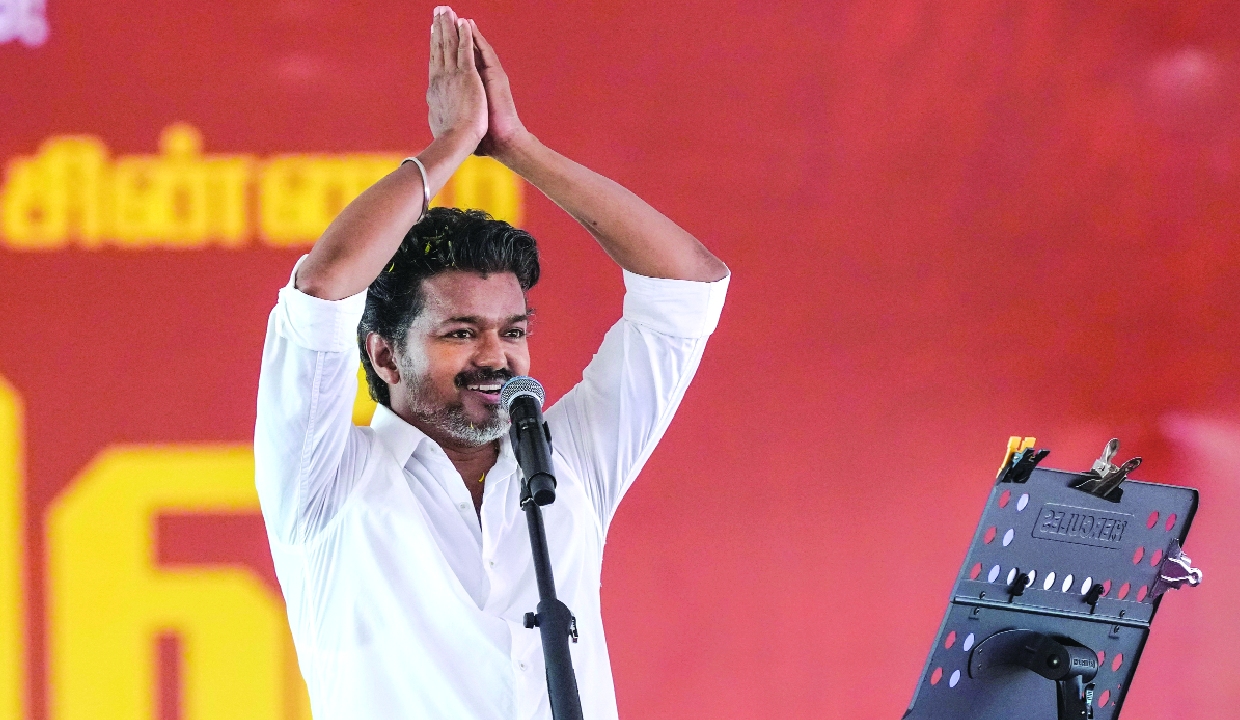
Actor turned politician Vijay will now join the likes of former chief ministers MGR and Jayalalithaa, both actors, as the stars who made it big in the political firmament in Tamil Nadu. He also did not repeat the mistakes of superstars like Kamal Haasan, Vijayakanth and Rajnikanth, who had entered Tamil Nadu politics but could not leave their marks.
And in that moment, a question began to echo across Tamil Nadu, was this just an election result. For the first time in decades, Tamil Nadu’s long-standing two-party dominance appears to be breaking.
Vijay’s charisma and established fan base too played a crucial role in tilting the scales in favour of the TVK. The star of hits such as “Mersal” and “Leo” went into the campaign with a list of lofty poll promises and made “super six” poll promises for women, including 8 gm gold for marriage, which is worth about Rs 14,000 per gram (22 carat), six free LPG cylinders and monthly financial aid.
The actor-turned-politician also assured a quality silk saree in addition to gold for indigent brides and interest-free loans up to Rs 5 lakh for women-run SHGs. He assured corruption-free good governance if voted to power in his maiden electoral fight. The manifesto also laid importance on education.
To prevent school dropouts, mothers or guardians of children studying in Government and State-aided schools will receive Rs 15,000 annually. Additionally, the party promised a Minimum Support Price (MSP) of Rs 3,500 per quintal for paddy and Rs 4,500 per tonne for sugarcane.
Addressing youth unemployment, Vijay pledged to create five lakh new Government jobs and offer as many stipendiary internships. Unemployed graduates will be provided a monthly aid of up to Rs 4,000.
When Vijay repeatedly asserted that the 2026 Assembly polls was a fight between his party, the TVK and the ruling DMK, many did not buy that argument. Not only on this point, but on several other aspects, TVK and Vijay differed from “mainstream” political parties and their conventional ways to seek votes. Vijay neither introduced candidates in all the constituencies nor toured all segments or vigorously campaigned in the traditional sense by addressing rallies.
But his messages were forwarded again and again in social media and by word of mouth by his fans and followers. He neither met the Press nor gave interviews and directly communicated to people via social media. Unusually, he focused on teens, youngsters/children to persuade their parents to vote for TVK.
When polling crossed 85 per cent, Vijay, addressed himself as “Vijay Mama” (Vijay uncle) specially thanked “Kutti, Nanba, Nanbees” (little children) for guiding their families. Also, he brilliantly combined elements of Dravidian ideology and Tamil nationalism in formulating his party’s ideology.
Vijay’s family introduced the promotional title “Ilaya Thalapathy” (Young Commander) for his third film itself, Rasigan (1994), which reflected their confidence and understanding of the importance of branding. This moniker would evolve over more than a decade as he matured into the undisputed “Thalapathy.”
Now Chandrasekar Joseph Vijay, the 51-year-old, has successfully graduated as ‘Thalaivan’ (leader) and Muthalvar (Chief Minister) from being the ‘Thalapathy’ (commander).
When Vijay’s fans, mobilised under the banner of Vijay Makkal Iyakkam (Vijay’s forum for the people) won local body polls in 2021 using the actor’s photos, it raised eyebrows and set the tone for his eventual political debut. Many of the VMI office-bearers are functionaries of Vijay’s Tamilaga Vettri Kazhagam (TVK).
When his movie ‘Thalaiva (The Leader, 2013)’ had the tagline “Born to Lead,” it gave a first, clear hint of his political ambition, but it was not definitive enough to conclude. However, about two years before Thalaiva, he had called on Anna Hazare at the venue of his fast in Delhi and expressed support, and it set tongues wagging.
As expected, Thalaiva courted controversy, and the movie’s release was delayed in Tamil Nadu by two weeks and it was screened only after its tagline had been removed. The AIADMK was in power at that time.
Vijay first appeared on screen as a child artiste in Vetri (1984), a Vijayakanth-starrer directed by his father, SA Chandrasekhar. At 18, he made his debut as a lead actor in ‘Naalaiya Theerpu’ (1992), a flop. For his second movie, Vijay was cast as Vijayakanth’s younger brother in Sendhoorapandi (1993). The immense popularity of Vijayakanth proved instrumental in the commercial success of the film, which blended action and romance with a narrative of villagers resisting feudal exploitation.