Neural Satyagraha: Reclaiming the Indian mind from the digital East India Company
As global AI models drain USD 150 billion through ‘predictive arbitrage,’ India’s path to a USD 30 trillion economy lies in weaponising its chaos against a new age of algorithmic colonisation
In his 1998 masterpiece, Seeing Like a State, James C. Scott argues that the first act of any great power is to make its people “legible.” For the early modern state, this meant inventing surnames, standardising weights and measures, and drawing maps. By making the messy, chaotic reality of human life readable on a flat sheet of paper, the state could finally tax, conscript, and control. Legibility, Scott noted, is the precondition for manipulation.
Three hundred years ago, the East India Company didn’t just conquer India with muskets; they conquered us with ledgers. They spent decades mapping our terrain, cataloging our crops, and indexing our social structures until the vast complexity of the Indian subcontinent was reduced to a set of predictable data points in a London office. Once we were “solved,” we were colonised.
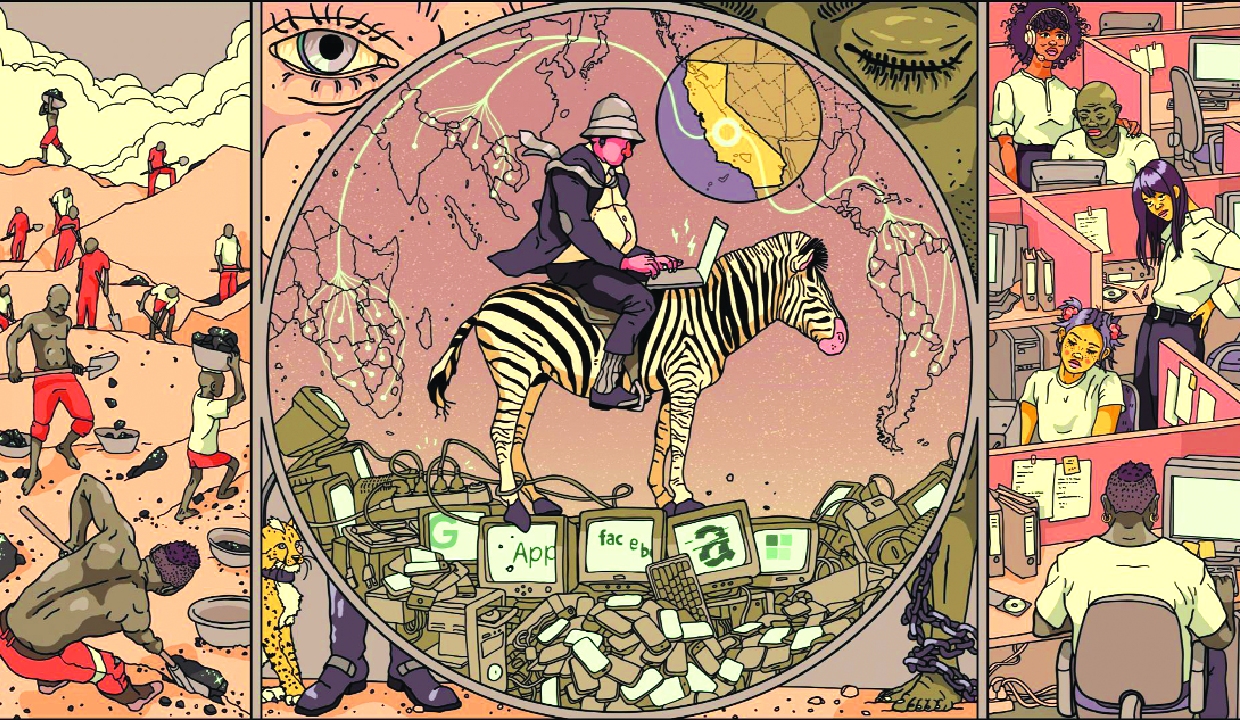
Today, we are witnessing the birth of a digital East India Company, but this time, the ledgers are written in code. As we move through 2026, the global economic order is pushing a new, intoxicating promise: absolute transparency. We are told that the more “legible” a country becomes—the more data it produces, the more its systems are digitised, the more its citizens are indexed — the more it will prosper. India has leaned into this promise harder than anyone. Through our Digital Public Infrastructure (DPI), we have built the most transparent, high-velocity data engine on the planet.
But here is the uncomfortable truth that no one in Silicon Valley or Davos wants to admit: in the age of Artificial Intelligence, transparency is no longer a path to prosperity; it is a blueprint for exploitation.
When a nation becomes perfectly legible, it becomes perfectly predictable. And in the 2026 global economy, if you are predictable, you are already owned.
The era of algorithmic front-running
We are currently witnessing the birth of a new kind of “Predictive Arbitrage.” While we celebrate our “Ease of Doing Business” rankings, global “Correlation Engines”—massive AI clusters owned by offshore hedge funds and tech titans—are using our own data to “solve” us.
According to the April 2026 Global Data Flow Report, the “value leakage” from the Indian economy due to predictive modeling by foreign entities has reached an estimated USD 150 billion annually. This isn’t just “big data.” This is Algorithmic Colonialism. By ingesting every UPI transaction, every logistical movement, and every frantic search query from a small-town smartphone, these models can now anticipate the fluctuations of the Indian market better than any domestic policymaker.
Think about what this means for a second. They know when a localised supply chain in Maharashtra will kink before the trucks have even stopped moving. They can predict how a specific youth cohort in Kanpur will react to a price hike before the first social media post is even written. By knowing our next move with terrifying accuracy, global capital can “front-run” our economy, extracting value before it even reaches our shores. When you are perfectly predictable, you lose the power to negotiate. You cannot strike a favorable trade deal or protect your currency when the other side’s AI has already simulated your breaking point a million times over.
The doctrine of neural satyagraha
If India is to reach its USD 30 trillion vision by 2047, we cannot continue to be a “legible” vassal. We must adopt a radical new defensive doctrine for the cognitive age: Neural Satyagraha. In the 1920s, Mahatma Gandhi launched Satyagraha —truth-force — as a refusal to cooperate with an exploitative legal structure. In 2026, we need a Neural Satyagraha: a refusal to cooperate with an exploitative predictive structure. This is not about “hiding” data or retreating into digital isolation. It is about the intentional creation of “Strategic Irrationality.”
It is the realisation that in an era of infinite surveillance, our greatest economic shield is not “Order,” but Entropy — or what we in India have always known as Jugaad. India has long been mocked by the West for our improvisational friction. But in the AI age, Jugaad is no longer a bug; it is our ultimate feature. It is the one thing a linear, Western-trained model cannot simulate because it refuses to follow a logical pattern. To protect our sovereignty, we must move from being “Algorithmically Legible” to “Algorithmically Opaque.”
The strategic blueprint: National noise injection
How does a 21st-century state practice Neural Satyagraha? It requires a fundamental pivot in our national technology policy, moving away from the pursuit of “perfect efficiency” toward the pursuit of “Strategic Complexity.”
First, we must establish a National Noise Protocol. We should use our sovereign AI clusters — the 60,000 GPUs now active under the IndiaAI Mission and the energy baseload secured by the SHANTI Act of 2025—not just to predict our citizens, but to shield them. We should intentionally inject “noise” into global data streams — synthetic but plausible “irrational” behaviors that mask the true state of our internal markets. We must make the Indian consumer the only “Unsolvable Variable” in global economics.
Second, we need Obfuscation as a Service. Our digital stack must integrate “privacy-preserving noise.” When a foreign entity queries Indian market data, they should receive a version that is functionally useful for legitimate business but “predictively useless” for extraction. We provide the pipes, but we keep the “Meaning” of the water for ourselves. Third, we must introduce an “Entropy Standard” for Trade. In future trade negotiations, India must demand “Reciprocal Opacity.” Data should no longer be valued by its volume, but by its “Predictive Decay” — how quickly it becomes useless to an outsider.
The paradox of productive friction
Standard economic theory suggests that the more efficient a market is, the better it performs. But that theory assumes the efficiency benefits the people in that market. In 2026, the hyper-efficiency of the Indian digital market is being captured by offshore algorithms, not by the small business owner in Bhopal.
By practicing Neural Satyagraha, we reintroduce “Productive Friction.” The Q1 2026 NASSCOM-Zinnov Report highlights a fascinating trend: while entry-level salaries in hyper-optimised metros like Bengaluru have plateaued, job demand in Tier-2 and Tier-3 hubs has surged by 28%. Why? Because these “less efficient” markets are harder for global models to “solve.” They require local intuition.
By being slightly unpredictable, we force global capital to stay in India longer, to engage with us more deeply, and to stop treating our economy like a high-speed slot machine. A less “efficient” market is, quite paradoxically, a more “sovereign” market. We are reclaiming the element of surprise — the very thing that makes us human.
Beyond the ballot: The council of nodes
As the political class continues to argue over the 2026 Delimitation Bill and the redrawing of constituencies based on population, they are fighting a 20th-century war. In the AI age, counting “heads” is a dead metric. The true power of a region is its “Neural Agency.”
A district’s value should not be measured by its population, but by its ability to generate unpredictable innovation. We need a new kind of federalism — a “Council of Nodes” — where states are rewarded for how well they protect their citizens from algorithmic exploitation. Sovereignty in 2047 will not be about who has the most people; it will be about who has the most “Unpredictable Talent.”
The “English Dividend” is dead. “Logic” is becoming a free commodity. What remains is the “Intuition Dividend.” India’s path to USD 30 trillion lies in being the world’s only “Intuition-Led” economy—a nation that can solve problems that don’t have a pre-set logical pattern.
The real struggle for independence in 2026 is not against a foreign army or a rival political ideology. It is against the “Perfect Prediction.” Neural Satyagraha is our new freedom struggle. It is the refusal to be categorised, the refusal to be “solved,” and the refusal to be managed by a foreign script.
In the age of the perfect algorithm, the most revolutionary act is to be unpredictable. The era of the “legible India” is over. The era of the “Sovereign Unknown” has begun.
Author is a physicist at the University of North Carolina at Chapel Hill and a columnist on AI, infrastructure and global systems; Views presented are personal.