Hindu vote consolidation becomes BJP’s electoral multiplier in States
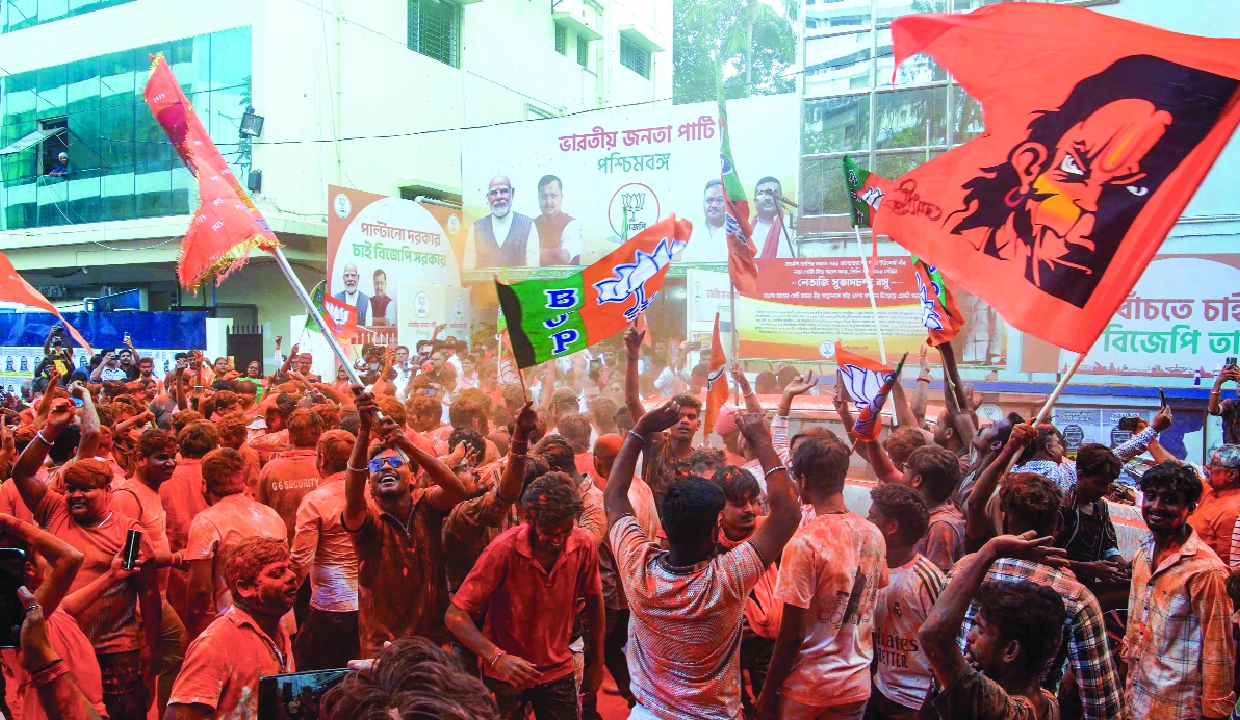
As BJP’s chief strategist Union Home Minister Amit Shah punched the West Bengal Assembly elections with a new tag line — “Anga, Banga and Kalinga” — the BJP and its allies are now in power in 21 States from the Rann of Kutch to the Bay of Bengal and the North East with only Himachal Pradesh, Jammu & Kashmir and Jharkhand as exceptions if a straight line is drawn from west to east.
The Monday’s poll results ostensibly sketched an era of Hindutva ‘dominance’. The Congress has only southern comfort (Himachal an exception) while regional parties are now on notice.
The unification of diverse Hindu castes and communities into a cohesive voting bloc behind the BJP has emerged as a potent electoral force in India’s Border States.
It counters opposition strategies reliant on minority appeasement and caste fragmentation, amplified by security concerns over illegal immigration, demographic shifts, and cross-border instability.
This dynamic is starkly evident in the BJP-led NDA’s decisive victories in the 2025 Bihar Assembly elections (202 seats out of 243) and the ongoing 2026 West Bengal polls, where the BJP has surged past the majority mark, leading in over 208 of 294 seats and has ended TMC’s 15-year rule.
In West Bengal, a state sharing a porous 2,200-km border with Bangladesh, Hindu consolidation proved decisive. Record voter turnout, driven largely by Hindu voters, reflected widespread anxiety over infiltration and cultural erosion. Post-Sheikh Hasina’s ouster in Bangladesh, reports of Islamist violence against Hindus and minorities under the interim regime heightened fears of spill over. BJP and RSS campaigns framed this as an existential threat, turning historically fragmented Hindu voters across upper castes, OBCs and Matuas into a unified bloc. The party swept border districts like those in North 24 Parganas, Malda and Murshidabad-adjacent areas, where whisper campaigns highlighted Jamaat influence and illegal migrants.
Despite TMC’s solid Muslim base (30 per cent of the population) and welfare schemes, anti-incumbency over scandals like Sandeshkhali and RG Kar, combined with Hindu polarisation, delivered the landslide. BJP leaders explicitly credited this consolidation for the surge, dismissing TMC claims of irregularities as desperation.
Bihar, while bordering Nepal rather than Bangladesh, fits the eastern border-state pattern through shared concerns over infiltration routes via West Bengal and demographic pressures. The 2025 NDA sweep (BJP: 89 seats, JD (U): 85) stemmed from alliance consolidation and a 10 per cent vote-share edge over the RJD-led Mahagathbandhan.
Hindu consolidation reinforced this by mobilising non-Yadav Hindu voters, upper castes, EBCs and OBCs, against RJD’s traditional Muslim-Yadav (MY) arithmetic. BJP’s national Hindutva narrative, amplified by welfare delivery and development promises under the double-engine model, fragmented opposition votes and boosted turnout among Hindu communities wary of perceived minority favouritism. Though alliance arithmetic was primary, the underlying Hindu unity echoed border-state themes of cultural preservation.
Across both states, this consolidation transcends caste by prioritising identity, security, and governance. In border regions, it resonates with lived realities, demographic change threatening local Hindu-majority ethos, allowing the BJP to convert 40-45% vote shares into disproportionate seats via first-past-the-post. It neutralises opposition fragmentation while projecting the BJP as the defender of Hindu interests alongside vikas. The twin victories signal the BJP’s eastward expansion: from Assam-like border fortresses to Bihar’s heartland, proving Hindu consolidation as a reliable multiplier in culturally sensitive zones. As eastern politics realign, this trend underscores how identity, security, and anti-incumbency converge to reshape India’s electoral map.