The bird that had to raise its voice
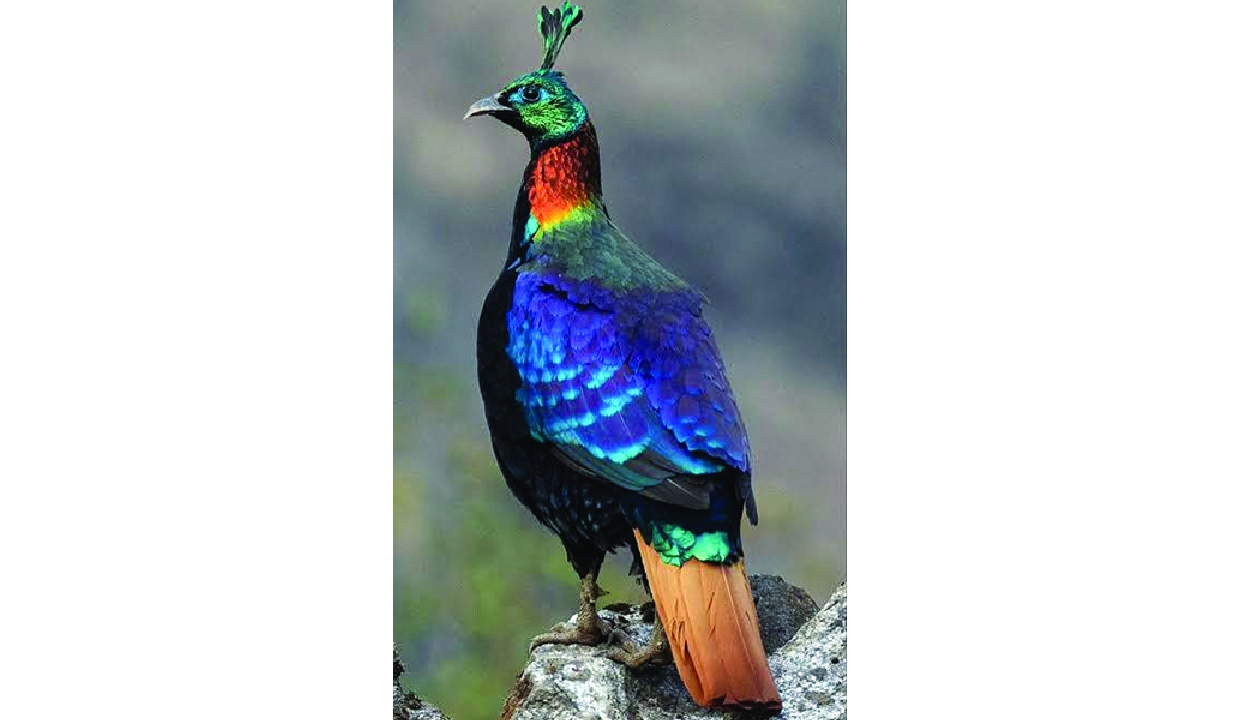
Stand on the trail above Chopta on a spring morning and you may catch it: a sharp, ringing whistle from the slope, followed by a flash of colour as a male monal bursts out of the rhododendrons. In the right light, his feathers shift from emerald to sapphire to burnished copper, as if someone had dipped him in molten metal. Locals in Garhwal have long treated the bird as part of the mountain itself. It is Uttarakhand’s state bird and Nepal’s national bird, and it appears in folk songs and village stories across the range.
But listen closely, and the monal in Chopta no longer sounds quite like it used to.
Singing over the traffic
Researchers at Hemvati Nandan Bahuguna Garhwal University spent a year, starting in April 2023, listening to monals in two valleys of the Kedarnath Musk Deer Sanctuary. One was Chopta, a busy stop on the pilgrim and trekking circuit, where taxis, bikes and tour groups fill the road for much of the season. The other was Madmaheshwar, still reached mainly on foot and largely quiet.
Using microphones and passive recorders, Dr Rajeev Lochan, Dinesh Kumar Sharma and Anand Kumar captured more than 700 calls. The difference was clear. Chopta’s birds called at a higher pitch and in shorter bursts, apparently to cut through the low drone of engines and voices. It is something like trying to talk to a friend across a crowded railway platform: you raise your voice, keep it short, and hope the message gets through.
The change is too slight for most of us to hear. For the birds, it may not be trivial. Calls are how monals court mates and warn off rivals, and a signal lost in the noise can mean a missed chance to breed. Lochan stresses that this is behavioural flexibility, not an evolutionary shift. The bird is coping. The question is how long coping is enough.
Climbing until there is nowhere left
A second study by the same lead researcher looked further ahead. Using the climate models and emission scenarios relied upon by the Intergovernmental Panel on Climate Change, the team projected how the monal’s habitat in Uttarakhand and Himachal Pradesh could change until 2100.
The picture is of a bird being nudged steadily uphill. As snowlines retreat and vegetation moves higher, the monal follows. At the same time, people are crowding into the alpine meadows that were once its refuge. The trouble is simple geometry: mountains get narrower towards the top. Higher ground means smaller, broken-up patches of habitat, populations cut off from one another, and a growing risk of local extinction.
Because the monal shifts between lower forests and high meadows through the year, scientists see it as a kind of early-warning system for the whole ecosystem. Environmental practitioner Vishal Singh points out that if a hardy, adaptable bird is being forced to change both its voice and its home, more fragile species are likely faring worse.
A pattern across the range
The monal is not alone. In Ladakh and Spiti, packs of free-ranging dogs, fed on scraps from hotels, camps and roadside dhabas, now hunt young bharal and ibex and compete with snow leopards for prey. Near Dras and Kargil, Himalayan brown bears have taken to raiding open garbage dumps, drawing them uncomfortably close to people. In Sikkim, Darjeeling and Arunachal Pradesh, the shy red panda is losing forest to new roads and settlements, its habitat chopped into ever smaller pieces.
Uttarakhand has already had painful reminders of what happens when building outpaces caution. The Chamoli disaster of 2021, which tore through hydropower sites, and the sinking of Joshimath in 2023 showed how unforgiving these slopes can be. Meanwhile, the Char Dham pilgrimage now draws visitors in the millions each season, bringing more vehicles, more waste and more noise into valleys that were remote within living memory.
Growth without balance
None of this is an argument against roads, livelihoods or pilgrimage. Mountain communities need incomes, and tourism provides many of them. But as Singh notes, the region’s economic growth has drifted out of step with what its ecology can bear.
Anjal Prakash of FLAME University, who has contributed to IPCC reports, believes human pressure is “rewriting the rules of life in the Himalaya.”
Lochan’s team calls its work preliminary, and more research is needed to understand the long-term effects. Yet the bird on the Chopta slope has already sent its message, in a slightly higher key than before. The mountains need space and quiet. Whether we are willing to give them some is now the real question.
The writer is a freelance journalist; Views presented are personal.