Subhash Kashyap: Doyen of Parliamentary Studies in India
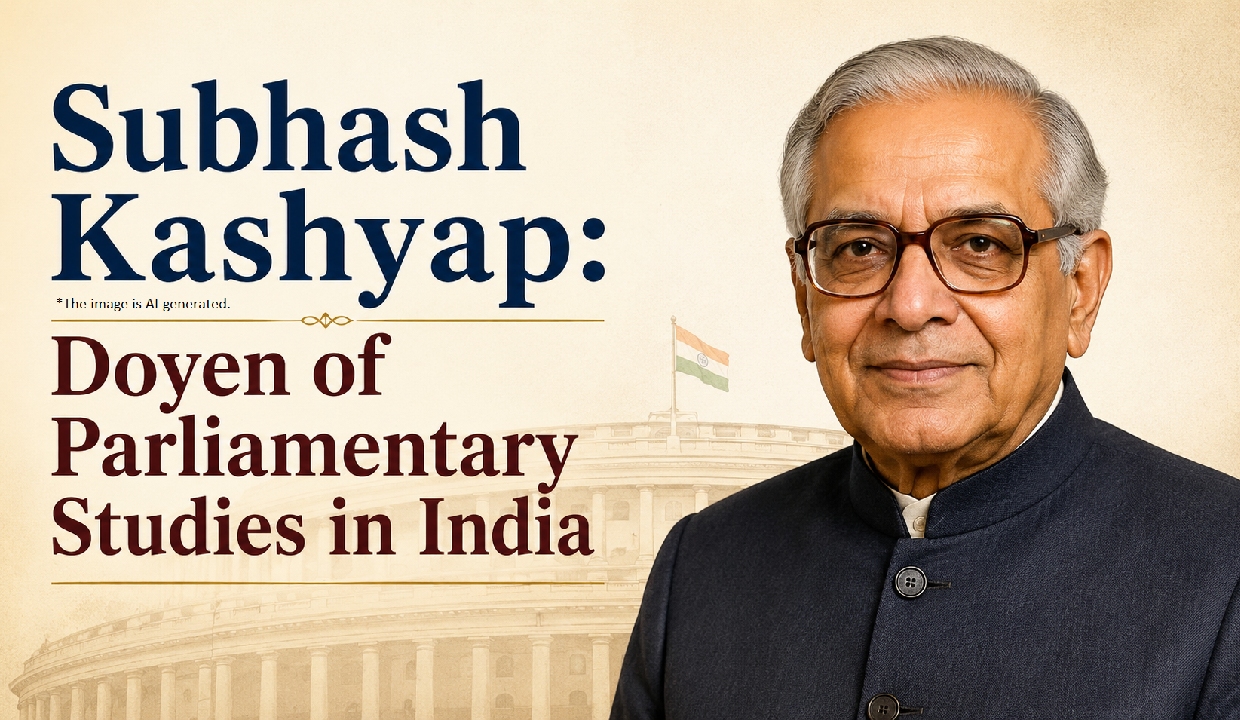
The news of the passing away of former Secretary-General of Lok Sabha was not a surprise to me. After I became the Consulting Editor of the Journal of Parliamentary Information (JPI), I was repeatedly trying to contact him, but each time the call remained unanswered and I reconciled that being an octogenarian in the twilight years, he must be ailing and bed ridden.
My fears were only confirmed. My memory of Dr Kashyap very clearly flashes back when I came to Delhi for my M.A at Delhi University in 1979. After I completed M. A in Political Science from the Arts Faculty, and was preparing for M.Phil at JNU, an officer from Lok Sabha secretariat who met me in brother’s house in Vinay Marg, Chanakyapuri, advised me to meet Dr Kashyap, who was then, director in the Research Division of Lok Sabha. I met Dr Kashyap with a cousin of mine who had passed out in M.Sc in agricultural science from Allahabad University. My cousin was also looking for a job in Delhi. He came from Allahabad with a recommendation letter from Dr. Pati, a professor in Mathematics at Allahabad University and a close friend of Dr Kashyap. Dr Kashyap received us with due courtesy and enquired about the purpose of our visit. My cousin passed on the letter of Professor Pati to Dr Kashyap. Dr Kashyap asked me of my academic background and after knowing that I had a masters in Political Science, quipped that agricultural science was like Greek and Latin to him and offered to guide me for a job in the Research Division of Lok Sabha Secretariat. As I was preparing for Civil Services examination, I thanked him and explained my aspirations.
I never met Dr Kashyap after that and joined JNU and prepared for the Civil Services Examinations and taught in a college of Delhi University on ad hoc for a short while. After failing to get into Civil Services, I appeared for the post of Research Assistants in the Lok Sabha secretariat. As my teaching job was an ad hoc basis, I decided to quit and joined Research Division of Lok Sabha Secretariat. Dr Kasyap had rose to become Secretary-General when I joined the Lok Sabha Secretariat.
I was asked by my senior officer whom I was reporting to meet Dr Kashyap with other freshly recruited Research Assistants. In a file he noted “Met Das today and was impressed, I’m sure, he will rise in his career’.
Be that as it may, I continued to server the secretariat with devotion and dedication. The Parliament Library in the old Parliament Building, the reading room in the Princes Chamber and the overall working environment nourished my interest in scholarly pursuits. My responsibilities including writing draft speeches and briefs for Speaker and Members of Parliament. Dr Balaram Jhakar was the Speaker, Lok Sabha then. Dr Kashyap enjoyed full confidence of Balaram Jhakar and later for brief while with Rabi Ray.
Dr Kashyap himself would supervise the drafts very meticulously, correct them and improve and would almost clear the file same day in spite of heavy work load. His personality was awe inspiring. While still a very junior functionary, I was entrusted to bring out a book on Nehru, his life and legacy under the supervision of Dr Kashap. It was an edited volume with a bio-profile of Nehru. I prepared a beautiful profile of Nehru and submitted it to Dr Kashyap through my superior officer to whom I was reporting.
Next day the file came back with comments of Dr Kasyap who wrote ‘hope the profile doesn’t violate some body’s copy right’. Aghast, my senior officer looked at me and asked if it did. I said, ‘yes, it does.’ Noticing the concerns of my officer, I said the profile will not appear in my name as I am the ghost writer. My officer heaved a shy of relief. More was in store for me when Dr Kashyap transferred me to report to him directly. It was indeed a great honour and pleasure for me to work under his benign guidance. While working with him, I was offered a field study grant by JNU to go to Hong Kong for two weeks for my Ph.D. In a conservative office, it would have been otherwise to get leave to go abroad.
Dr Kashyap not only granted leave, but also wished me best of luck. When I returned from Hong Kong and met Dr Kasyap, he asked me how was the trip. I said it was fine, but food was a problem. Then he said, ‘Das you didn’t go to Hong Kong to eat native food, you should have tried Chinese food’.
Dr Kashyap was indeed a great institution builder. Although we had brilliant Secretary-Generals like M.N. Kaul and S.L. Shakdhar, Dr Kashyap contributed immensely in strengthening parliamentary institutions. It was during his time that Parliamentary Standing Committees in its embryonic shape took place when he established the subject based Parliamentary Committees. He also started the flagship programs like the Parliamentary Internship Program and legislative drafting program at the Bureau of Parliamentary Studies and Training (BPST), now rechristened as PRIDE. These two programs were supported by the Ministry of External Affairs, Government of India through its Indian Technical and Economic (ITEC) program attracting Parliamentarian’s and Parliamentary officials in their capacity building. Dr Kashyap, in particular, took personal interest in developing the research services of the Parliament for the benefit of Parliamentarian’s and in wider dissemination of awareness and knowledge outside Parliaments. He was instrumental in goading the officials in the research division to bring out useful books and monographs and also in updating the Practice and Procedure of Parliament, first authored by M.N. Kaul and S.L. Shakdar which is getting updated by succeeding secretary-generals. The latest edition is updated by Utpal Kumar Singh, present secretary-general of Lok Sabha.
During his long innings as the secretary-general, he also successfully organized a number of Parliamentary Conferences such as the Inter-Parliamentary-Union (IPU), the Commonwealth Parliamentary (CPA); and also the Presiding officers Conferences.
In short, Dr Kashyap, not only enhanced the image of Parliament in India and abroad, but also the position of Secretary-General, which succeeding secretaries-general, including the incumbent Secretary-General Utpal Kumar Singh, have upheld thorough neutrality, objectivity and high degree of professionalism.
The writer is the Consulting Editor of the Journal of Parliamentary Information (JPI) of Lok Sabha Secretariat, who worked with Dr Kasyap when he was Secretary-General of Lok Sabha; Views presented are personal.