SC asks states to weigh uniform policy on illegal construction demolitions
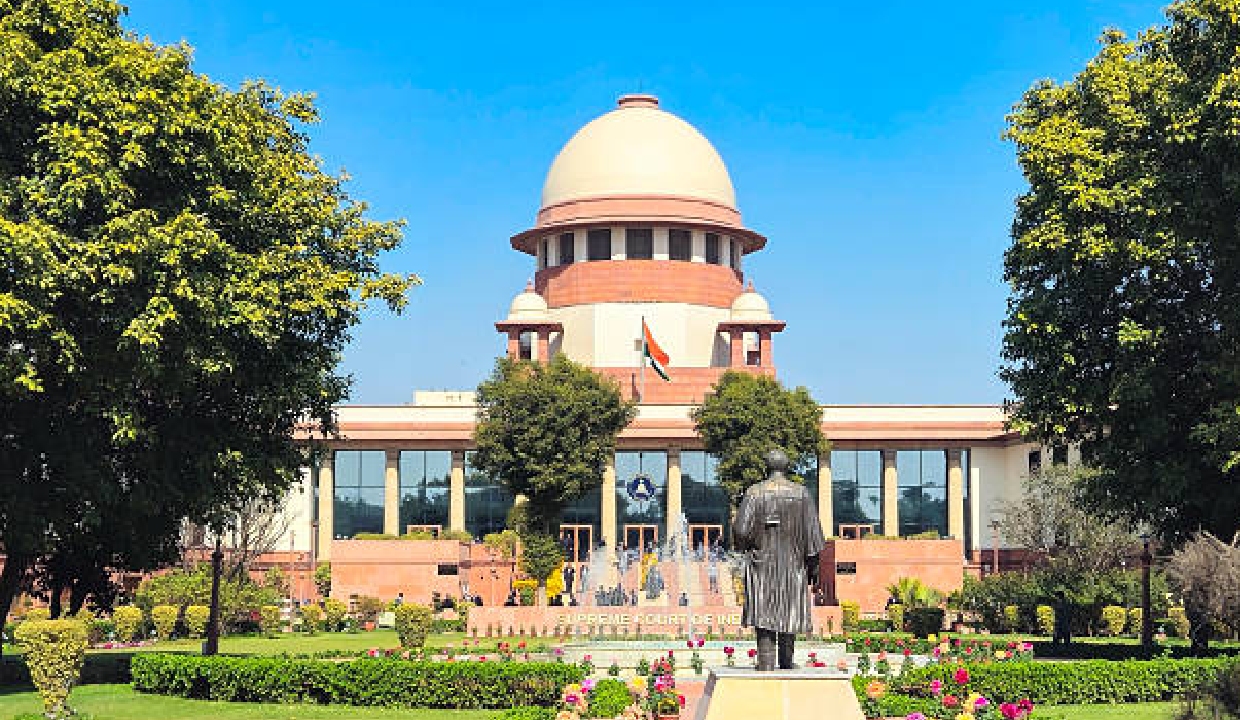
The Supreme Court on Wednesday, August 12, asked states and Union territories to consider framing a policy for regularisation and demolition of long-standing unauthorised constructions, while declining to order a single nationwide framework itself.
A bench of Chief Justice Surya Kant and justices Joymalya Bagchi and V Mohana was hearing a public interest litigation filed by the Centre for Law and Good Governance, which sought directions to the Centre and all states to frame such a policy to protect unauthorised dwelling units of poor persons.
The court held that the issue largely falls within the policy domain of state governments and local authorities, noting that circumstances vary from state to state.
"It would be difficult and may not be prudent for this court to lay down a uniform policy framework to be applied across various states," the bench said.
The court said states could consider the issues raised in the petition while framing new policies or revisiting existing ones. "We are hopeful that due consideration shall be given to all such issues by the competent authorities," it said in its order.
The plea pointed to settlement and regularisation schemes already in place in Andhra Pradesh, Telangana and Delhi, but alleged that in several cases, unauthorised colonies and structures were demolished suddenly, often without adequate notice or any rehabilitation mechanism for affected families.
It argued that demolition is an extreme and irreversible measure and cannot be carried out without a policy balancing enforcement of planning and land-use laws with the constitutional rights to shelter, livelihood and dignity under Article 21.
Counsel for the petitioner told the bench that state governments follow inconsistent approaches towards unauthorised constructions, and that demolitions are at times carried out in a hurried, erratic and unsystematic manner.
The counsel said authorities sometimes assure residents their structures would be regularised while continuing to collect municipal and property taxes and allowing access to civic amenities such as electricity, only for residents to be told after 40-50 years that their structures are illegal and face demolition, without any assessment of alternative accommodation.
The petitioner urged the bench to examine the issue from a human-rights perspective, particularly for families in possession of properties or colonies for decades.
The CJI said the Supreme Court had already laid down comprehensive safeguards against illegal and unauthorised demolitions.
When the counsel argued that existing judicial directions were inconsistent, referring to an earlier three-judge bench ruling that recognised the right to shelter as part of the right to live with dignity, the CJI cited a July 14 judgment holding that the long-standing existence of a colony does not by itself create a legal right, and that mere passage of time or administrative inaction does not cure an illegality.
"This court's humanist jurisprudence, beginning with Olga Tellis, recognises that a person in settled possession cannot be dispossessed without due process. This court has also directed that even a rank unauthorised occupant must ordinarily be given at least 15 days' notice before demolition," the CJI said.
The bench said a court-appointed committee could not substitute the powers vested in state governments and municipalities to enforce the law, and reiterated that the top court had already issued safeguards against sudden and arbitrary demolitions.
Justice Bagchi said the issues raised would have to be assessed case by case and could not necessarily be resolved through a single policy framed by the court, adding that the prayers in the petition were too broadly framed and risked drawing the court into the executive's policy domain.
The bench also observed that unauthorised construction does not always involve economically vulnerable residents, with some structures raised for commercial or profit-making purposes.
"There are also situations where large numbers of economically marginalised people occupy tracts of land and require alternative accommodation... This calls for a policy decision. We cannot prevent the state from adopting a particular policy," the bench said.
(Inputs from PTI)