Quantitative Trading Is Now an AI Game and Most Traders Are Still Playing the Old One
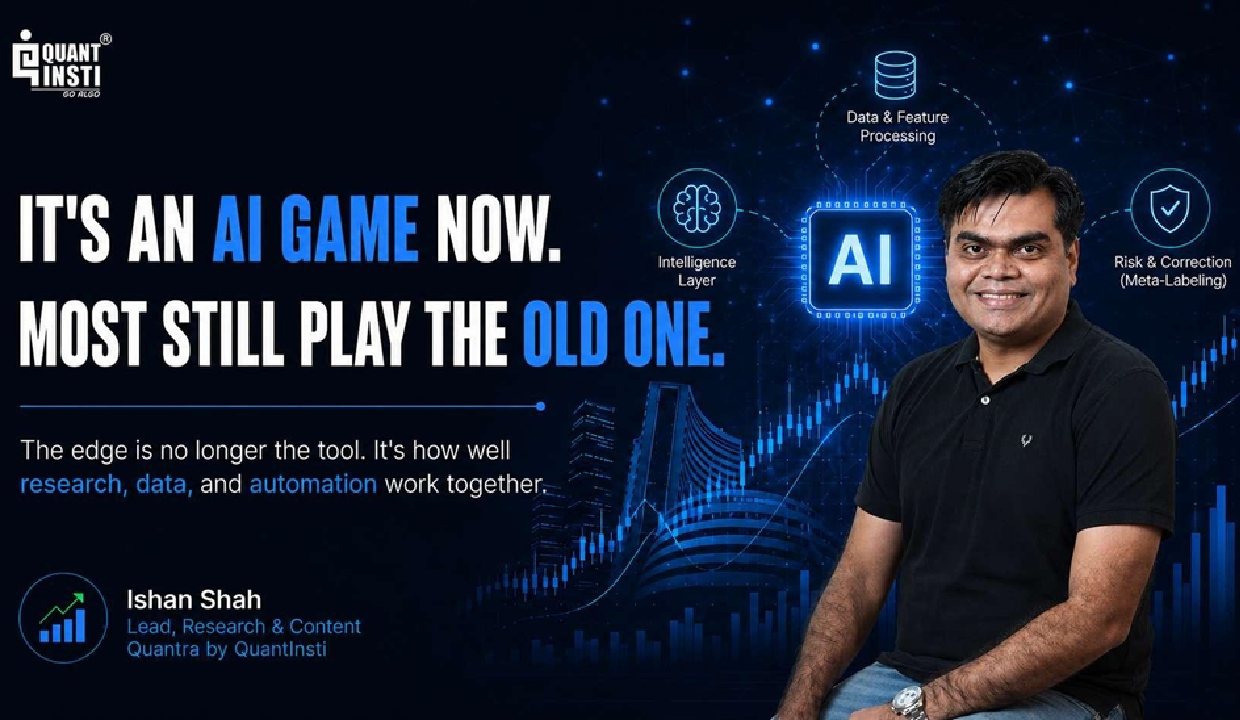
A quiet restructuring is underway in global financial markets. The traders and firms that once competed on the speed of their rules are now competing on the quality of their machines. Quant trading, long associated with mathematical formulas and rule-based automation, is being rebuilt around artificial intelligence, and the gap between those adapting and those waiting is widening quickly. While traditional systematic strategies remain widely used, AI tools are changing how traders generate ideas, process data, validate models, and adapt to changing market conditions. Today, competitive advantage depends less on access to technology and more on how effectively research, data, and automation are combined within a disciplined trading process.
The shift is no longer theoretical. On India's largest exchange, the composition of trading itself has already tipped. In FY25, algorithmic trading crossed 50% of NSE cash-market turnover for the first time on record, reaching about 53.8%, up from roughly 17% in FY11 (Business Standard). A larger value of shares now changes hands through computer-driven orders than through individuals placing trades by hand. The ground the article describes has, in a measurable sense, already moved.
The Limitations of the Rule-Based Era
Traditional quant trading relied heavily on hypothesis-driven rules. A trader would observe a market inefficiency, formulate a mathematical rule, and code it into a script to automate execution. While these methods improved speed and reduced emotional decision-making, they remained rigid. A static moving average crossover cannot recognise when market conditions have fundamentally changed; it simply continues to apply the same predefined logic.
Traditional rule-based strategies rely on predefined rules created through research and statistical testing. Machine learning extends this approach by helping identify more complex relationships within large datasets and by supporting tasks such as feature selection, pattern recognition, and model optimisation. Rather than replacing rule-based methods, AI increasingly complements them within modern quantitative workflows. The global generative AI in the financial services market was valued at approximately USD 2.2 billion in 2024, according to Grand View Research, and is projected to grow at a compound annual growth rate of about 30% through 2033 as adoption spreads across trading, risk management, and portfolio construction.
The stakes are particularly visible in India. SEBI's study found that 93% of individual traders in the equity F&O segment lost money between FY22 and FY24, with aggregate losses exceeding Rs 1.8 lakh crore (SEBI). The picture has not improved since. SEBI's FY25 follow-up found that individual traders' net losses in equity derivatives widened by about 41% to roughly Rs 1.05 lakh crore in FY25 alone, with over 91% of individual traders still losing money (Business Standard). Against that backdrop, the shift toward disciplined, AI-assisted quantitative research is not just a technological upgrade. For Indian market participants, it is increasingly a question of whether they are equipped to compete in a market that has already moved on.
The Architecture of the AI Game
Winning in today's environment requires a layered research architecture rather than a single predictive model.
- The Data and Feature Processing Layer: Modern systems combine price and volume data with fundamental, macroeconomic, and, where appropriate, alternative datasets. AI in trading supports feature engineering by transforming raw information into meaningful inputs such as volatility measures, sentiment indicators, or regime-based variables. High-quality data remains the foundation of every successful quantitative workflow.
- The Intelligence Layer: Predictive models such as Long Short-Term Memory (LSTM) networks and transformer-based architectures are increasingly used to estimate future price movements or volatility. AI in trading can help identify changing market conditions, improve research efficiency, and support parameter optimisation. However, these outputs still require rigorous validation, testing, and risk controls before deployment.
- The Risk and Correction Layer (Meta-Labeling): Advanced quants now use AI for more than just "Buy" or "Sell" signals. They apply a second layer of machine learning, known as meta-labeling, to predict whether their primary strategy's signal is likely to be correct in current conditions. This corrective AI acts as a digital filter, flagging low-probability trades and preserving capital during regime shifts.
Machine Learning Approaches and Methodology
To apply machine learning for trading effectively, practitioners need to understand the three primary approaches used across modern quantitative research. Each serves a different purpose, from forecasting and classification to market regime detection and execution optimisation.
- Supervised Learning: This approach uses labeled historical data to predict specific outcomes. For example, a regression model can be trained to predict the potential high and low range of the next day based on yesterday's deviations. By training models on one portion of historical data and validating them on a separate, unseen period, quants can assess whether a model generalises beyond its training window. In financial applications, this process requires additional care to prevent data leakage across time periods, a problem standard machine learning splits do not automatically guard against.
- Unsupervised Learning: This method is vital for portfolio construction and regime detection. Clustering algorithms can group assets by hidden similarities rather than simple sector labels. A Gaussian Mixture Model can divide the market into "Bull," "Bear," or "Sideways" zones without explicit human labeling.
- Reinforcement Learning: Unlike static models, reinforcement learning agents learn by interacting with the environment. They take actions, receive rewards or penalties, and optimize their policies for long-term cumulative reward. This is particularly useful for order execution, where the agent must adapt instantly to evolving liquidity and minimize market impact.
The Generative and Agentic Frontier
Large Language Models (LLMs) and agentic AI are increasingly being integrated into quantitative research workflows. They can summarise research, generate code, explore datasets, and automate documentation. Some organisations are also experimenting with agentic AI systems that coordinate multiple specialised models to automate portions of the research process, although these approaches are still evolving.
Adoption has moved quickly at the institutional level. In AIMA's 2025 research, covering 150 fund managers representing about USD 788 billion in assets, 95% reported using generative AI in their work, up from 86% in 2023, and 58% expected to increase its use in the investment process over the following year, compared with just 20% who said so in 2023 (AIMA). The direction of travel among professional managers is clear.
LLMs allow researchers to prototype strategies much faster. However, they are productivity tools rather than domain experts. They can generate inaccurate code, flawed assumptions, or incorrect numerical outputs with high confidence. Their outputs should always be validated before being incorporated into research or production trading systems. It is worth noting how even large incumbents frame the technology: JPMorgan rolled out its in-house generative-AI assistant, LLM Suite, to roughly 140,000 employees in 2024, positioning it as a research and productivity layer that supports staff rather than one that replaces their judgment (CIO Dive).
A Note of Caution on the "AI Edge"
There is a counterpoint worth stating plainly, because it changes how a serious practitioner should read all of the above. Adoption is not the same as edge. When 95% of fund managers use the same class of tool, near-universal access is precisely the condition under which that tool stops being a differentiator. What is genuinely changing is not that rules are obsolete, but that the cost of building adaptive research has fallen. As that cost falls for everyone, the durable advantage migrates back to the things that are hard to copy: proprietary data, disciplined validation, execution quality, and risk control. The reader chasing the newest model may be optimising the one layer where an edge is hardest to keep.
For the Indian retail participant, the two figures above combine into a single practical observation. As automated flow becomes the majority of exchange activity and discretionary losses keep compounding, a trader placing manual, undisciplined bets is increasingly taking the other side of a machine. That is the concrete version of what "the game has changed" actually means.
Actionable Roadmap: Moving to the New Game
For traders still using manual analysis or static rule sets, the transition to AI requires a disciplined methodology. The starting point should not be complex models, but refining an existing, proven edge with machine learning for optimisation.
Step 1: Clean and Prepare Your Data. Synthetic or noisy data will lead to erroneous decisions. The data preparation phase should focus on removing look-ahead bias and survivorship bias.
Step 2: Build a Rigorous Backtesting Workflow. A strategy that only works in hindsight is a story, not a system. Move beyond simple vectorized backtests to event-based simulations that account for slippage and brokerage commissions.
Step 3: Paper Trade Before Live Deployment. Something that worked in the past may not work in the near future. Paper trading with virtual money allows a trader to observe how an AI model handles real-time volatility without risking actual capital.
Step 4: Continuous Upskilling. The algorithmic world never stops evolving. Building capability requires a mix of statistics, programming, and financial market knowledge. Practitioner-led programmes that combine statistics, programming, market microstructure, and risk management into a structured curriculum can provide a more guided path than self-directed learning alone, particularly for those transitioning from adjacent fields like software engineering or data science.
Strategic Conclusion and Next Steps
Artificial intelligence is changing how quantitative trading research is conducted, but it has not replaced the need for disciplined methodology, sound statistical reasoning, or effective risk management. A quantitative trader working with static rule-based systems is, in effect, betting that the conditions under which the strategy was built will not change. That bet has become harder to sustain as markets grow more complex and machine learning tools offer more adaptive alternatives.
For those building toward this capability, the learning path typically runs in two directions simultaneously: an algorithmic trading course that covers strategy research, programming, and live execution workflows, and a quantitative finance course that builds the statistical and modelling foundations those workflows depend on. The two reinforce each other, and skipping either creates gaps that tend to surface at the worst possible moment, during live deployment. As AI capabilities continue to evolve, long-term durability will depend less on using the latest tool and more on understanding when, why, and how to use it responsibly.
Trading and investing in financial markets carry risk of loss. Nothing in this article is investment advice. The data points cited above are drawn from the sources linked inline.
About the Author
Ishan Shah
Lead, Research and Content, Quantra
Ishan Shah is the Lead, Research and Content at Quantra by QuantInsti, specialising in statistical arbitrage, systematic trading, and quantitative strategy development. He has prior experience with Barclays and Bank of America Merrill Lynch, and has co-authored Machine Learning for Trading. He has spoken at various workshops organized by PyData Mumbai, SGX, IBKR Campus, Zerodha Varsity, Face2Face Conclave. Ishan is known for simplifying complex trading concepts and helping learners build, test, and improve algorithmic trading strategies using statistics, data, and disciplined research; Views presented are personal.