President Murmu urges push to preserve Ol Chiki script
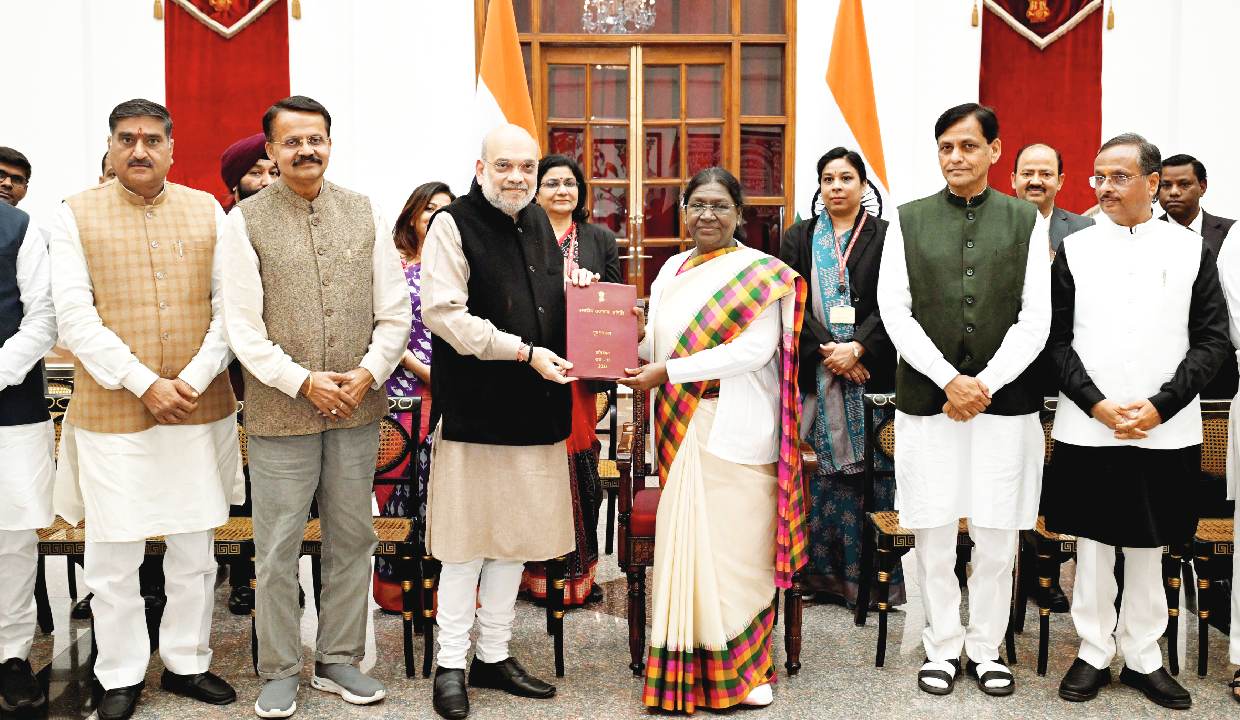
President Droupadi Murmu on Monday said efforts should be made to preserve and promote Ol Chiki, the alphabetic script for the Santhali language.
Addressing a gathering to commemorate the centenary of the Ol Chiki script, Murmu also expressed happiness that the script is growing in the digital medium.
In 1925, Pandit Raghunath Murmu created the Ol Chiki script. Since then, it has become a powerful symbol of the Santhal identity.
It was included in the Constitution’s Eighth Schedule in 2003.
In her address, Murmu described India as a “garden of multiple languages”, stressing the importance of using one’s mother tongue in communication.
She also said efforts should be made to preserve and promote the Ol Chiki script.
Earlier, a military band welcomed Murmu at the venue, the Bhim Hall of the Dr Ambedkar International Centre. It first played the national song, ‘Vande Mataram’, followed by the national anthem, ‘Jana Gana Mana’.
A group of folk artistes sang songs in Santhali, followed by a performance by a troupe of Santhali dancers on a theme that celebrated nature and the cultural diversity of India.
A short film on the genesis and evolution of the Ol Chiki script was also screened on the occasion.
A special postage stamp and a commemorative Rs 100 coin, along with a souvenir on Ol Chikiscript, were also released at the event.
Ol Chiki is the official script of the Santhali language, one of India’s prominent tribal languages spoken widely across Jharkhand, Odisha, West Bengal, Assam, and Bihar.
Belonging to the Austroasiatic language family, Santhali has historically thrived through oral traditions.
The script consists of 30 letters, designed to accurately represent Santhali phonetics. It has two styles, ‘Chapa’ and ‘Usara’.
Union Minister for Tribal Affairs, Jual Oram, Union Culture Minister, Gajendra Singh Shekhawat, and Union Culture Secretary, Vivek Aggarwal, were present at the event.
Murmu also felicitated several persons who worked to promote the Ol Chiki script.
Murmu urges ITS officers to shape India’s economy
New Delhi: Underscoring the time of profound global transformation when new rules are reshaping interaction among nations, President Droupadi Murmu on Monday told the Indian Trade Service (ITS) officer trainees their decisions can shape India’s economic trajectory for decades to come and asked them to balance openness with the protection of core priorities.
Addressing probationers of the ITS, Indian Audit and Accounts Service (IA&AS) and Defence Aeronautical Quality Assurance Service (DAQA), who called on her at Rashtrapati Bhavan, the President said the service they joined gives them an opportunity to serve the nation through every decision and action during their careers.
She told ITS officer trainees to remember that each policy they implement, each trade barrier they address, and each agreement they support will contribute to India’s emergence as a stronger and globally more respected trading partner.
“You have joined the service at the time of a profound global transformation. Digital trade, sustainability requirements, and new global rules are reshaping how nations interact. You stand at a unique intersection: where law meets enterprise, negotiation meets strategy, and where your decisions can shape India’s economic trajectory for decades to come,” the President said.
Asking the probationers to keep national interest as a guiding compass and balance openness with protection of core priorities, the President said they will contribute to attracting investment, creating jobs, and fostering environments where Indian businesses can innovate, expand, and compete globally.
“I understand that your training at the Indian Institute of Foreign Trade has given you the analytical sharpness and global perspective essential for understanding today’s complex trade environment,” she said.
In her address to the officer trainees of the IA&AS, the President said that the impact and value addition of the framework of accountability on the governance system is enhanced when there is synergy between the Executive and Audit institutions.