POSH Act — A Personal Armour
VERSATALITY, thy name is woman. Although the phenomenal playwright has voiced the line “Frailty thy name is woman”, through Hamlet, there cannot be a second thought that Shakespeare, a singular in his genius, only portrayed a reflection of Hamlet’s wounded mind. However, the phrase “Frailty, thy name is woman” has too often been detached from its dramatic context and treated as timeless wisdom. Yet the irony is striking. The perception of women as frail did not arise in isolation; much of that supposed frailty was historically shaped by social systems largely designed and controlled by men. In many situations, men themselves contributed to the very frailty they later criticised by restricting women’s choices, manipulating their dependence, or offering favours in exchange for compliance.
Today, however, the narrative is shifting as Education, economic independence, social awareness, along with supportive Legal Framework reveal a different reality. In order to provide women with the ability to navigate their professional roles without hindrance, the legal framework needed to be strengthened with women-centric provisions.
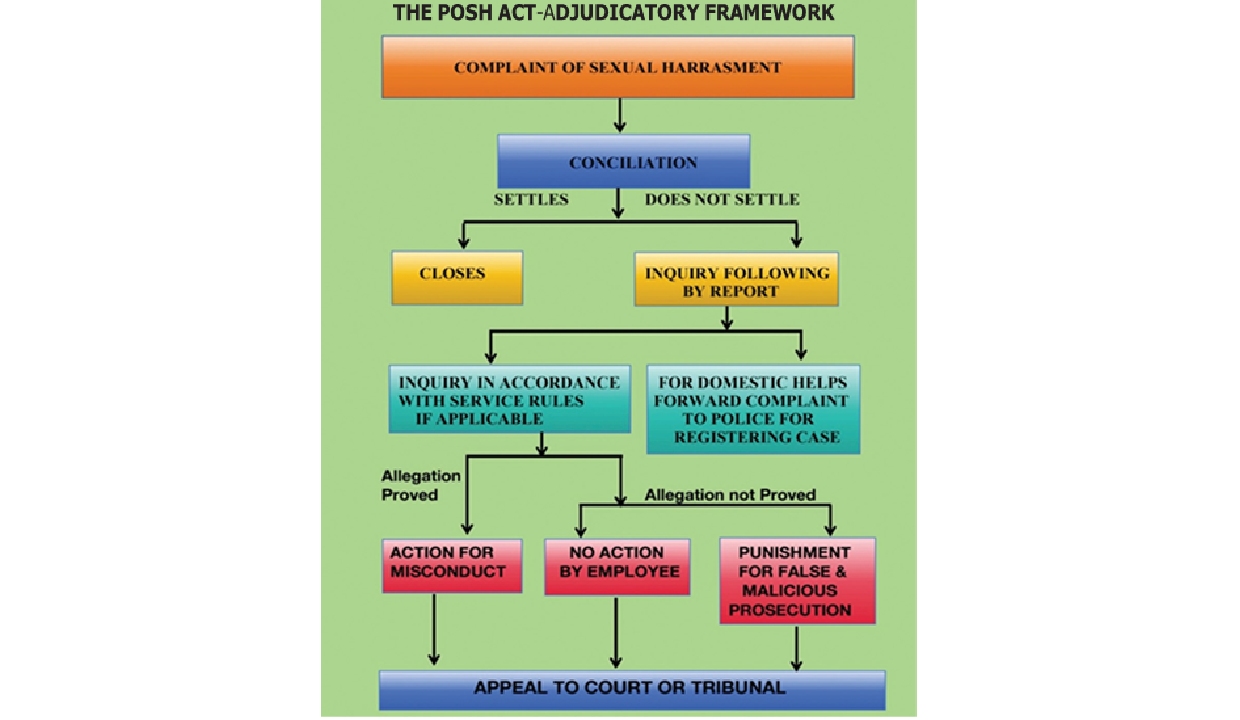
Consequently, the POSH Act (Prevention of Sexual Harassment at Workplace Act, 2013) was enacted to ensure safe and respectful work environments that combine preventive measures, training and internal enforcement.
Genesis of the legislation
History has glaring examples of people who have stood for a cause which a has brought revolutionary change. One such tall-standing example is Bhanwari Devi, who lived in Bhateri village in Rajasthan. She was part of the grassroots workers to Women’s Development Project run by the Government of Rajasthan. In the year 1992, when the Government of Rajasthan launched a campaign against child marriage, she canvassed against child marriage and tried to prevent the marriage of a 9-month-old baby from an upper-caste family. This lead to 5 men gang-raping her. This extraordinary struggle caught the attention of many women organisations, who attributed her rape to the insecure working conditions. Thus, the doors of the Hon’ble Apex Court was knocked and in the most celebrat ed Vishaka and Ors Vs State of Rajasthan — AIR 1997 SUPREME COURT 3011, Apex Court filled the vaccum in the absence of any enact ment laying down the guidelines after referring to various interna tional conventions on protection and dignity of women and observed that “the international conventions and norms are to be read into them in the absence of enacted domestic law..”. This judgement nudged the Government to enact ‘The Sexual Harassment of Women at Workplace (Prevention, Prohibition and Redressal) Act, 2013 commonly called as the “PoSH Act”.
Evolution of PoSH Law
Through a series of judicial pronouncements, Indian law has progressively evolved to adopt a more nuanced approach to sexual misconduct. In the case of Apparel Export Promotion Council Vs AK Chopra (1999) 1 SCC 759, the Respondent, AK Chopra, a senior, officer in the Apparel Export Promotion Council, was removed from service after being found guilty of sexual harassment to a female employee. Upon challenge, the Hon’ble Delhi High Court held that he had only “tried to molest” the employee and had not actually made physical contact. The Hon’ble Apex Court, while reversing the Order, reasoned that “The observations made by the High Court to the effect that since the respondent did not actually molest Miss X but only tried to molest her and therefore his removal from service was not warranted rebel against realism and lose their sanctity and credibility. In the instant case, the behaviour of the respondent did not cease to be outrageous for want of an actual assault or touch by the superior officer”.
The Hon’ble Karnataka High Court, in the case of Miss (X) Vs Internal Complaints Committee; W. P. No. 8127/ 2019, was called upon to consider if Platform-based Drivers associated with OLA could fall within the definition of ‘employees’ so as to attract the liability under the POSH Act. His Lordship Justice M G S Kamal, adopted a purposive and expansive interpretation of the PoSH Act by extending the applicability of the PoSH Act even to Digital Collaboration Platforms.
The position of international law was exhaustively considered, such as the judgements rendered by the Courts of England, California and France, where with regard to Uber, a similar situation had arose and the Courts therein held that Uber retains power to monitor and control the services offered by its driver and also has retained power to terminate. Thus, the Hon’ble Karnataka High Court held that in the instant case, the components of the definition ‘employee’ under section 2(f) of the PoSH Act, 2013, leaves no doubt that the driver-subscriber is rendering his services directly in connection with the commercial activity of OLA for which it is established. In that view of the matter and more particularly for purposes of advancement of the intent and object of the PoSH Act, 2013, it is necessary and compelling that the meaning of the term ‘employee’ be extended to cover the persons like driver-subscribers.
CONCLUSION
While the PoSH Act is a major milestone in women’s empowerment, true empowerment extends beyond legal protection.
Lasting gender equality requires greater opportunities for women not only in the workplace but also in political leadership, religious institutions, and economic decision-making. When women are adequately represented in these spheres, they are better positioned to shape policies, challenge structural inequalities, and contribute to more inclusive development.
The writer is practicing law in Bengaluru, Senior Government Counsel; Views presented are personal.