PM Modi’s Slovakia visit: Opening new frontiers
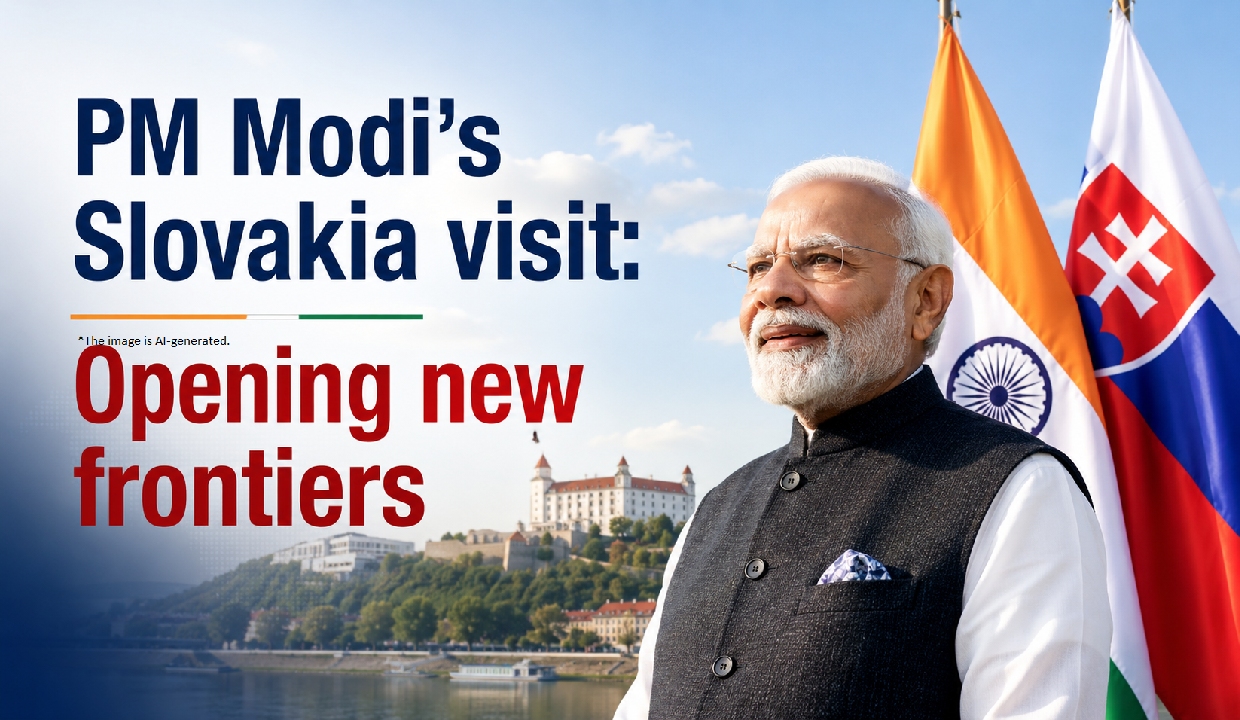
Modi’s historic visit to Slovakia is a strategic signal that India’s engagement with the world is growing wider, deeper and considerably more purposeful
When Prime Minister Modi stepped off the plane in Bratislava, the occasion was about far more than exchanging pleasantries across a negotiating table. It was about staking out a vision — of an India that is quietly but purposefully embedding itself into the sinews of European geopolitics, not through headline-grabbing rhetoric, but through the unglamorous yet essential work of building frameworks, forging alliances and finding common ground.
Upgrading India-Slovakia ties to a “Comprehensive Partnership” might look routine. It is not. For three decades, the two countries maintained a relationship that was perfectly pleasant and almost entirely unremarkable. What the Bratislava summit achieved was a fundamental transformation of that dynamic, replacing polite distance with purposeful proximity.
Defence cooperation, counter-terrorism, artificial intelligence, semiconductors, digital infrastructure, energy and labour migration — the breadth of agreements signed tells its own story. The decision to establish an ICCR Chair in Artificial Intelligence at the Technical University of Košice, the first such initiative anywhere in the world, is perhaps the clearest signal of all: this partnership is being built with its eyes firmly on tomorrow. The timing matters enormously. The visit came on the heels of the landmark India-EU trade deal, and both sides were candid about their intent to capitalise on it. Modi’s acknowledgement that he would work towards the agreement’s “earliest implementation” signals that India is serious about this relationship. Automotive manufacturing, electronics and advanced manufacturing have been identified as sectors ripe for collaboration. For too long, India’s economic and strategic calculus has been concentrated around a narrow cluster of relationships — the United States, China, the Gulf and, to some extent, Russia. Each of these ties carries its own vulnerabilities, compounded by the volatility of an era defined by trade wars, geopolitical rivalry and the weaponisation of supply chains. Diversification is no longer a strategic luxury; it is a structural necessity. Europe, in this context, offers a compelling opportunity. The continent is itself reconfiguring — militarily, economically and politically. Central and Eastern European nations such as Slovakia are increasingly assertive members of the European Union, with growing industrial capacity, technological expertise and political influence.
Slovakia’s reiteration of support for India’s permanent membership of the UN Security Council and the Nuclear Suppliers Group reflects the kind of multilateral solidarity that India needs to build, brick by brick.
Modi’s European tour underscores a calculated pattern. India is positioning itself as a pivotal power that refuses to be captured by any single camp. The joint condemnation of terrorism builds international consensus around India’s security concerns. In India’s emerging foreign policy arithmetic, every relationship adds to the sum of a larger ambition: India is not a supplicant to powerful nations but an independent, confident country charting its own course.