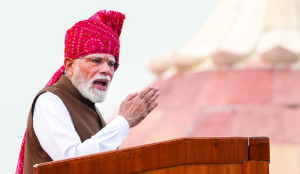
PM Modi wears maroon Bandhani safa for 80th Independence Day
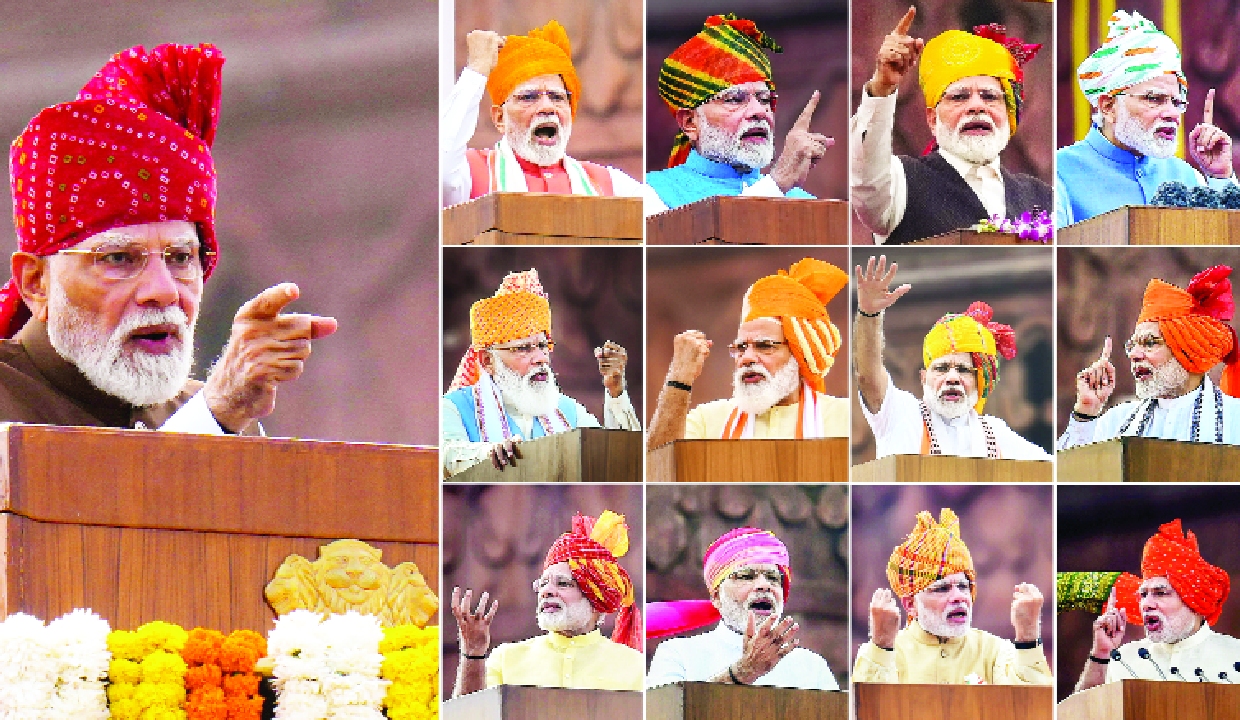
Prime Minister Narendra Modi’s Independence Day wardrobe has become a visual tradition, with his annual choice of turbans and traditional attire attracting almost as much attention as his address from the Red Fort. His Independence Day looks have ranged from fiery reds and bright yellows to saffron, pink and multicoloured designs. Each appearance has offered a different take on traditional Indian headgear while reflecting the country’s diverse cultural heritage.
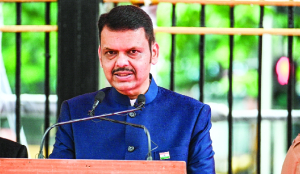
To mark India’s 80th Independence Day, Prime Minister Narendra Modi appeared at the Red Fort in a maroon Bandhani safa, its yellow-and-white dotted pattern standing out against a white kurta-pyjama and chocolate brown vest as he delivered his 13th consecutive Independence Day address from the historic ramparts, next only to 17 by Jawaharlal Nehru in a row. He also sported three pocket squares of saffron, green and white colours.
The turban featured intricate red, green and white patterns, reflecting styles associated with Rajasthani and Gujarati traditions. Look closely at the fabric, and those tiny dots are not printed on it. They are made by tying the cloth before it is dyed. An artisan picks up tiny portions of fabric, ties them tightly with thread and then dips the cloth into dye. The tied sections resist the colour, leaving behind the little dots and patterns that have come to define Bandhani. Bandhani is far older than its latest appearance at the Red Fort.PM Modi’s safa is not just a brightly coloured turban with dots on it. It draws on a textile tradition in which colour, pattern, fabric and the way something is worn have long carried cultural meaning.
Bandhani, also called Bandhej or Bandhni in different regions, belongs to India’s long tradition of resist dyeing. The name is linked to the Sanskrit root bandh, meaning to tie or bind. In Gujarat, the craft is commonly known as Bandhej, while Bandhani or Bandhini is widely used in Rajasthan and Madhya Pradesh.
In Gujarat, Bandhani became closely associated with the Khatri community, whose artisans played a major role in developing and passing down the craft. The Ministry of Textiles says Khatris introduced Bandhani to Kutch in the 12th century, where it subsequently became an important craft and eventually an export product. Today, Jamnagar and Kutch remain major Bandhani centres.
Jamnagari Bandhani even has a Geographical Indication (GI) registration, with Jamnagar identified as the main production centre in Saurashtra and Bandhani also produced across Kutch. The fabric itself can vary too. Traditional Bandhani has been made on cotton, silk and other fabrics, with natural dyes historically used before chemical dyes became widespread.
Rajasthan developed a rich vocabulary of turbans and safas, with different communities and occasions having their own ways of tying and wearing them. Bandhani became one of the fabrics used to make these head coverings particularly striking. Since his first address as Prime Minister in 2014, he has chosen safas and turbans in a wide range of colours, patterns and regional styles, often bringing India’s rich textile heritage and craftsmanship into focus. From Rajasthan’s bandhej and leheriya to tricolour-inspired designs, his choice of headgear has evolved from year to year while retaining its traditional character.
In 2023, he opted for a bandhani print in shades of yellow, green and red, and paired it with a black V-neck jacket.
In 2022, he wore a saffron turban with red motifs and a flowing tail that he paired with a blue jacket and a stole.
In 2021, a cream-and-saffron turban complemented his half-sleeved kurta, while 2020 saw him adapting to the COVID-19 pandemic with a white scarf edged in saffron, used as a protective face covering.