Owaisi slams Gujarat’s UCC Bill; calls it unconstitutional
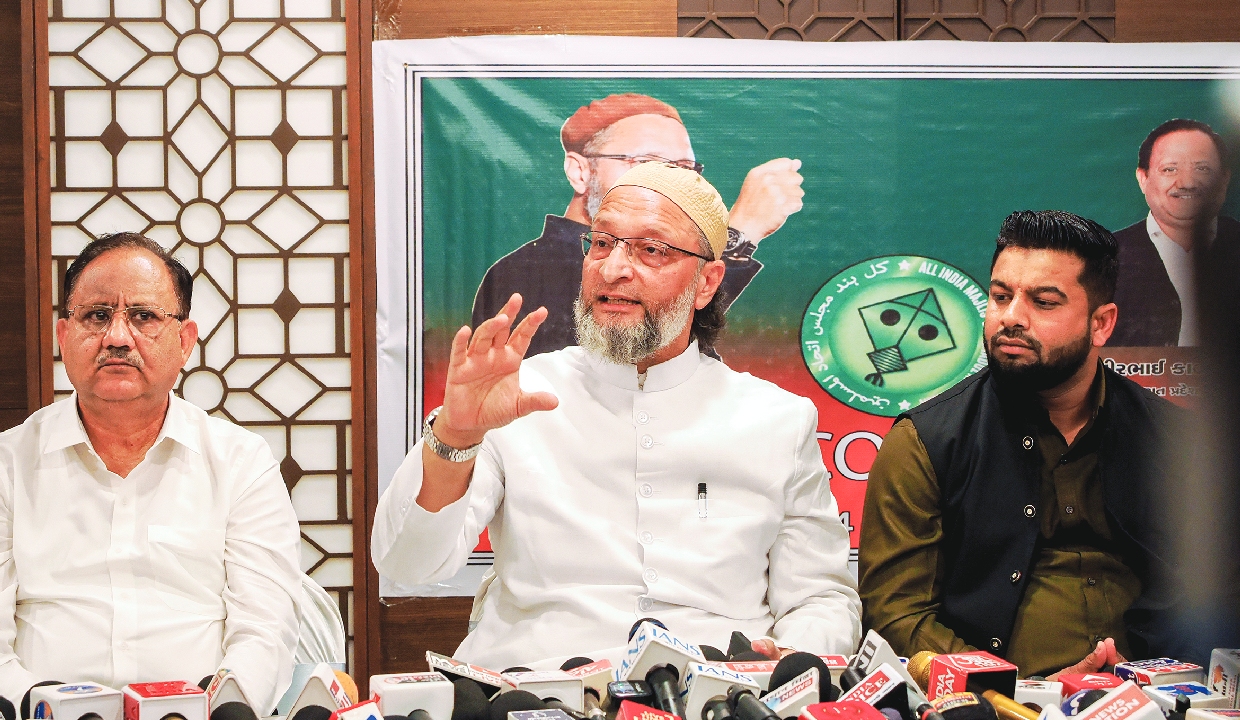
All India Majlis-e-Ittehadul Muslimeen (AIMIM) chief Asaduddin Owaisi on Saturday said the Uniform Civil Code Bill and the amendment to the Disturbed Areas Act passed recently by the Gujarat assembly are unconstitutional.
After a marathon debate of more than seven hours, the Gujarat assembly last week passed the UCC Bill that seeks to put in place a common legal framework to govern marriage, divorce, succession and live-in relationships irrespective of religion.
It stipulates a seven-year jail term if marriages are conducted through force, coercion or fraud, and also prohibits bigamy and polygamy. It makes registration of marriages and live-in relationships mandatory.
The assembly also passed a Bill to amend the Gujarat Prohibition of Transfer of Immovable Property and Provision for Protection of Tenants from Eviction from Premises in the Disturbed Areas Act 1991.
“The UCC is a directive principle, not a fundamental right. It is mentioned in Article 44 of the Constitution. During the constituent assembly debate, Babasaheb Ambedkar did not say that after the code is framed, the State shall enforce it upon all the citizens. The code shall apply only to those who make a declaration and voluntarily agree to be bound by it,” Owaisi claimed.
In the Bill, which is a “cut-paste” of the one passed in Uttarakhand, the Hindu Marriage and Divorce Act and the Hindu Succession Act have been applied to all communities except for the Scheduled Tribes, so it is not a uniform bill, he told reporters.
“It is violating Article 25 (freedom of religion) of Muslims. They are the affected party. It is unconstitutional. If someone has to get a divorce now, they’ll have to prove adultery and stay in judicial custody. This is all a part of the Hindu religion. Why are you applying it to us (Muslims)?” Owaisi asked.
He also slammed the provisions in it regarding live-in relationships and questioned the RSS and the BJP on it. It destroys the sanctity of marriage and is against Islam, Owaisi contended.
The Bill to amend the Gujarat Prohibition of Transfer of Immovable Property and Provision for Protection of Tenants from Eviction from Premises in the Disturbed Areas Act 1991 introduces a clearer definition of “aggrieved person” to include not just the buyer and seller of a property, but any resident living within the notified specified area, he said.
“Now, a third person can also register their objection against any property deal in the specified area. With the addition of ‘aggrieved persons,’ the BJP has legalized the taking of commission by anyone. Looking at the earlier judgments of the High Court, this all is unconstitutional,” Owaisi said.
The amendment also expands the State Government’s power to notify regions, allowing it to declare areas prone to disturbance and involuntary displacement due to communal tensions, rather than relying solely on a history of riots or mob violence.
“The BJP claims Gujarat is a peaceful State. If it were truly peaceful, such an amendment would not have been necessary,” the AIMIM chief asserted.
He also said his party will contest local body elections in six municipal corporations, 29 taluka panchayats and 28 district panchayats in Gujarat, fielding 539 candidates.