One water for all: Transcending the artificial boundaries
As climate extremes become the new normal, India urgently needs a unified water governance framework. A ‘One Water for All’ approach—integrating urban, rural and forest landscapes into a single hydrological strategy—offers the only durable pathway to safeguarding livelihoods, biodiversity and long-term economic resilience.
Amid an escalating global climate crisis, India's environmental security has reached a critical inflection point due to a huge monsoon deficit across the core agrarian and central forest zones. In a nation where the southwest monsoon acts as the economic lifeblood, this severe climatic stalling-compounded by an intensifying El Nino-threatens to destabilize the national economy, rural livelihoods, and our natural resource base.
A severe urban water crisis is tightening its grip across major Indian cities. In business hubs like Mumbai, dwindling reservoirs have left the city with barely over a month of water reserves, forcing municipal corporations to ban water use for non-essential purposes like swimming pools and construction. While cities like Pune have been placed on alternate-day rationing schedules; Delhi, Jaipur and Lucknow people endure hours-long queues at public distribution sites and grapple with falling groundwater tables that are threatening the structural and ecological stability of urban landscapes.
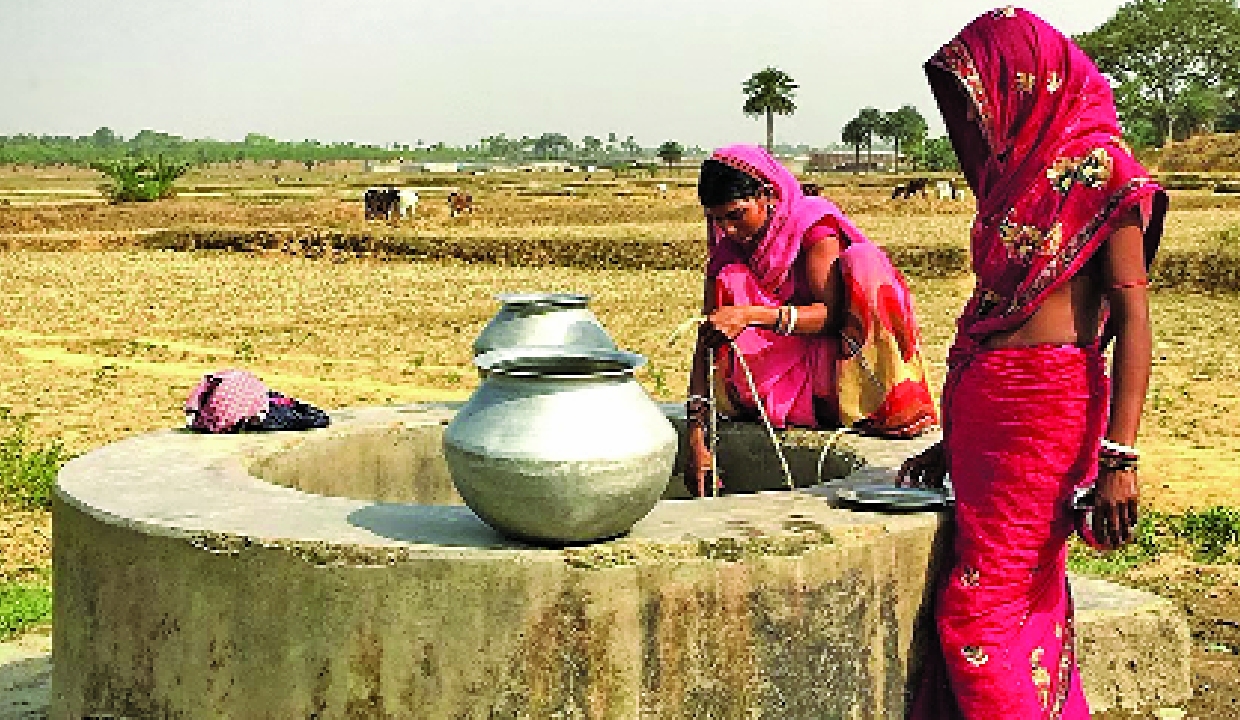
The agricultural sector, which employs nearly half of the country's population, faces widespread crop failures and rapid depletion of surface water reservoirs. Across critical farming belts in states like Maharashtra, Madhya Pradesh, and Uttar Pradesh, the extreme rainfall deficit-which reached over 40% in mid-June-has caused water bodies and many major reservoirs to dry and reach near-zero storage levels. Dependent on single, shared hand pumps or erratic, emergency water tankers for potable water, primary summer kharif crops sowing has become difficult. There is a rapid depletion of underground aquifers because of the desperate communities intensifying groundwater extraction to survive.
For the poorest of the poor-particularly the marginalized forest dwellers directly dependent on the ecosystem for survival-this hydrological breakdown is simply an existential threat. In the tribal belts of Jharkhand, Chhattisgarh, and Madhya Pradesh, many hand pumps have dried up forcing the indigenous communities to the drudgery of extracting water from makeshift sand pits or small, muddy hill streams. As the drought dries up natural streams and forest sponges, forest dwellers get caught in a devastating trap. Increasingly pushed by popular schemes for intensive agriculture on poor quality lands in and around forest areas, the depletion of water bodies and local aquifers plunges them into a desperate, zero-sum competition for water between them and resource-stressed roaming wildlife. The death of eleven wild animals including three gaur and a blue bull in Melghat reserve of Maharashtra due to poisoning of water hole is just one example of the imminent escalation of human-wildlife conflict.
To mitigate the crisis in forest areas, forest departments across multiple states are working under intense climate stress to artificially replenish solar-powered borewells and concrete water troughs inside the reserves. The expanding footprint of human settlements within protected ecological zones, however, driven by the extensive grant of both habitation and cultivation rights under the Forest Rights Act (FRA) is significantly amplifying water stress inside India's wildlife habitats. This pressure is accelerating due to a recent heavy thrust by various state governments on Rule 16 of the FRA, which mandates post-claim support and departmental convergence to provide resources for the modernization of agriculture and increased crop productivity. Under this developmental push, state agencies are introducing intensive agricultural infrastructure, such as subsidized borewells and permanent irrigation wells, directly into forest interiors and wildlife areas. While these initiatives aim to uplift indigenous farming, they inadvertently cause deep, systemic extraction of localized groundwater tables and the diversion of pristine perennial streams that wild animals have been relying on for survival. As natural water holes dry up under the strain of automated extraction and fragmented catchments, the ecological balance of these reserves is heavily disrupted, systematically forcing thirst-driven wildlife out of woodland interiors and into perilous, direct confrontations with human populations along the newly modernized agricultural fringes.
The National Disaster Management Authority recognizes "drought", a classification that state governments can declare solely based on strict, agriculture-centric scientific indices. This legal framework completely excludes wildlife areas from National or State Disaster Response Funds (NDRF/SDRF), which are statutorily reserved for human and agricultural relief. Consequently, forest ecosystems and national parks do not qualify for emergency disaster funds when water sources evaporate. Forest departments have to independently fund emergency interventions through internal budgets just as any routine forest or wildlife management issue.
Government's water resource funding policy framework operates on a structural hierarchy that prioritizes rural infrastructure and food security over urban centres but leaves deep gaps for tribal populations and forest and wildlife areas. Rural areas receive the dominant share of funding (65-70%), spearheaded by the Jal Jeevan Mission and agricultural drought-proofing schemes like PMKSY, while urban water management receives high regulatory and statutory focus (20-25%) via AMRUT 2.0 to protect industrial GDP through recycling and conservation mandates.
In contrast, tribal areas receive moderate funding integrated into broader rural sub-plans, though remote terrains cause heavy administrative and structural delays during active monsoonal failures. Finally, forests and wildlife areas receive the lowest emphasis. Water security under the Ministry of Environment is funded via restrictive eco-budgets resulting in reactive, micro-level field interventions rather than systemic, long-term drought proofing.
Ecological studies across South Asia, including data from the Kerala State Planning Board, the Goa Forest Department, and regions like Bardia and the Terai Arc land scape on Bhutan and Nepal borders establish that maintaining interior forest water holes acts as a vital spatial anchor that restricts wildlife movement within park boundaries and reduces human-wildlife conflict on agricultural fringes during severe dry seasons. However, long-term research-most notably a multi-decade study from Kruger National Park alongside technical findings from the Wildlife Institute of India study in reserves like Bandipur National Park of Karnataka and Tadoba Tiger Reserve in Maharashtra warns that over-reliance on permanent, deep-borewell provisioning triggers severe ecological imbalances. It drives localized groundwater depletion, permanently dries up shallow natural springs, alters predator-prey dynamics, and causes habitat degradation or invasive weed expansion due to the constant congregation and overgrazing of dominant herbivores (the Piosphere effect).
While a bore-well actively steals water out of an aquifer, a rainwater check dam does the exact opposite. It catches water to recharge the aquifer. The schemes for the forest right holders must use eco-friendly material, avoid extractive approach, and species cultivated should make the area blend with its surroundings. Reconciling short-term conflict mitigation with long-term ecosystem resilience, modern conservation must shift toward "smart" water management, replacing continuous groundwater extraction with catchment engineering techniques like rainwater harvesting, and rotational pumping that mimic natural seasonal scarcity.
Policy makers must realize that catchment treatment in forest areas ultimately benefits not just the forests and wildlife but even the populations away from them. The traditional approach of acting in isolated silos while tackling the water crises of urban, rural, and forest areas must be discarded if we are to prevent total ecological and social breakdown. Water belongs to a single, continuous hydrological cycle; a severe monsoon deficit does not stop at a city limit or a forest boundary. In fact, bringing in the Forest Department as the main player, prioritization of ecological restoration and watershed management in upstream forests, hills, and wildlife areas must become the core of our national strategy, as these natural catchments serve as the hydrological sponges that regulate groundwater recharge and river flows for the whole country.
The concept of "One Water for All" can serve as a foundational pillar for water security akin to the global "One Health" framework, which recognizes that the health of humans, domestic animals, wildlife, and our shared environment are deeply interconnected.
Water does not conform to political boundaries; it links all living beings on Earth within a shared biological destiny. Only a "One Water for All" approach-which safeguards water security across urban, rural, and wild landscapes simultaneously; can protect the ecological integrity of natural habitats and secure the collective, intertwined future of all living systems on our planet.
The writers are Former PCCFs, UP and Maharashtra; Views presented are personal.