Meghalaya's wettest towns face growing drought risk as rain patterns shift
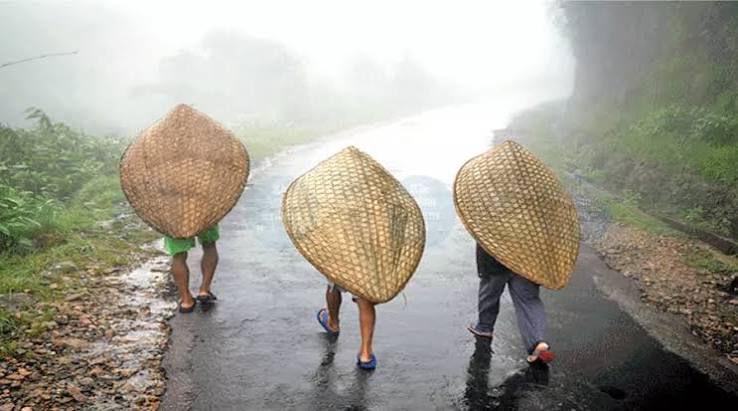
Meghalaya's Mawsynram and Cherrapunji, among the world's wettest places, are facing a growing risk of drought as climate change brings more intense rainfall, fewer rainy days and rising temperatures, according to a new study.
Published recently in Theoretical and Applied Climatology, the study analysed projected climate and hydrological data for Meghalaya and adjoining areas from 1981 to 2100 to examine the apparent paradox of increasing rainfall intensity alongside rising drought vulnerability.
Researchers Ashesh Rudra Paul and Pankaj Kumar Roy found that rainfall is becoming concentrated in intense spells, while light rain and the number of rainy days are declining.
The study recorded an increase in the Simple Daily Intensity Index (SDII), with a maximum local rise of 0.08 mm per day per year. The number of rainy days, meanwhile, declined by an average 0.40 days per year.
SDII measures the average rainfall received on a wet day over a specified period.
"Contrary to the conventional expectation that increased precipitation alleviates drought," the researchers said, the findings showed "a clear tendency toward elevated drought risk" in Meghalaya.
The changing rainfall pattern is particularly significant for the state because of its steep terrain and shallow soils, they said.
Intense rainfall causes rapid surface runoff instead of allowing more water to be absorbed into the soil, reducing groundwater recharge. Consequently, heavy monsoon rainfall may not translate into sufficient water availability during drier months.
"Such rainfall concentration enhances surface runoff and reduces infiltration," the study said.
Rising temperatures are adding to the pressure by increasing evapotranspiration, or water loss from soil, vegetation and other surfaces. Minimum temperatures were found to be rising by as much as 0.08 degrees Celsius per year.
The researchers said higher temperatures increase atmospheric water demand and accelerate soil-moisture loss during rain-free periods.
To assess drought conditions, they used the Standardized Precipitation Evapotranspiration Index (SPEI) at a three-month timescale. The analysis indicated an increasing frequency and intensity of moderate, severe and extreme drought events, particularly under the high-emission SSP585 scenario.
Drought occurrences were projected to generally increase from the near future to the far future under the scenarios examined, with the sharpest rise under SSP585.
The projections also pointed to declining river flows.
Using hydrological modelling, the researchers examined the Sari-Gowain and Surma-Meghna river basins, both of which originate in or receive significant flows from Meghalaya.
The model projected a maximum decline of 9.8 per cent in mean annual streamflow in the Sari-Gowain basin in the far future under SSP585. For the Surma-Meghna basin, the projected maximum decline was 11.6 per cent under the same scenario.
SSP585 is a high-emissions climate scenario used to model a future in which rapid economic growth remains heavily dependent on fossil fuels.
The researchers said river flows would continue to be concentrated during the monsoon, peaking around June and July before declining, potentially increasing the risk of hydrological drought later in the year.
The study did not account for human-induced factors such as deforestation, urban expansion, land-use change and groundwater extraction, which can also influence water availability.
The researchers called for water-management strategies that consider not only total rainfall but also its intensity and distribution, rising temperatures and basin-level water flows.
"Collaboration between scientists, policymakers, and local communities will be vital," the study said.
Local observations have also pointed to increasing water stress. Residents of Sohra and Mawsynram said several waterbodies and waterfalls have been drying up faster this year, with the trend visible as early as mid-September.
"Many waterfalls in Sohra area are getting dried, and I am seeing this as early as mid September," said P Hujon, a Mawkisyiem resident who runs a guest house.