Lexster Lead Dialogue on Global Arbitration Ecosystem in Dubai
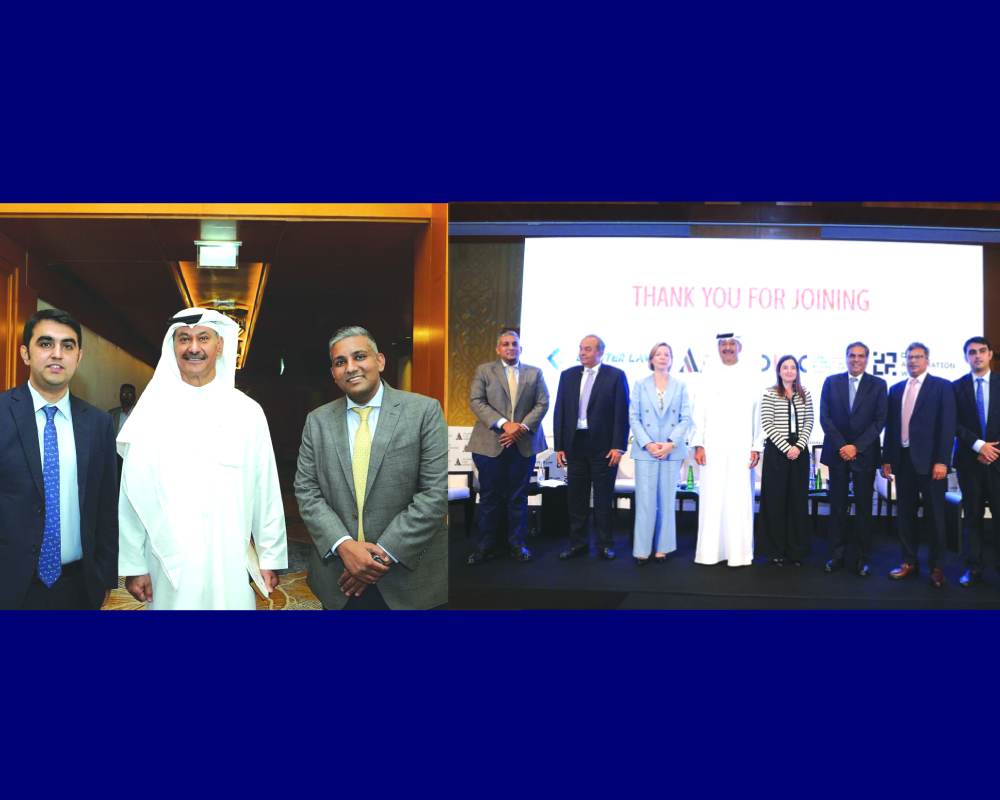
A substantive panel discussion examining the complexities of multi-party and cross-border disputes in mega project arbitration took place on November 14, 2025, during the recently concluded Dubai Arbitration Week 2025, organised by the Dubai International Arbitration Centre. The event, co-hosted by Lexster Law LLP and Agrawal Law Associates, drew together leading legal practitioners and adjudicators from across the globe. Lexster Law LLP also served as a Gold Sponsor of Dubai Arbitration Week 2025.
The distinguished panelists included Justice Sanjiv Khanna (Former Judge of the Supreme Court of India), HE Essam Al Tamimi (Chairman, Al Tamimi and Company), Mukul Rohatgi (Former Attorney General of India), Anne K Hoffmann (International Arbitrator, Hoffmann Arbitration), Soraya Corm-Bakhos (International Arbitrator, Corm-Bakhos Arbitration) and Mahesh Agarwal (Managing Partner, Agarwal Law Associates). The discussion was moderated by Shantanu Agarwal (Managing Partner, Lexster Law LLP) and Saurabh Seth (Counsel, Delhi High Court).
Conceptual Clarity in Contractual Structures
Justice Sanjiv Khanna opened the discussion by addressing a fundamental challenge in contemporary mega project disputes: the need for precise conceptual frameworks when analysing interconnected contractual arrangements. He underscored the necessity of distinguishing among a group of contracts, a composite contract and a group of companies — distinctions that remain critical to resolving jurisdictional and substantive disputes.
Justice Khanna further identified multi-party issues such as consolidation, joinder, parallel proceedings and non-signatory participation as requiring principled and coherent judicial approaches. He attributed a significant proportion of contemporary disputes to inadequate contractual drafting, emphasising that careful anticipation of inter-contractual dependencies at the drafting stage remains the most effective preventive mechanism.
India-UAE Relations and Legal Institutional Development
HE Essam Al Tamimi addressed the historical and ongoing partnership between India and the United Arab Emirates, acknowledging the substantial contributions of Indian legal professionals to the UAE’s institutional and economic development.
He characterised this relationship as foundational to the nation’s progress over several decades. Highlighting recent legal reforms, Al Tamimi identified the establishment of common law courts within DIFC and ADGM as exemplary institutional innovations that have enhanced investor confidence by incorporating international adjudicatory standards and robust enforcement mechanisms. He noted that the UAE’s evolution from a non-signatory to the New York Convention in 2006 to a host jurisdiction for approximately 82 international law firms demonstrates how institutional modernisation attracts global legal talent without diminishing the competitive position of domestic practitioners.
India’s Evolving Arbitration Jurisprudence
Mukul Rohatgi reflected on the transformation of India’s arbitration landscape over recent decades. Under the 1940 Arbitration Act, he observed, disputes were comparatively straightforward, lacking the multi-party contractual structures and multi-seated proceedings characteristic of contemporary projects.
The economic liberalisation of 1993 catalysed a marked shift, introducing complex contractual ecosystems where disputes frequently fragment across multiple arbitral seats and parallel proceedings. Rohatgi highlighted the practical impediments arising from this fragmentation: non-signatory parties typically resist consolidation, preferring parallel arbitrations under distinct contractual arrangements.
This fragmentation often results in protracted litigation through successive court levels before substantive arbitration can commence — a process consuming several years. Rohatgi advocated for unified adjudication mechanisms, proposing that a single composite tribunal could provide the holistic oversight necessary for coherent resolution in complex infrastructure projects involving several parties.
Procedural Coordination and Award Consistency
International Arbitrator Anne K Hoffmann examined the escalating frequency of multi-party arbitrations and the procedural challenges they present. She identified numerous complications that emerge prior to tribunal formation, emphasising that uniform arbitration clauses — particularly regarding seat selection, appointing institution and tribunal composition — are instrumental in facilitating consolidation. Hoffmann cautioned that divergent arbitration provisions across related contracts create substantial coordination difficulties and heighten the risk of inconsistent awards.
She advised counsel to coordinate evidence and submissions comprehensively across related proceedings to mitigate award discrepancies, noting that evidentiary support for claims remains critical regardless of whether full consolidation has been achieved.
Dispute Resolution Architecture in Mega Projects
Soraya Corm-Bakhos provided a systematic analysis of the multi-tiered dispute resolution frameworks typical of large infrastructure projects. She identified the structural complexity introduced by numerous underlying contracts — including construction agreements, joint venture arrangements and layered dispute resolution protocols — which frequently require exhaustion of pre-arbitral procedures before arbitration commences. Corm-Bakhos noted that the enforceability of such preliminary steps as mandatory conditions precedent often remains contested, generating jurisdictional disputes. She observed that mediation, though frequently positioned as an initial step, proves substantially more effective once parties have exchanged pleadings and expert evidence, at which point they gain realistic perspectives on case viability and settlement prospects.
Contract Design as the Foundation of Dispute Prevention
Mahesh Agarwal emphasised how contractual interdependencies generate cascading disputes across jurisdictions. He identified a fundamental tension between party autonomy — a cornerstone of arbitration — and the procedural coordination necessary for coherent dispute resolution.
While major arbitral institutions have increasingly developed consolidation mechanisms, Agarwal noted that Indian arbitration law currently lacks equivalent statutory provisions, although Indian courts have demonstrated progressive jurisprudential development in related areas.
He concluded by emphasising that strategic contract formulation — particularly standardisation of arbitration clauses, seat, governing law, arbitral language and procedural choices — remains the most effective preventive approach, with the drafting stage determining success or failure in achieving coordinated resolution frameworks.
Drawing a diverse audience of over 120 in-person attendees and more than 500 virtual participants, the session reflected India’s growing engagement with international arbitration networks. The event is an important step towards deepening collaboration between Indian firms like Lexster Law and Agarwal Law Associates and global law firms and advancing India’s ambition to become a global arbitration hub.