Israel settlers spray teargas on Palestinian children
Israeli settlers attacked a Palestinian home in the south of the Israeli-occupied West Bank overnight, spraying tear gas at children and killing sheep, a Palestinian official said Tuesday. It was the latest in a surge of attacks by settlers against Palestinians in the territory in recent months.Israeli police said they arrested five settlers.
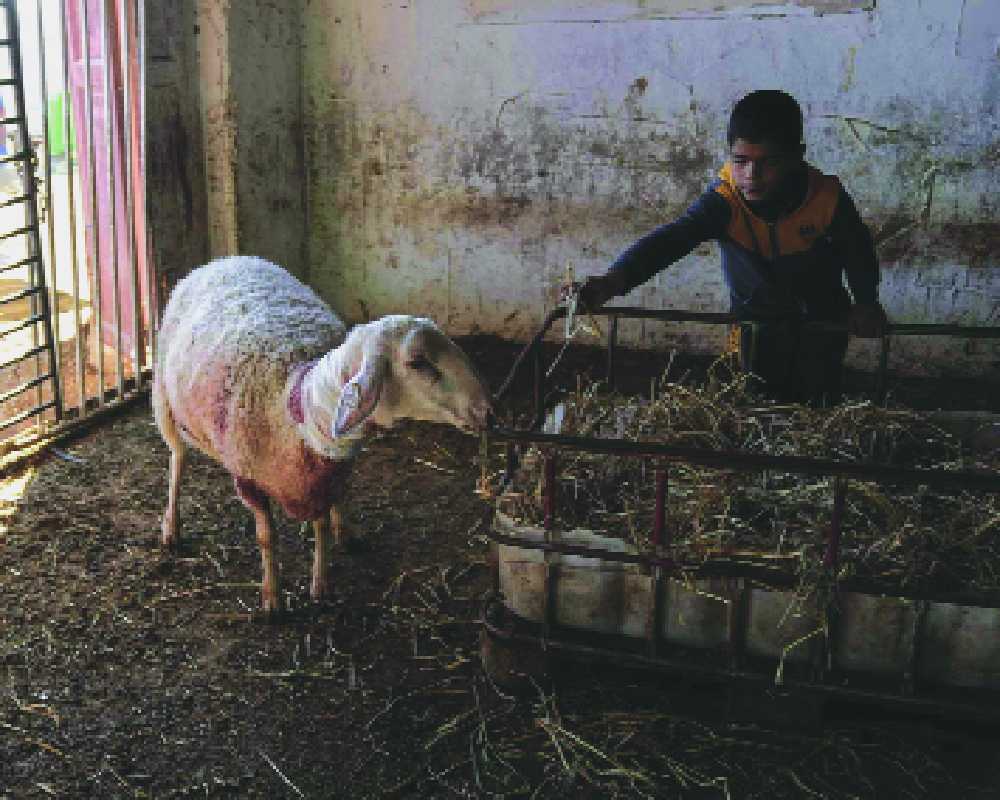
The settlers smashed a door and a window of the home, firing tear gas inside that sent three Palestinian children under the age of 4 to the hospital, said Amir Dawood, who directs an office documenting such attacks within a Palestinian governmental body called the Wall and Settlement Resistance Commission. He said settlers also entered the family's sheep pen, killing three sheep and injuring four others. Israeli police said they arrested the five settlers on suspicion of trespassing onto Palestinian land, damaging property and dispensing pepper spray. They said they are investigating.
CCTV video from the attack in the town of As Samu', shared by the commission, showed five masked settlers in dark clothing, some with batons, approaching the home and appearing to enter. Sounds of smashing are heard, as well as animal noises. Another video from inside shows masked figures appearing to strike sheep in the stable. Photos of the aftermath, also shared by the commission, show smashed car windows and a shattered front door. Bloodied sheep lie dead as others stand with blood staining their wool. Inside the home, photos show broken glass and the furniture ransacked.
Dawood said it was the second settler attack on the family in less than two months. He called it “part of a systematic and ongoing pattern of settler violence targeting Palestinian civilians, their property and their means of livelihood, carried out with impunity under the protection of the Israeli occupation.” During October's olive harvest, settlers across the territory launched an average of eight attacks daily, the most since the United Nations humanitarian office began collecting data in 2006. The attacks continued in November, with the UN recording at least 136 by November 24.
Israel captured the West Bank, east Jerusalem and Gaza — areas claimed by the Palestinians for a future state — in the 1967 war. It has settled over 500,000 Jews in the West Bank, in addition to over 200,000 in contested east Jerusalem. Israel's government is dominated by far-right proponents of the settler movement, including Finance Minister Bezalel Smotrich and Cabinet Minister Itamar Ben-Gvir, who oversees the nation's police force. Earlier this week, Smotrich said the Israeli cabinet had approved a proposal for 19 new Jewish settlements, another blow to the possibility of a Palestinian state.
Late on Monday evening, the Syrian defence ministry announced an order to halt fire. It was not immediately clear how the new clashes in Aleppo’s Sheikh Maqsoud and Achrafieh neighbourhoods started. Syria’s Civil Defence agency said two of its emergency responders were wounded after fighters with the Kurdish-led SDF opened fire on their vehicle. A statement from the Kurdish-led forces accused Syrian Government forces of opening fire on a Kurdish checkpoint, while Government officials accused the SDF of attacking first.
In Damascus, the Syrian capital, Turkish Foreign Minister Hakan Fidan said his talks with Syrian officials focused on the integration of the SDF into the new Syrian army, as well as on Israel’s military incursions in southern Syria and the fight against the Islamic State group. “Syria’s stability means Turkey’s stability. This is extremely important for us,” he said, appearing alongside his Syrian counterpart, Asaad al-Shibani. He called on the SDF to “cease to be an obstacle to Syria achieving stability, unity and prosperity.”
Fidan’s delegation, which also included Turkish Defence Minister Yasar Guler and intelligence chief Ibrahim Kalin, also met with Syrian interim President Ahmad al-Sharaa. The integration deal faces obstacles Under the March agreement signed between al-Sharaa’s Government and the SDF, the Kurdish-led force was to merge with the new Syrian army, but details were left vague, and implementation has stalled.
A major sticking point had been whether the SDF would remain as a cohesive unit in the new army or whether it would be dissolved and its members individually absorbed into the new military. Turkey has been opposed to the SDF joining as a single unit. Ankara considers the SDF as a terrorist organisation because of its association with the Kurdistan Workers’ Party, or PKK, which has waged a long-running insurgency in Turkey, although a peace process is now underway.
Kurdish officials have said that a preliminary agreement has been reached to allow three divisions affiliated with the SDF to integrate as units into the new army, but it’s unclear how close the sides are to finalising it. The original deadline for implementation of the March deal was the end of the year, and there have been fears of a military confrontation if progress is not made by then. Al-Shibani, the Syrian foreign minister, accused the SDF of “systematic procrastination.”
“We have not seen an initiative or a serious will from the Syrian Democratic Forces to implement this agreement,” he said, adding that Damascus had submitted a proposal to the SDF for moving forward with the military merger. He said a response was received on Sunday, without elaborating. Turkey slams Israel’s presence in Syria Fidan criticised Israel’s “expansionist policies” in Syria and accused the SDF of coordinating with Israel, without giving evidence. Israel has been wary of new authorities in Syria since the fall of former President Bashar Assad in December 2024.
Although al-Sharaa, the former leader of an Islamist insurgent group, has said he does not want a conflict with Israel, Israeli forces have moved to seize a UN-patrolled buffer zone in southern Syria and have launched hundreds of airstrikes on Syrian military sites. While Turkey had a complicated relationship with al-Sharaa when he was the leader of Hayat Tahrir al-Sham, a militant group that controlled much of northwestern Syria, Ankara has backed his Government since he led a charge that overthrew Assad. Turkey, along with Saudi Arabia and Qatar, has intervened to persuade US President Donald Trump to lift decades-old sanctions on Syria.
The Turkish military has also provided support to the new Syrian army, including training cadets and officers. Asked about the possibility of a Turkish intervention against the SDF in Syria, Omer Celik, spokesman for Turkish President Recep Tayyip Erdogan’s ruling party, told reporters at a news conference last Friday that Turkey’s military has preparations in place to ensure Turkey’s security. But, he added: “We don’t want this to be necessary.” “The agreement’s provision must be implemented quickly,” he said, and “in the coming period, we should focus our energy on Turks, Kurds, and Arabs living together in prosperity and peace.escapees were prisoners doing time for minor offenses.