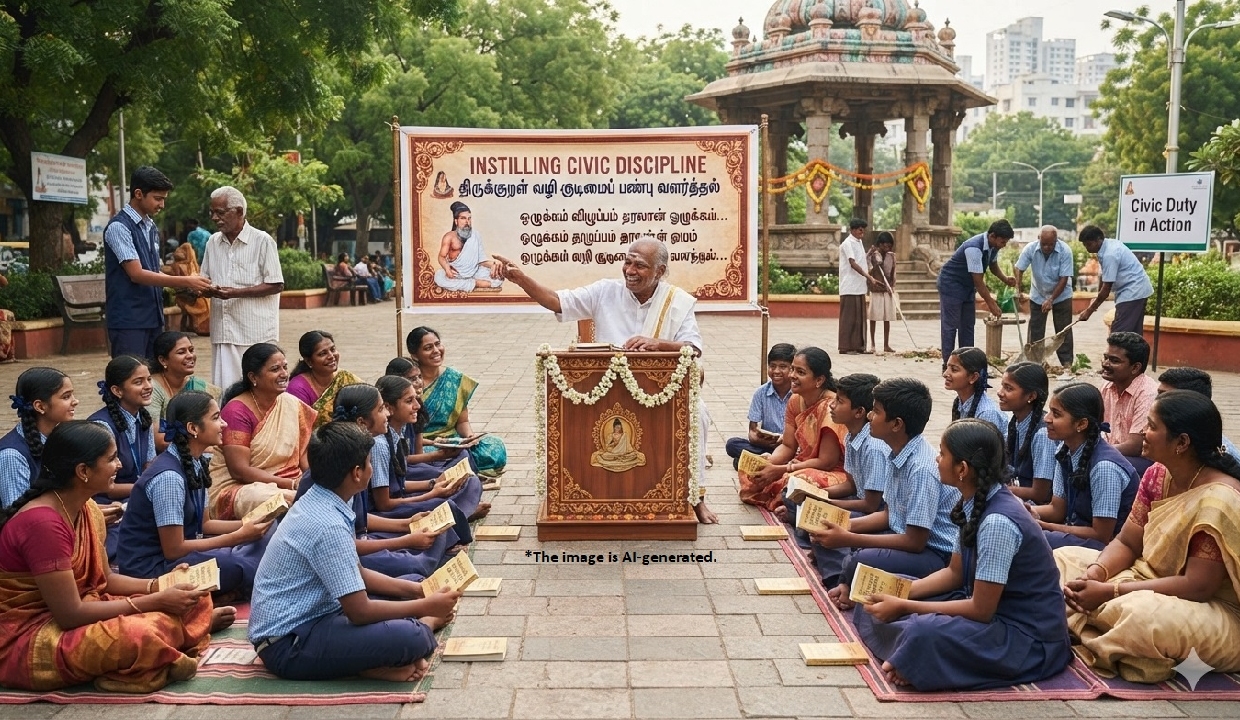
Instilling Civic Discipline through the wisdom of the Tirukkural
The Tirukkural, usually attributed to the Tamil sage Thiruvalluvar, who lived in India in the 6th century, is probably one of the most concise and universal secular treatises on ethics. It contains 1,330 verses, the 'kurals,' which encompass almost every facet of human life. Its 133 sections of 10 verses each are divided into three books: aram (virtue), porul (government and society) and kamam (love).
Although the Tirukkural is often read as a work of personal ethics, its moral vision extends far beyond the private individual. Thiruvalluvar is concerned with the conditions under which human beings can live together in an orderly, prosperous and just society. In modern vocabulary, a substantial part of this teaching may be described as a philosophy of civil or civic discipline.
While the text speaks in the language of its time, often addressing an audience of kings, ministers, and householders, its valuable insights into righteousness and personal conduct; and the reciprocal duties of rulers and subjects offer a powerful framework for cultivating civic discipline in contemporary citizens. Thus, Tirukkural envisages civic order as a chain: self-control —> right conduct —> responsible speech —> social obligation —> respect for others —> impartial justice —> responsible government —> social harmony.
The most significant feature of Tirukkural is that the text is non-sectarian. It avoids endorsing any particular religion and instead focuses on universal moral principles such as truth, compassion, and justice. For a diverse, multi-religious democracy like India, this secular and inclusive ethic is crucial because it allows citizens to find shared values that cut across caste, religion, and region. In its own unique way, this text propounds a political philosophy that is democratic at its core, where citizens see civic duties as expressions of widely shared virtues for self-governance. This could be juxtaposed with another monumental work on socio-political philosophy, the Arthashastra by Kautilya.
Three concepts of social ethics form the basis of aram. Moral order and right behaviour or "ozhukkam, duty to society or, "oppuravarithal" and possession of self-restraint or "adakkamudaimai".
Kural 121: Self-control places a person among the gods; lack of it leads into deepest darkness.
Kural 122: Guard self-control as a precious treasure; there is no greater wealth in life.
The first and perhaps the most crucial step in becoming a dutiful citizen is mastering one's own impulses. This quality is of paramount importance, especially regarding traffic discipline. Queue-jumping, road rage, or failure to drive in one's designated lane happens when one lacks self-control. In crowded cities, treating restraint as valuable wealth would help people observe traffic rules, silence in public libraries, and orderly behaviour. The discipline of speech and control of anger is another important component of the Tirukkural. It warns that wounds inflicted by harsh words never fully heal and that uncontrolled anger destroys both the individual and the community.
Kural 127: Whatever else you leave unguarded, guard your tongue; otherwise errors of speech will bring bitter suffering.
Kural 129: The wound inflicted by fire may heal, the scar inflicted by the tongue does not.
Kural 301: He truly restrains anger who restrains it when he has the power to harm; when he has no power, restraint is of little account.
These kurals are directly relevant, especially in the context of social media and public discourse. In an age of instant messaging, information deluge and online anonymity, these couplets speak with particular force. The decision not to share an inflammatory rumour, to withhold a reply in anger to a communal slur, and avoiding to indulge in trolling become civic acts. Calm, measured speech protects social harmony and strengthens the unity-in-diversity that the Constitution seeks to safeguard. Thus, the verses instruct the citizens to speak with utmost responsibility.
The Tirukkural goes on to expand the concept of "oppuravarithal".
Kural 211: Duty asks for no repayment, what repayment can the world offer to the rain?
Kural 212: All the wealth acquired through one's labour, is ultimately meant to be used in service of those who deserve assistance.
Kural 215: The wealth of a wise person who understands the world's needs, is like a village reservoir filled with water.
Kural 216: When wealth belongs to one who cares for others, it resembles a fruit-bearing tree standing in the centre of the village.
Kural 217: The wealth of a truly generous person, is like a medicinal tree whose every part can heal.
Modern social reformers from Gandhi to Ambedkar and Periyar have cited the Tirukkural's emphasis on human dignity, non-violence, and social justice. The text criticises pride based on birth and wealth, valuing virtue over status, thereby undermining the ideological basis of rigid hierarchies. The text has been cited by national leaders, included in parliamentary speeches and public addresses, as a symbol of India's civilisational wisdom that transcends narrow politics. Its universal ethical language makes it possible to speak of duty, sacrifice, and service without privileging any single community, which supports unity in diversity.
Perhaps the most compact statement of Thiruvalluvar's social philosophy occurs in Kural 983, which establishes that a perfected character is supported by the five pillars of love, moral shame, social responsibility, consideration for others, and truthfulness. A disciplined citizen possesses love, because society cannot be sustained by hostility; moral restraint, because conscience must operate even when enforcement is absent; social responsibility, because human beings have obligations beyond themselves; consideration, because others possess dignity; and truthfulness, because trust is essential to collective life.
Using Tirukkural to frame civic education (whether in schools, public campaigns, or government messaging) can therefore strengthen a nationally constructive discourse that respects regional cultures (such as Tamil heritage) while tying them to a shared Indian ethos of dharma and responsible citizenship.
From the Himalayas to the Indian Ocean, our nation possesses a profound wealth of scriptures, philosophical concepts, and ideas. This heritage is vital in today's world, where we urgently need a guiding light. Across time and space, the teachings of our sacred texts reiterate that strong ethics are essential for leading a happy, purposeful life and becoming responsible citizens. In our journey toward a Viksit Bharat, we must bring these teachings to the centre stage, ensuring the latent wisdom of our glorious country is accessible to all. A true milestone will be achieved when all of us are well versed with the scriptures of the north, south, east and west. We must unearth and disseminate this ocean of wisdom residing in texts, poetry, and proverbs to every corner of our nation.
Manoj K Arora, Hony. Visiting Fellow, Bharat Ki Soch, Former IRS Officer; Dr Prachi Sharma, Senior Research Fellow, Bharat Ki Soch; Views presented are personal.