
- HOME
- INDIA
- WORLD
- BUSINESS
- STATES
- LAW & JUSTICE
- ENTERTAINMENT
- SPORTS
- VIEWPOINT
- LIFESTYLE
- TECH
As geopolitical tensions and volatile fuel markets reshape energy security, India and Japan are turning to domestic renewable resources. Their initiative to develop 1,000 compressed biogas (CBG) plants in India by 2030 combines India’s abundant biomass with Japan’s technology and financing
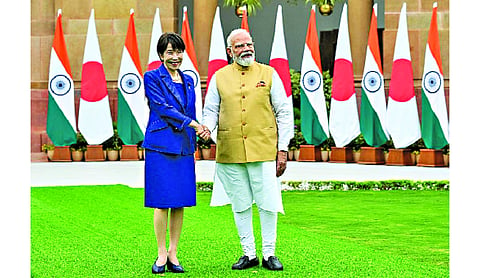
When people think about the energy transition, they usually picture solar panels, wind turbines and electric vehicles. However, the recent meeting between the Indian Prime Minister Narendra Modi and the Japanese Premier Sanae Takaichi in New Delhi suggests that both countries are beginning to see energy security differently. Among the several announcements on bilateral energy cooperation, the launch of the India-Japan Cooperative Biogas for Growth Initiative stands out. The initiative aims to support the development of 1,000 compressed biogas (CBG) plants by 2030 in India. In an era marked by geopolitical uncertainty, volatile fuel markets and increasingly fragile supply chains, the question is no longer simply how to generate cleaner electricity. It is also how to produce the fuels that modern economies will continue to need and to do so from domestic resources.
The crisis in West Asia has underscored the strategic importance of energy security. It has also exposed how the concept itself has evolved through three dimensions. For decades, energy security has been centred on securing uninterrupted supplies of oil and gas. The clean energy transition introduced the second one, focused on technologies, critical minerals and manufacturing supply chains, supply chains that remain concentrated in a handful of countries. A third dimension is now emerging that involves securing domestic renewable resources for reducing dependence on both imported fuels and imported clean-energy technologies. While electricity would power much of the future economy, modern economies cannot run on electrons alone. Industries such as steel, fertilisers, chemicals, shipping, aviation and long-haul freight will continue to depend on molecules for decades. Therefore, a more successful and strategic energy transition should seek where electrons are sufficient, where molecules are indispensable, and how those essential molecules can increasingly be produced from domestic renewable resources.
This is where the India-Japan partnership becomes strategically important in addressing their complementary energy security vulnerabilities. With over 90% of its crude oil and nearly all its LNG sourced from overseas, Japan’s energy insecurity remains overwhelmingly molecular and import-dependent. In addition to the risks of geopolitical vulnerabilities, this also contributes to annual greenhouse gas emissions of approximately 994 million tonnes of CO2-equivalent, the key barrier to Japan’s 2050 net-zero target. Under this partnership, Japanese public and private entities provide finance, advanced technologies and equipment to support CBG projects in India. The resulting emission reductions are quantified, verified and authorised as Internationally Transferred Mitigation Outcomes under Article 6.2 of the Paris Agreement. These mitigation outcomes are allocated between India and Japan according to their agreed financial and technological contributions, with Japan applying its authorised share towards its Nationally Determined Contributions and, where applicable, voluntary corporate climate commitments. For Tokyo, supporting renewable gas projects is also a way to diversify future energy options while advancing its international decarbonisation commitments.
India, meanwhile, faces a dual challenge of energy security and systemic decarbonisation. It imports nearly 90 per cent of its crude oil requirements and around 50 per cent of its natural gas demand, while its rapidly expanding clean energy transition remains heavily dependent on imported solar modules, battery technologies and upstream processing of critical minerals.
In other words, India’s vulnerabilities extend across both molecules and electrons. Since CBG is produced from domestic feedstocks — cattle dung, agricultural residues, municipal organic waste and industrial biomass —CBG simultaneously addresses energy security, waste management and methane emissions while creating value from domestic resources.
Unlike crude oil, LNG or battery minerals, its feedstock cannot be monopolised by distant producers or disrupted by maritime conflict. Also, unlike several emerging energy carriers like hydrogen that still require new supply chains and infrastructure, CBG can leverage existing gas networks. The partnership is also economically complementary. India possesses one of the world’s largest and most diverse biomass resources, generated by its extensive agricultural sector, livestock population and growing urban organic waste streams. Japan, meanwhile, brings technology through precision engineering and project financing.
Rather than competing in the same segment of the value chain, the two countries bring different strengths to building a regional renewable gas economy. More importantly, this cooperation leverages India’s existing GOBARdhan programme and the National Dairy Development Board’s extensive cooperative network, providing an institutional foundation for scaling feedstock collection, avoiding the starting-from-scratch route. But none of this suggests that scaling compressed biogas will be straightforward. India’s principal constraints lie less in technology than in systems integration.
Countries routinely map their coal reserves, oil fields and critical mineral deposits because they are recognised as strategic assets. Biomass resources deserve similar treatment. Crop residues, cattle dung, food waste and organic municipal waste constitute dispersed but significant domestic energy reserves in the form of residual and renewable carbon. This biomass is geographically dispersed, seasonal, variable in quantity and quality, and generated by millions of small producers. Establishing transparent pricing mechanisms, village-level aggregation centres and reliable collection systems, while ensuring that its qualitative characteristics for digestion are maintained, will be as important as constructing digesters themselves. While this complicates logistics, it also makes domestic energy supply inherently more resilient by reducing dependence on single points of failure.
Another, more manageable challenge is the infrastructure. Pipeline connectivity, gas compression facilities and assured offtake remain essential for commercial viability. Without investment in downstream infrastructure, new plants risk becoming underutilised assets. The third challenge is market development. Stable pricing mechanisms, harmonised gas quality standards, stronger carbon market incentives and recognition of digestate as a valuable fertiliser are necessary to improve project economics. India’s experience with renewable energy offers an important lesson. Rapid expansion of solar generation often outpaced transmission infrastructure, leading to curtailment and stranded capacity in some regions. The CBG sector should avoid repeating this mistake by investing as much in logistics and distribution as in plant construction.
One underappreciated aspect of CBG is renewable carbon. While renewable electricity will power much of the future economy, many industries will continue to require carbon-containing fuels and feedstocks. Biomethane addresses this need by providing not only renewable methane but also renewable carbon, making it more than just another low-carbon fuel. Produced from agricultural residues, livestock waste and organic municipal waste, it can be integrated into existing gas infrastructure while reducing methane emissions, producing organic fertiliser and creating rural economic opportunities.
The significance of the India-Japan biogas partnership therefore extends beyond the number of plants it builds. It reflects a broader shift in energy security, from dependence on imported hydrocarbons and vulnerable clean-energy supply chains towards greater reliance on domestically produced renewable fuels. By combining India’s abundant biomass resources with Japan’s technological expertise, this partnership offers a model for strengthening energy security, accelerating decarbonisation and building resilient energy systems across Asia.
India’s vulnerabilities extend across both molecules and electrons. Since CBG is produced from domestic feedstocks — cattle dung, agricultural residues, municipal organic waste and industrial biomass —CBG simultaneously addresses energy security, waste management and methane emissions while creating value from domestic resources
The writer is a Research Associate at the Centre for Climate Change and Energy Transition, Chintan Research Foundation; Views presented are personal.