From Himalayan tragedy to global accountability
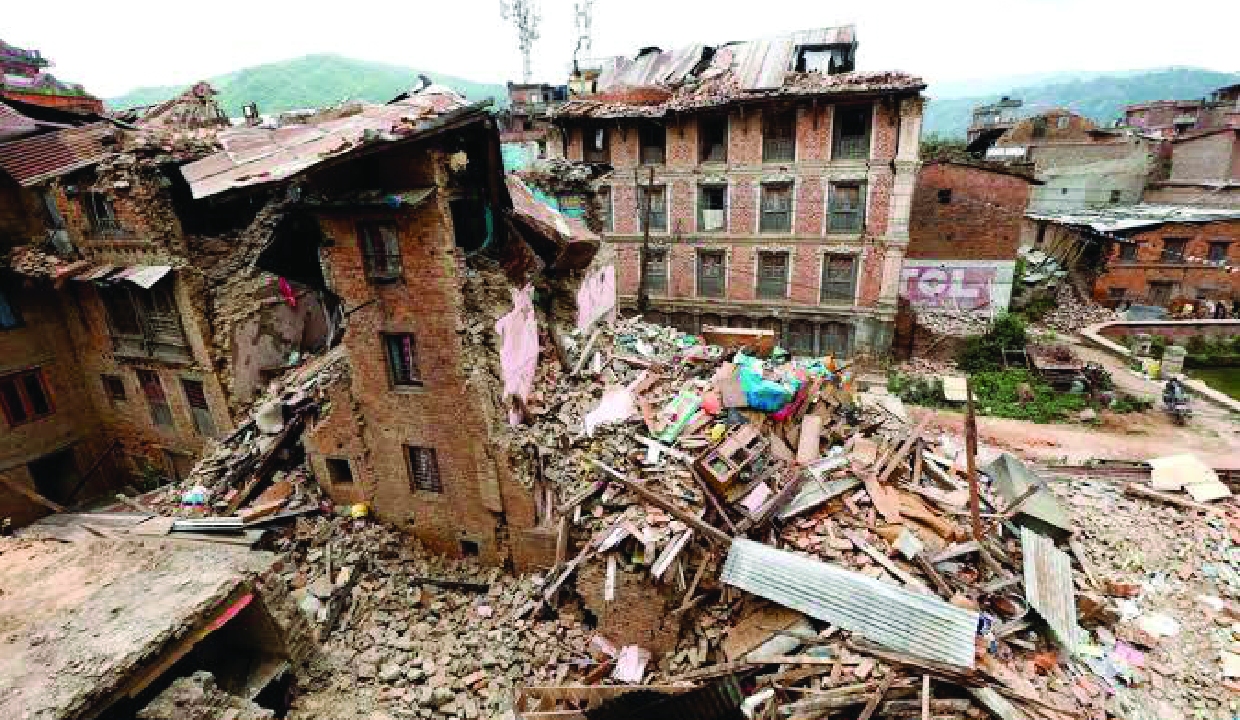
Foreign Minister Shisir Khanal laid the diplomatic groundwork. Prime Minister Balendra Shah has now carried it to the leaders’ level - and done something harder than plead for sympathy after the Bhotekoshi-Trishuli catastrophe. He has turned a national tragedy into an argument about climate justice, financing, resilience and the failures of global governance.
Climate, Shah told the UN General Assembly, respects no border. Khanal had already framed the disaster as an extraordinary Himalayan catastrophe and placed Nepal’s experience before the international community, arguing that climate-induced disasters do not respect political boundaries. Shah carried the message further, describing the tragedy as a warning to humanity and insisting the Himalayas - whose rivers, glaciers and ecosystems sustain nearly two billion people - cannot be treated as a peripheral ecological zone. Tellingly, he resisted turning climate change into a geopolitical battlefield, calling instead for shared responsibility and solidarity.
Finance, he insisted, must be real rather than repackaged. Khanal’s demand that the Loss and Damage Fund be capitalised through new, additional grants rather than repackaged commercial debt became, in Shah’s hands, a critique of the entire architecture of climate finance. His formulation - “Relief. Rehabilitation. Reconstruction. And also: Responsibility. Reparation. Resilience.” - gave Nepal’s diplomacy a vocabulary worth repeating. His point was blunt: when a poor country must borrow to rebuild what a crisis it did not cause has destroyed, the system is failing at justice, not merely at generosity. The conversation, in his hands, moved beyond climate solidarity as rhetoric to the architecture, accessibility and quality of financing itself.
Development, in this telling, becomes a resilience question. Khanal’s language of “climate-resilient, inclusive and sustainable” development gave Shah a still-wider frame. For Nepal, resilience is no longer confined to the climate sector; it touches infrastructure, connectivity, energy, agriculture, livelihoods and the durability of development gains themselves. Shah’s warning that a single disaster can erase years of progress reframes catastrophe as a development emergency, not only a humanitarian one.
The means matter as much as the message. Shah pushed further on finance, technology and participation - the tools developing countries actually need, not just the sympathy they are offered. He linked climate vulnerability to food, fuel, fertiliser, supply chains and the ability of ordinary citizens to build secure livelihoods. His most striking image was the contrast between a world that can move weapons rapidly across borders and one where poor farmers still struggle to get fertiliser and fuel: proof, he suggested, that global systems mobilise vast logistical and financial capacity for war while remaining inadequate for basic human security.
Taken together, these threads mark an evolution in how Nepal argues its case - from asking the world to help it recover, to asking the international system to change how it responds. Shah placed Nepal alongside other climate-vulnerable states, landlocked developing countries and LDCs, and argued that justice must be both distributive, over who bears the costs, and procedural, over who gets a voice. His proposal for a Himalayan Climate Resilience Mechanism led by Nepal, India and China - sharing satellite data, monitoring dangerous glacial lakes, running joint early-warning systems and coordinated cross-border disaster assistance - would move Himalayan cooperation from political declaration to operational architecture. For a region where disaster still outruns warning systems, that shift from paperwork to plumbing is not cosmetic. His hope that the range could become “a laboratory of international cooperation, rather than a frontier of fragmented information” captures that strategic ambition well.
One place the address could have gone further: acknowledging India’s role as first responder. Shah thanked India and China jointly for their “prompt and generous assistance,” a formulation that understates what actually happened. On 26 August 2026, Prime Minister Narendra Modi called Shah directly, conveyed condolences, and pledged “all possible humanitarian assistance”; Indian teams, per the PIB, were already coordinating rescue and relief with Nepalese authorities on the ground. That first-responder relationship, and the highest-level commitment behind it, deserved explicit mention in a speech otherwise built around the future architecture of Himalayan cooperation. Naming it would not have undercut Shah’s proposal; it would have grounded it, showing that the trust a trilateral mechanism requires already exists in practice between Nepal and India.
What Shah’s address ultimately asks is bigger than aid for Nepal. It asks what the international system must do differently when disasters threaten to erase decades of hard-won development gains - through finance that doesn’t reproduce the debt it claims to relieve, through preparedness before rather than sympathy after, through cooperation instead of fragmentation. From Vanuatu to Kathmandu, vulnerable nations are no longer simply describing what climate change does to them; they are demanding that the system which enabled it be held accountable for fixing it. Nepal has spoken from the mountains. The question now is whether the world is ready to listen, and, more importantly, to act.
But the deepest cost of the Bhotekoshi-Trishuli catastrophe may not be measurable in either lives or infrastructure alone. Along that river stood a living civilisation: settlements, temples, livelihoods and generations of ancestral memory shaped by the water itself. Roads and bridges can be rebuilt.
A cultural landscape, once its communities and continuity are broken, cannot simply be reconstructed. This is the dimension still missing from most Loss and Damage frameworks: recognition that climate disasters can amount to civilisational loss, not merely a humanitarian or developmental setback. For Nepal, and for every country the Himalayas touch, rebuilding cannot mean only replacing what was destroyed. It must also mean preserving what can never be replaced.
The author is a financial, geopolitical and security analyst and India-Nepal Relations Observer; Views presented are personal.