Govt constitutes expert panel to tackel city’s hazardous air
The Delhi Government has constituted an expert committee to provide independent ideas, suggestions and solutions to tackle the capital’s chronic air quality crisis. According to officials, the Special Expert Committee comprises 11 members, including former secretaries, former chairpersons of the Delhi Pollution Control Committee (DPCC), secretaries of the environment and forest departments, representatives from the Commission for Air Quality Management (CAQM), and experts from institutions such as IIT Kanpur and IIT Delhi.
The implementation committee has 16 members, including the chief secretary, MCD commissioner, Delhi Development Authority (DDA) vice-chairperson, New Delhi Municipal Council (NDMC) chairperson, Delhi Urban Shelter Improvement Board (DUSIB) chief executive officer, special commissioner of police (Traffic), and other senior officials.
The committee is key to the government’s five-pronged pollution-control strategy, which focuses on innovation, scientific management of dust and solid waste, action against polluting industries, reduction of vehicular emissions, and long-term efforts to make Delhi greener and healthier.
Officials said the move marks a departure from earlier approaches that relied largely on regulatory orders without structured expert consultation. To ensure faster execution of pollution-related decisions, the government has also set up the Implementation Committee on Control of Air Pollution (ICCAP), aimed at translating expert recommendations and government schemes into effective on-ground action.
Apart from this, the Government has identified vehicular pollution as a key focus area, with large-scale road infrastructure upgrades currently underway, officials added. According to official data, over 50,200 potholes have been repaired this year, compared to 36,629 last year.
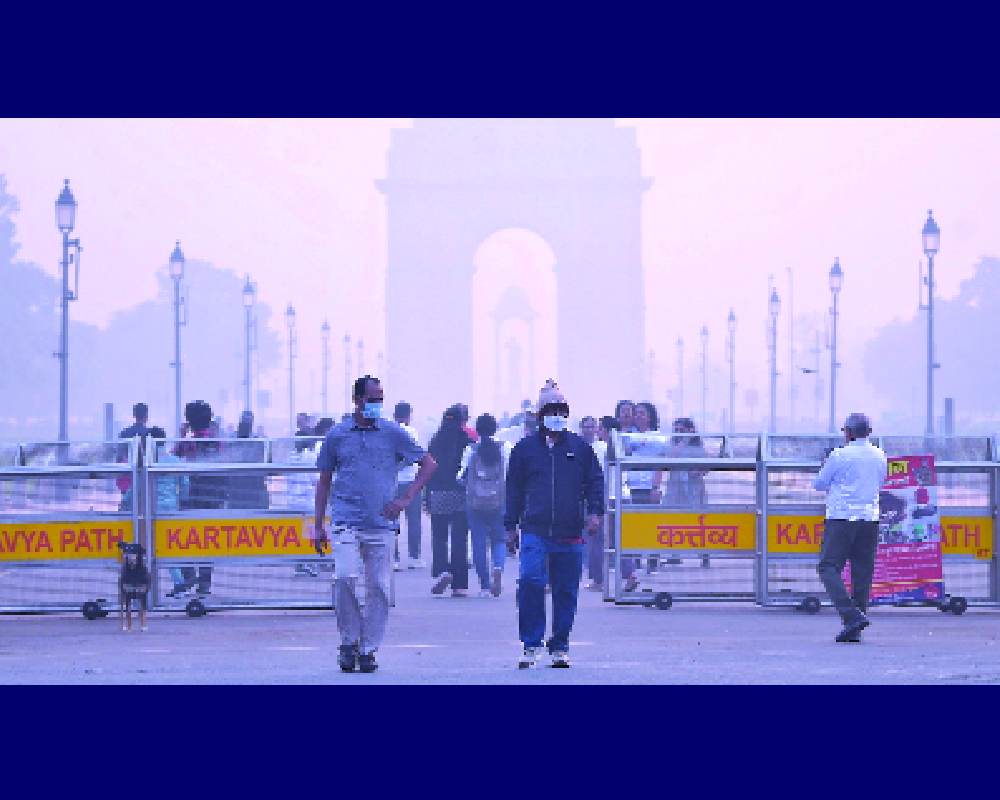
Delhi recorded its worst air quality for December this year since 2018 with an average AQI of 349, even as farm fires accounted for just 3.5 per cent of the PM2.5 pollution, according to official data. In December 2018, the capital logged an average Air Quality Index (AQI) of 360, an official said.
The December average stood at 294 in 2024, 348 in 2023, 319 in 2022, 336 in 2021, 332 in 2020, 337 in 2019, and 301 in 2015, Central Pollution Control Board (CPCB) data showed.
This month, the city recorded ‘severe’ air quality on five days. Last year, Delhi saw six such days in December. On Monday, too, Delhi’s air quality slipped into the ‘severe’ category with an AQI of 401 at 4 pm, as against 401 at 4 pm, in the ‘very poor’ category, on Sunday. However, daily mean data generated by the Decision Support System (DSS) of IITM Pune under the Ministry of Earth Sciences shows a steady decline in the contribution of stubble burning to PM2.5 levels during the October-December period over the years.
The share of stubble burning stood at 13 per cent in 2020 and 2021, fell to 9 per cent in 2022, rose marginally to 11 per cent in 2023, and was 10.6 per cent in 2024 before dropping to 3.5 per cent in 2025.
Delhi recorded its worst air quality for December this year since 2018, with an average AQI of 349