
- HOME
- INDIA
- WORLD
- BUSINESS
- STATES
- LAW & JUSTICE
- ENTERTAINMENT
- SPORTS
- VIEWPOINT
- LIFESTYLE
- TECH
The Rs 23,731-crore GOBARdhan scheme aims to drive a 10-fold increase in compressed biogas (CBG) production, save more than Rs 40,000 crore in fuel imports, add over Rs 75,000 crore to GDP and create more than 1.5 lakh jobs, as the government seeks to turn agricultural and organic waste into a new source of domestic energy.
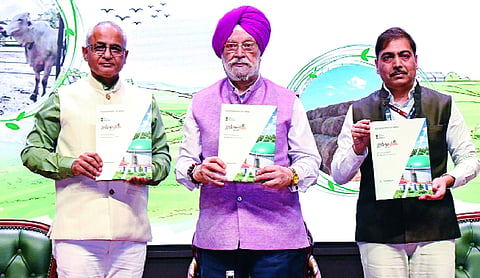
Speaking at the formal launch of the scheme, Oil Minister Hardeep Singh Puri said the scheme provides capital assistance, as well as guaranteed offtake of the renewable fuel produced by processing organic waste such as agricultural residue, animal dung, food waste and other biomass.
Capital support plus guaranteed offtake is likely to lift CBG (essentially methane-rich gas) from current 0.4 million standard cubic metres per day to 4-6 mmscmd, he said, hoping this would help in achieving the target of raising share of natural gas - a cleaner-burning, lower-pollution fuel — in India’s energy basket to 15 per cent by 2030 from current 6-7 per cent.
The scheme is designed to replace about 10 million tonnes of fossil fuel with clean gas, potentially cutting more than 40 million tonnes of CO2 emissions, while producing around 250 million tonnes of organic manure for farmers. Puri said the programme would help turn farmers from “Annadatas to also being the Urjadatas”.
GOBARdhan - Galvanising Organic Bio-Agro Resources Dhan — will convert agricultural residue, cattle dung, press mud, food waste and segregated biodegradable municipal waste into CBG and organic manure. The CBG can be supplied through city-gas networks for CNG transport and domestic PNG use.
It provides capital assistance of up to Rs 30 crore per CBG project across the two eligible capital-support components. For new greenfield plants, assistance is set at Rs 1.25 crore per tonne per day (TPD) of eligible CBG capacity. Brownfield projects can receive support at 50 per cent of the applicable greenfield rate for additional capacity created through fresh investment.
Existing biogas plants upgraded to produce CBG can receive Rs 0.60 crore per TPD, subject to a Rs 5-crore project ceiling.
To make CBG projects more commercially viable, the government is offering producers assured offtake of up to 100 per cent of eligible output, at an administered price of Rs 2,110 per million British thermal units — equivalent to about Rs 98 per kg. The administered price is set to remain in place until March 2036, providing greater revenue visibility to investors.