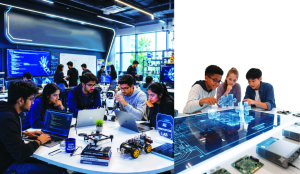
Equipping students with skills for tomorrow’s workplace

For generations, a university degree has represented preparation for a profession and a pathway to a stable career. But as Artificial Intelligence begins to transform how industries operate, how professionals work and even how skills are defined, the traditional idea of being “job-ready” is evolving. Today, students need more than knowledge of a discipline; they need the ability to learn continuously, adapt to change and make thoughtful decisions in an increasingly technology-driven world.
Education needs to transcend employment. The duty of every university is to produce graduates who have professional expertise, curiosity, innovation, ethical sense and are socially impactful in their thinking. This ideology is founded on the principle that a university must train students for life, not merely a profession.
The impact of AI on education is profound, and this transformation will make an indelible impression on us. This is because AI has transcended beyond technology companies or departments of computer science to become more pervasive than healthcare, law, education, management, agriculture, architecture, hospitality, media and almost any other professional area. Therefore, having a basic knowledge of AI is no longer an advantage, but a basic requirement.
In order to respond to this transformation and the growing importance of AI, universities are adapting to modern pedagogy with AI taking centre stage. At BBD University, we have moved beyond treating AI as an elective add-on; nearly 10 per cent of every curriculum across our schools, right from engineering to management to humanities, is now built around AI literacy and application, ensuring that no student graduates without the fluency that this moment demands. AI is now being incorporated in a way that students of different disciplines can grasp its application in their respective disciplines. These initiatives include AI labs, specialisation programmes like B Tech in Computer Science & Engineering (Generative AI) and MBA in Data Science & Artificial Intelligence, along with strong industrial partnerships like IBM and HCL GUVI.
Nevertheless, preparing the students for the world of AI would not be another attempt at familiarising them with a bunch of technological skills. Rather, it would mean preparing them to apply judgement about where technology can add value, where human intelligence cannot be replaced and how innovation can be pursued responsibly. As AI becomes more advanced, qualities such as critical thinking, creativity, empathy, collaboration, leadership and ethical decision-making, which are distinctively human, are going to be valued more highly. This is why the university experience must not remain restricted to the classroom and examination hall. There must be spaces for experiential learning, interdisciplinary collaboration, research, entrepreneurship and interaction with industry.
There is also no denying that the future workplace would require professionals who can function beyond the discipline-specific boundary lines. For instance, an engineer would need to know something about business, a lawyer about AI and cyber law, a manager about data and an educator about the potential of AI in education. Interdisciplinary education therefore becomes crucial for creating professionals who would be versatile enough to cope with these demands of the times. And even within an interdisciplinary curriculum, AI and technological enhancements will lead the way to futuristic education, which will help produce a skilled workforce.
Ultimately, rather than churning out graduates who merely keep up with technology, the ideal outcome of higher education is for graduates who know how to use technology in their favour. The future lies not with those competing against AI, but with those who know how to leverage AI for what it can offer and yet preserve all those qualities that AI cannot bring to the table. While getting a degree is important to get through the doors, what will make all the difference for students is the ability to learn and lead. For every institution of learning, the mission should be to equip the students not only with degrees, but with the tools and the knowledge necessary to prosper in the AI-driven world.
The writer is Pro Chancellor, Babu Banarasi Das University; Vice-President, Badminton Association of India; and President, Uttar Pradesh Olympic Association; Views presented are personal.