International education needs stronger partnerships
India-France education ties are evolving beyond student mobility, building lasting partnerships across academia, research, innovation, industry and employment
For 30 years, international education has largely been shaped by competition. Countries have sought to attract the brightest students, universities have competed for global rankings, and success has often been measured through enrolment numbers and international visibility. But as education becomes increasingly connected to research, innovation and employment, this model no longer tells the whole story.
The relationship between France and India illustrates how this is changing. Student mobility is increasingly supported by academic agreements, research cooperation, institutional partnerships and stronger links with industry. International education is no longer simply about where students choose to study, but about the networks of knowledge, opportunity and collaboration that can be built around them.
The growing movement of Indian students to France reflects this expanding relationship. Indian enrolment in French higher education increased by 17 per cent in a single year, reaching 9,100 students in the 2024-25 academic year. India consequently became the eleventh-largest source country of international students in France, rising from thirteenth place the previous year. Broader visa and residence-permit data, which also include exchange students and shorter programmes, indicate that approximately 12,000 Indian students were studying in France in 2025.
These figures are significant, but they also represent a growing network of individuals contributing to academic, scientific, cultural and professional ties between the two countries. Every student who studies in France develops knowledge of another academic system and builds relationships that can sustain bilateral cooperation. The partnership between India and France demonstrates how education can serve as a foundation for wider collaboration. Academic exchanges, institutional agreements, research cooperation and student mobility have strengthened ties in education, research, innovation, technology, entrepreneurship and industry.
The India-France Year of Innovation 2026 further reflects this shared ambition, highlighting the growing connections between higher education, research, entrepreneurship and industry across areas such as aerospace, artificial intelligence, healthcare, sustainable development and energy transition. At the same time, partnerships between Indian institutions and French universities, engineering schools and business schools are creating pathways across a wide range of disciplines. Institutions such as CentraleSupélec, Mines Paris-PSL, IMT Atlantique, ISAE-SUPAERO and ENAC form part of an academic and industrial ecosystem connected to aerospace, advanced engineering and emerging technologies. Business schools including ESSEC, ESCP, and KEDGE contribute to cooperation in management, entrepreneurship and innovation, while French public universities support partnerships across the sciences, humanities and social sciences.
The objective is not simply to create more opportunities for students to leave one country and study in another. It is to develop deeper institutional relationships through joint programmes, research cooperation, academic exchanges, local engagement and connections with industry. International mobility becomes more valuable when it is embedded within partnerships that continue before, during and after a student’s period of study. The presence of French institutions in India reinforces this approach. ESSEC’s presence in India, for example, reflects a model in which international institutions engage more closely with local academic, professional and innovation ecosystems. Partnerships between French and Indian institutions similarly create opportunities to combine expertise, develop joint academic pathways and strengthen research cooperation. For instance, we witnessed the recent inauguration by President Macron and Minister J.P. Nadda of the Franco-Indian Centre for AI in Health, co-chaired by Sorbonne University and AIIMS, that will bring together the best innovation in biotechnologies and healthcare, which is beneficial to both countries and to the world.
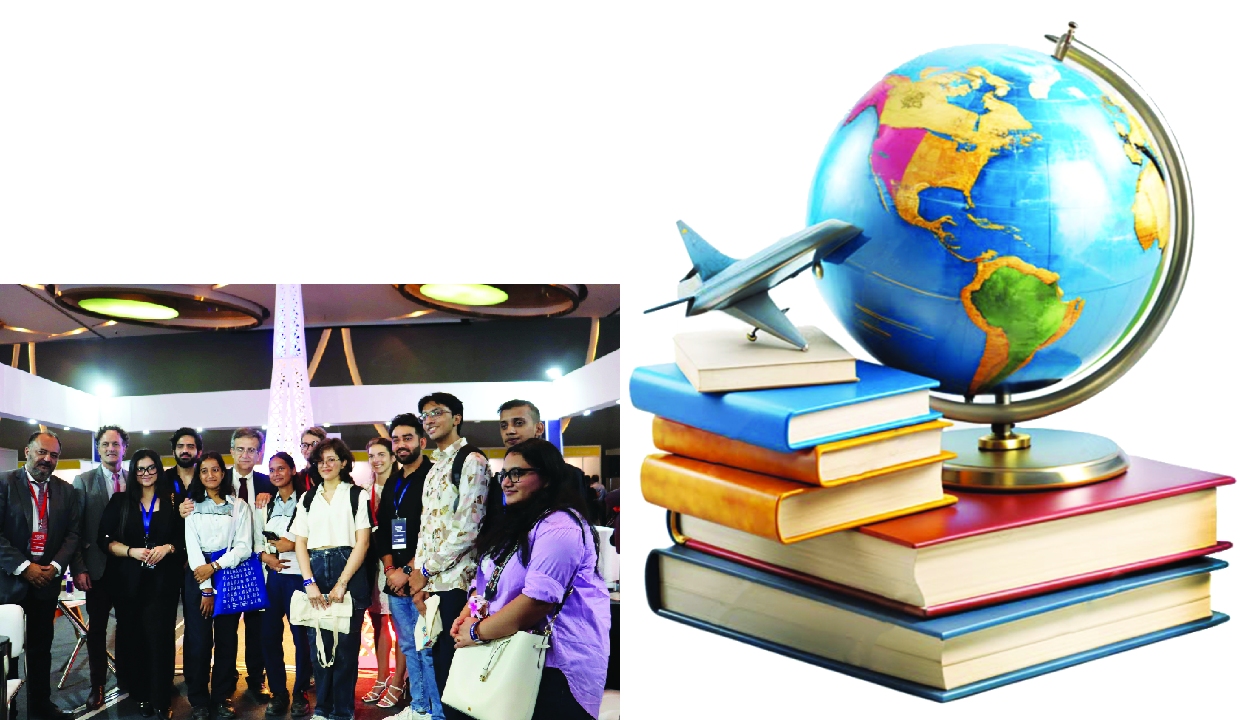
This is also why initiatives that bring students closer to international opportunities are increasingly important. Programmes supported by Campus France and outreach initiatives such as the Choose France Tour 2026 allow students and families to engage directly with institutions, explore academic pathways and obtain guidance on scholarships, visas, accommodation and student life. With representatives from more than 50 French institutions across business, engineering, public universities, arts and design, hospitality and specialised education, the Tour reflects the diversity of the bilateral education ecosystem. More importantly, it creates direct connections between prospective students and the institutions that may become part of their academic and professional journeys.
Initiatives such as Classes Internationales further demonstrate how partnerships can make international education more accessible. The programme combines French-language training with academic preparation before students begin full undergraduate degrees. Involving more than 30 French institutions and providing access to over 200 undergraduate programmes, it creates a structured pathway for students who may not previously have considered studying in France. Yet the value of an education partnership cannot stop at graduation. International mobility and academic cooperation must also connect students to professional opportunities. This is where relationships between universities, companies, chambers of commerce and employers become equally important.
The Indo-French Chamber of Commerce and Industry (IFCCI) brings together around 800 members, while more than 570 French companies operating in India are estimated to support close to 500,000 jobs. Initiatives such as the IFCCI Job Fair connect students and graduates with this wider professional ecosystem, demonstrating how the France-India network extends beyond academia into employment, entrepreneurship and industry.
Student mobility creates connections between people. Institutional and research cooperation deepens them. Employability ensures that the skills, knowledge and relationships developed through education contribute to the wider economy and society.
France’s ambition to welcome 30,000 Indian students by 2030 should therefore be viewed through this broader lens. It is not simply a numerical target, but an investment in a network of students, institutions, researchers and professionals capable of sustaining cooperation between the two countries over the long term. As international education evolves, success will no longer be measured solely by rankings, recruitment figures or student numbers. The more meaningful question is whether international education creates lasting connections between institutions, research communities, industries and people.
In an increasingly interconnected world, the future of international education will be defined not by who competes most aggressively, but by who builds the strongest partnerships and views international education as an integrative opportunity for all involved parties.
The writer is the Ambassador of France to India; Views presented are personal.