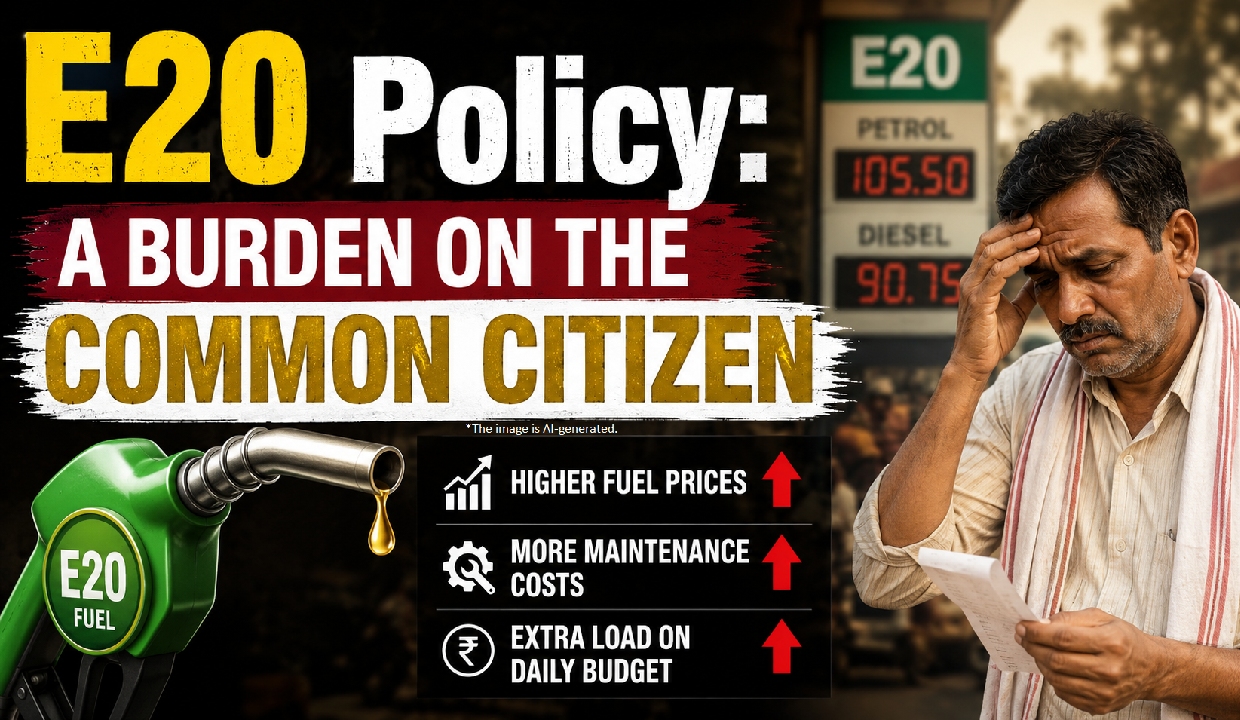
E20 Policy: A burden on the common citizen
The Indian National Congress believes that any energy transition must be people-centric
The Government of India's push towards 20% ethanol blending (E20) in petrol is being projected as a revolutionary step towards energy security and environmental sustainability. While reducing dependence on imported crude oil is an important national objective, public policy must be judged not by its intentions but by its impact on ordinary citizens. Unfortunately, the E20 policy raises serious concerns that cannot be ignored.
First, millions of Indians own vehicles that were never designed to run on E20 fuel. Using higher ethanol blends in older vehicles can increase maintenance costs, reduce fuel efficiency, and potentially damage engine components over time. The burden of these costs will ultimately fall on middle-class families, small businesses, and farmers who depend on affordable transportation for their livelihoods.
Second, expanding ethanol production requires enormous quantities of sugarcane and other crops. India is already facing growing water scarcity in many states. Encouraging water-intensive crops to meet ethanol targets risks putting additional pressure on our limited water resources while diverting agricultural land away from food production. At a time when food security and farmer welfare remain critical priorities, this imbalance deserves serious reconsideration. Third, the government has failed to provide a transparent assessment of the economic costs. Consumers deserve to know whether E20 fuel will actually reduce their overall expenses when lower mileage is taken into account. If vehicles consume more fuel per kilometre, any apparent savings at the national level may not translate into savings for individual citizens.
There are also concerns about the readiness of the automobile ecosystem. While newer vehicles may be engineered for E20 compatibility, millions of existing vehicles remain on Indian roads. The government cannot expect citizens to replace perfectly functional vehicles simply to comply with a policy introduced without adequate transition planning or financial support.
India certainly needs cleaner fuels and lower emissions. However, a balanced strategy should promote electric mobility, public transport, green hydrogen, bio-CNG, and research into next-generation sustainable fuels rather than relying excessively on one solution. Environmental progress must go hand in hand with affordability, technological readiness, and public confidence.
The Indian National Congress believes that any energy transition must be people-centric. Before implementing E20 nationwide, the government should conduct independent scientific studies, consult farmers, automobile manufacturers, consumer groups, and state governments, and ensure that no citizen bears an unfair financial burden. National progress should never come at the expense of the common man.
India deserves an energy policy that is sustainable, scientifically sound, economically responsible, and socially just. The government must rethink the current approach and place the interests of citizens above publicity-driven targets.
The writer is President of Indian Youth Congress; Views presented are personal.