The sacred flavours of Gauri’s homecoming
In Rajasthan, spring enters courtyards through folk songs, appears on palms in patterns of mehendi, travels through bazaars in processions of colour and takes edible form in delicately shaped gune, syrup-laced ghevar and meals prepared for reunion, worship and farewell. Gangaur is often described as a festival of marital devotion, but its meaning is wider than a prayer for domestic happiness. It celebrates fertility, renewal, companionship and feminine creativity, as well as the enduring relationship between a woman’s marital home and her maternal family. Its cuisine reflects these ideas. Food is moulded like jewellery, sent as affection, offered before it is eaten and shared after restraint, turning the kitchen into one of the festival’s most important sacred spaces.
Gangaur, also known as Gauri Tritiya, is celebrated on Chaitra Shukla Tritiya, the third lunar day of the bright fortnight of Chaitra. This year, it was observed on 21 March, while in 2027 it will fall on 9 April. In Rajasthan, the festivities traditionally begin after Holi and unfold over approximately eighteen days, culminating in the principal worship and ceremonial farewell of Gauri. The name Gangaur brings together “Gan”, associated with Isar or Shiva, and “Gaur”, referring to Gauri or Parvati. Married women worship the divine couple for marital harmony, family well-being and prosperity, while unmarried girls traditionally pray for a worthy partner and an auspicious future. Yet Gangaur extends far beyond household worship, filling courtyards, streets, lakesides and village squares with songs, decorated images, processions and a shared celebration of spring, feminine creativity and community life.
The story at the heart of Gangaur presents Gauri as both goddess and beloved daughter. In Rajasthani tradition, she is imagined as visiting her maternal home after Holi, remaining there through the celebration before Isar arrives to take her back. Her departure on Gangaur carries the tenderness of a daughter’s vidai, which explains the festival’s mixture of joy and wistfulness. Women fashion or decorate clay and wooden images of Isar and Gauri, offer water, flowers, sacred grass and food, and sing songs in which the divine couple is addressed with the familiarity of family. The rituals transform distant divinity into an intimate presence within the household.
The history of Gangaur cannot be reduced to a single founding moment. It grew through regional customs, royal patronage, household worship and the seasonal rhythms of western and central India. Rajasthan’s princely courts gave the public processions grandeur, but the festival’s continuity has always depended upon women in homes and communities. Jaipur’s ceremonial procession traditionally moves from the City Palace through the old city, while Udaipur’s Mewar Festival carries images of Gauri towards Lake Pichola amid music, decorated boats and public celebration. Beyond Rajasthan, Gangaur is also observed in parts of Madhya Pradesh, especially Nimar, where the goddess is honoured as a powerful maternal figure and the conclusion of the festival may include collective worship and community meals.
Gangaur also reveals the vital role of women as custodians of intangible cultural heritage. Although the festival is rooted in traditional ideas of marriage, fertility and household well-being, its continuity depends upon a distinctly female world of knowledge, memory and collective participation. Women preserve not only the visible customs of worship, song, dress and food, but also the less tangible understanding behind them: when a ritual must be performed, how an offering should be shaped, which songs belong to each stage of the observance, and how meanings are adapted within different families and communities. Much of this knowledge is not formally written down. It is absorbed by watching mothers and grandmothers, joining group rituals, preparing food together and taking part in processions and seasonal gatherings. In this way, women do more than maintain inherited practices. They interpret them, renew them and decide how they will be transmitted. Gangaur therefore gives women cultural authority within the household and the community, positioning them not simply as participants in tradition, but as its principal knowledge-bearers and the people most responsible for carrying it into the future.
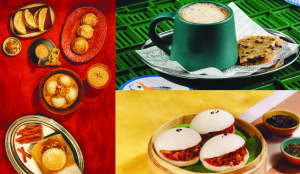
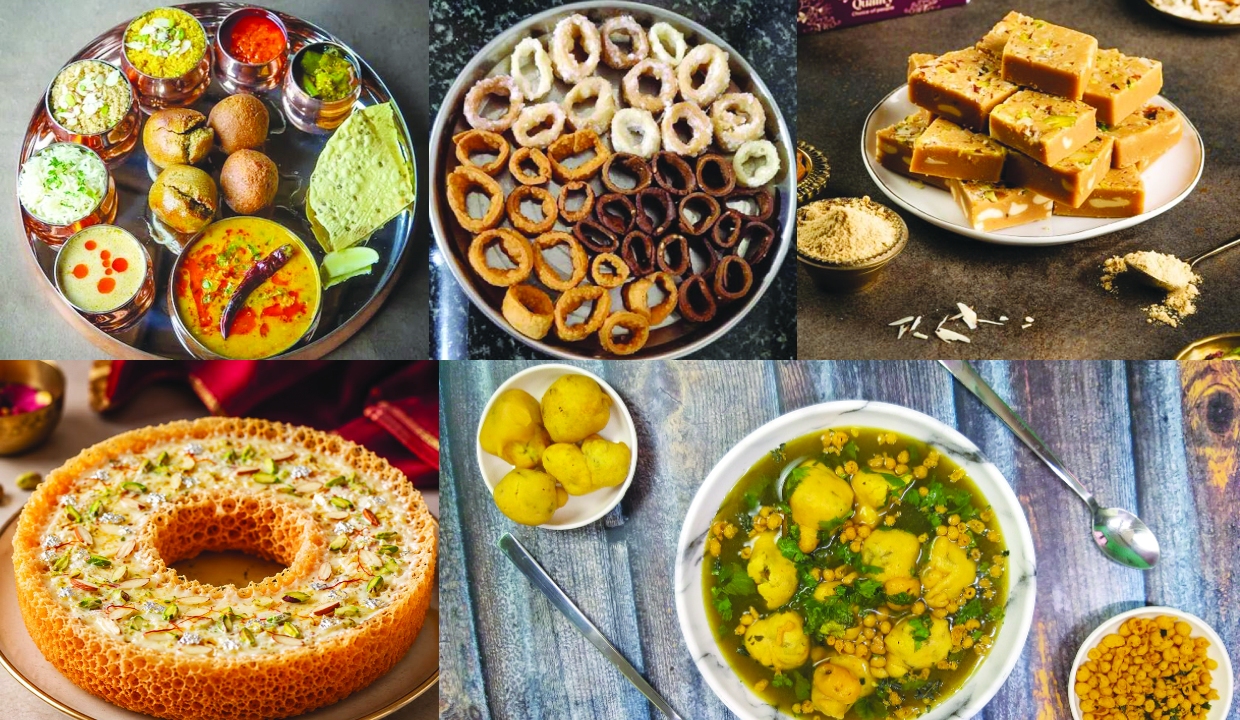
The cuisine becomes one of the clearest expressions of this inherited knowledge, beginning with the festival’s most distinctive preparation, Gangauri Gune. These crisp forms are made from wheat flour, refined flour or gram flour and shaped to resemble ornaments, discs, flowers or other auspicious designs. Sweet versions may contain jaggery or be coated lightly with sugar syrup after frying. The word gune is often connected with gehne, meaning jewellery, because the edible shapes are offered to Gauri as symbolic adornments. After worship, they are shared among women of the family, including mothers-in-law, sisters-in-law and other relatives. Flour becomes ornament, while shaping and sharing it become acts of devotion. Alongside them appear Besan ke Namkeen Gune, a savoury counterpart made by combining gram flour with turmeric, salt, carom seeds, cumin or crushed spices. The dough is rolled, cut or shaped by hand before being fried in a kadai until firm and golden. Their restrained seasoning distinguishes them from ordinary snacks, while their jewellery-like forms preserve the ritual association with Gauri. Some households prepare both sweet and savoury batches so that the ceremonial plate contains contrasting flavours, textures and colours.
The second great emblem of the Gangaur season is Ghevar, whose intricate surface seems designed for a festival devoted to beauty and adornment. A thin batter of flour, ghee and chilled water or milk is poured repeatedly from a height into a deep kadai of hot ghee or oil, allowing each stream to set around the previous one and gradually form the sweet’s porous, honeycombed structure. Once crisp, the disc is drained and lightly soaked or coated with sugar syrup. Malai Ghevar is finished with thickened milk, saffron, pistachios and almonds, while Mawa Ghevar carries a richer layer of sweetened khoya.
Ghevar is closely associated with Sinjara, the gifts traditionally sent from a married woman’s maternal home before the main celebration. Along with clothes, mehendi, ornaments and other festive items, the sweet conveys remembrance and affection across households. It is therefore more than a dessert. It becomes an edible expression of the continuing bond between a daughter and the home in which she grew up, even after marriage has taken her elsewhere.
That exchange of sweetness continues through Mawa Kachori, particularly associated with Jodhpur. This festive pastry encloses sweetened khoya, nuts and cardamom inside a crisp flour shell before being glazed with sugar syrup. Its contrast between brittle pastry and soft filling makes it especially suited to celebratory trays. Mohanthal, prepared by slowly roasting coarse gram flour in ghee in a heavy-bottomed vessel and setting it with sugar syrup, cardamom, saffron and nuts, offers a denser sweetness. Its characteristic grainy texture depends upon patient roasting and careful control of the syrup, making it a preparation through which culinary skill becomes visible.
A more rustic expression of celebration appears in Churma Laddoo. Wheat dough is baked or fried, crushed and combined with ghee, jaggery or sugar, cardamom and dry fruits before being shaped by hand. Dilkhushal, also known as besan chakki in parts of Rajasthan, is similarly built upon gram flour, ghee and sugar but cooked into a firm mass and cut into diamonds. These preparations create richness through the slow transformation of flour, fat and sweetener rather than elaborate decoration. Their ability to remain fresh also makes them suitable for gift trays, family visits and the steady movement of food between maternal and marital homes. The sweet sequence may conclude with dishes served warm. Malpua with Rabri combines shallow-fried pancakes, often flavoured with fennel, with thickened milk scented by cardamom and saffron. The edges remain crisp while the centre absorbs syrup and rabri. Kesar Mawa Kheer, made by gently simmering milk with rice or reduced milk solids, saffron and nuts, provides a softer conclusion. Neither dish is an obligatory Gangaur offering across every community, but both belong naturally to the larger festive table of Rajasthan and neighbouring regions. Gangaur cuisine is not one fixed menu. Its sacred core is surrounded by family recipes, local preferences and dishes selected according to place, season and means. Once the fast or principal worship is complete, the savoury meal restores appetite through dishes that are substantial without losing their regional identity. Hing Kachori is filled with ground lentils seasoned with asafoetida, fennel, coriander and chilli, then fried until blistered and crisp. Its powerful aroma awakens the palate after restraint. Kanji Vada, particularly suited to the spring period following Holi, offers an entirely different sensation. Lentil dumplings are soaked in a mustard-spiced liquid and left to ferment, creating the sourness and pungency that balance the richer fried foods of the festive meal.
The main table often turns to Rajasthan’s mastery of gram flour. Govind Gatta elevates the familiar gatta into a festive preparation by filling or enriching gram-flour dumplings with khoya, paneer or nuts before simmering them in a spiced yoghurt gravy. The gravy must be cooked over a controlled flame and stirred carefully so that the yoghurt does not split. Pitod ki Sabzi begins with gram flour and buttermilk or yoghurt cooked into a firm mixture, spread, cooled, cut into diamonds and finished in a tempered gravy.
Papad Mangodi ki Sabzi begins long before it reaches the stove, with seasoned lentil paste shaped into small nuggets and dried under the strong Rajasthani sun for storage. When required, the mangodi is cooked with papad, spices, yoghurt or a light tomato base to create a dish of surprising depth from ingredients that can be preserved for months. Such preparations arose from practical necessity but became an essential part of Rajasthan’s culinary identity.
The relationship between cuisine and ecology becomes most visible in Ker Sangri, a dish shaped by an arid landscape where water was precious, rainfall uncertain and fresh vegetables highly seasonal. Dried ker berries and sangri beans, gathered from hardy desert plants, are soaked repeatedly, boiled and cooked with oil, chillies, coriander, cumin, dried mango or yoghurt until tangy and concentrated. The soaking softens the ingredients and reduces their natural sharpness, while slow cooking allows them to absorb the spices.
Panchkuta expands the same desert logic by bringing together five preserved ingredients, commonly including ker, sangri, kumatiya, dried gunda and amchur. Although the combination varies between communities, the preparation expresses a culinary culture built upon sun-drying, storage and careful use of what the land could sustain. Papad, mangodi, gram flour, millet, dried berries and fermented dairy were not merely substitutes used in times of shortage. They became the basis of a distinctive cuisine that transformed ecological restraint into flavour and variety. During Gangaur, these dishes connect the goddess’s associations with fertility and abundance to a tradition that defines abundance not as excess, but as resilience, preservation and respect for limited resources.
Traditional Rajasthani cooking methods are woven into nearly every part of this festive meal. Ingredients are dried beneath the sun, yoghurt gravies are simmered gently, milk is reduced slowly into khoya and rabri, and flour is patiently roasted in ghee until its aroma changes and its flavour deepens. Heavy iron, brass or thick-bottomed vessels help retain heat, while frying gives gune, kachori and ghevar the crispness needed for ceremonial sharing and storage. Fermentation sharpens kanji, and slow cooking allows dried ingredients to regain tenderness. These techniques conserve ingredients, limit waste and create the concentrated tastes that distinguish the region’s cuisine.
Bread and grain complete the savoury range. Khoba Roti is a thick wheat bread whose surface is pinched into decorative patterns before being cooked slowly on a tawa or over gentle heat and brushed generously with ghee. Its sculpted appearance is especially appropriate to a festival in which adornment carries ritual meaning. Rajasthani Dhokla with Kadhi, made from firm wheat dough rather than the soft Gujarati gram-flour preparation, is steamed or cooked and then broken into pieces to be eaten with tangy yoghurt kadhi.
Jodhpuri Kabuli adds a more elaborate note through layers of fragrant rice, vegetables, fried bread, nuts and warming spices. The ingredients are arranged and cooked together so that each serving reveals contrasting textures. Across the border in Madhya Pradesh, particularly in areas connected with Nimar and Malwa, Dal Bafla provides a fitting communal preparation. Wheat balls are boiled before being baked, giving them a softer centre than baati, and are then opened, enriched with ghee and served with lentils, chutneys and sometimes churma. Its generous, shareable character suits the family gatherings and community meals associated with regional Gangaur observances. Beverages provide relief from the early summer warmth and balance the ghee-rich sweets and fried foods. Kesar Badam Thandai, blended from milk, almonds, melon seeds, fennel, pepper, cardamom and saffron, carries forward the cooling flavours associated with the season after Holi. Makhaniya Lassi offers thick yoghurt churned with sugar and crowned with malai, while salted Chaas, flavoured with roasted cumin, mint and black salt, cools the palate during the savoury meal. Fermented Kanji may be served separately from the vadas as a sharp, mustard-scented drink. In some households, Kesar Doodh or Bael Sherbet provides a gentler alternative for children, elders and those breaking a fast.
To carry Gangaur forward, future generations must inherit more than the sight of a procession or a date on the calendar. They should know why flour is shaped into jewellery for Gauri, how a stream of batter becomes the lattice of ghevar, why Sinjara travels from a daughter’s maternal home, how desert berries become a dish of celebration and why mangodi is dried long before it is cooked. They should also recognise the women whose knowledge keeps each practice alive. When children are invited to shape gune, stir mohanthal, learn a Gangaur song and serve the first offering before eating, heritage moves from observation into experience. Gangaur will endure when its cuisine remains cooked, shared and understood, allowing Gauri’s homecoming to nourish the cultural confidence of generations yet to come.
The writer is Secretary, Cuisine India Society; Views presented are personal.