Democracy’s real strength lies in its institutions
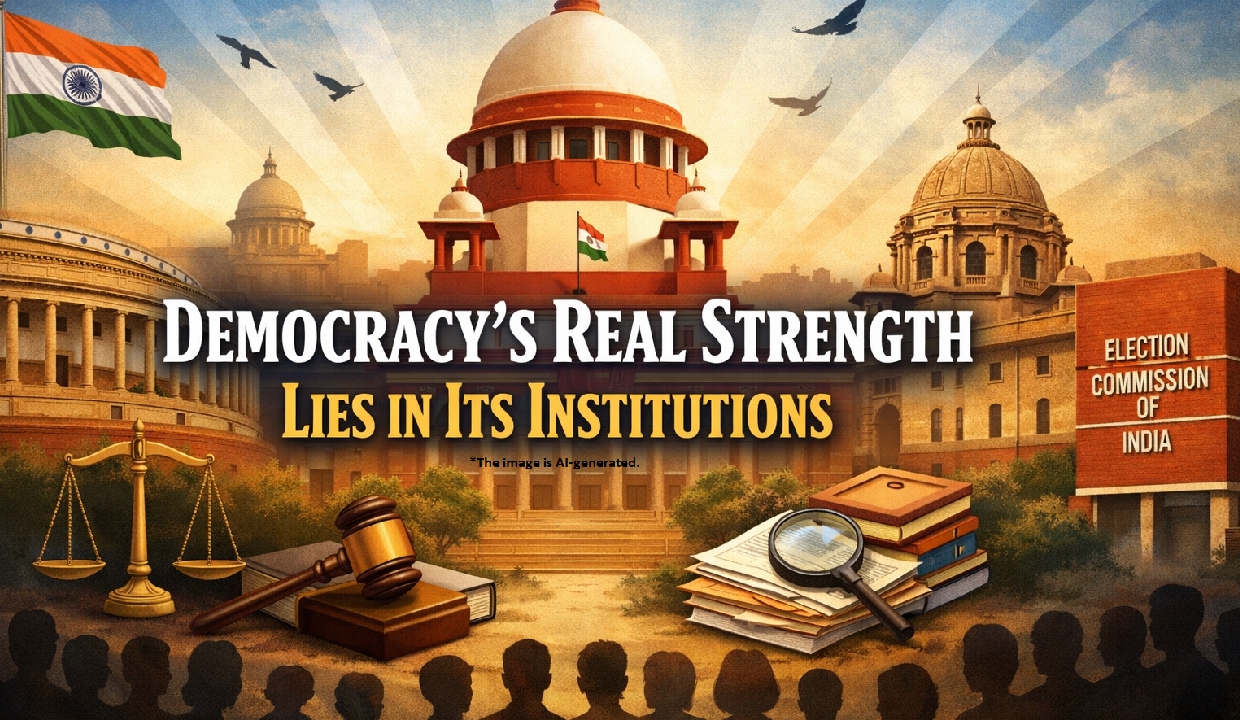
Institutions endure where individuals inevitably fade; they embody continuity, restraint, and collective wisdom beyond the perceptible limits of any single personality. While individuals may inspire, disrupt, or even dominate a moment, it is institutions that preserve order, ensure accountability, and outlast human fallibility. A strong institution does not depend on the virtue of one single leader but is designed to withstand the weaknesses of many-its legitimacy is drawn from process, not personality. As Dr BR Ambedkar wisely cautioned, “However good a constitution may be, it is sure to turn out bad because those who are called to work it, happen to be a bad lot.”
The reverse, too, holds true: even imperfect individuals can uphold justice when bound by strong, principled institutions.
The term “good governance” does not find a mention in the Constitution of India, as it was not a part of the common terminology at the time when the Constitution was drafted. However, even a bare, cursory reading of the Constitution and particularly its chapters on Fundamental Rights and the Directive Principles of State Policy makes it abundantly clear that the founding fathers of our Constitution had in mind good governance as the objective.
The contemporary use of the term “good governance” began with the World Bank’s 1989 report on “Sub-Saharan Africa: From Crisis to Sustainable Growth”, where it advanced the argument that economic and social development hinges on the quality of governance. Broadly speaking, the concept of “good governance” has two aspects. The first, which relates to the form of Government, is usually regarded as best exemplified in liberal democracy. The second, which relates to the efficiency of Government, requires that the process of governance be free from corruption and caprice. Effectively, however, these two aspects tend to overlap, because several of the principles that constitute a liberal democracy, such as the rule of law, also contribute to ensuring its effectiveness. As a result, the extent to which a constitution promotes good governance depends to a great extent on its success in establishing a liberal democratic framework.
In a democracy as vast and complex as India, the enduring strength of governance lies not in personalities but in the sanctity and resilience of its institutions. A vibrant democracy does not survive on electoral rituals alone; it rests on a carefully constructed architecture of institutional safeguards.
In India, this architecture includes constitutional and statutory offices such as those of the President, Vice President, Governors, the Prime Minister, the Chief Justice of India, the Cabinet Secretary, and oversight bodies like the Election Commission of India, Lokpal of India, the Central Bureau of Investigation, and the Comptroller and Auditor General of India. These institutions collectively ensure continuity, accountability, and the rule of law, acting as bulwarks against arbitrariness and excess. The very essence of democratic stability lies in the primacy of institutions over individuals. While individuals may bring competence, vision, or, at times, controversy, institutions are designed to endure beyond transient personalities. The institutions, with their codified powers, established conventions, and constitutional backing, provide a veritable framework within which governance operates. This continuity ensures that even when individuals change, the system remains steady, predictable, and accountable.
Critics often argue that the system occasionally elevates individuals who may appear incompetent or even questionable in integrity. However, this argument overlooks a fundamental strength of institutional design: the ability of systems to moderate individual excesses. Institutional processes, checks and balances, bureaucratic continuity, judicial oversight, and public scrutiny collectively act as correctives. Even a flawed individual, once within the framework of a high constitutional office, is often compelled to operate within clearly defined limits, guided by precedent, law, and institutional memory.
At the same time, public discourse and intellectual critique are indispensable in a democracy. They serve as instruments of accountability and transparency. However, there is a thin dividing line between constructive criticism and systemic erosion. Unrestrained or indiscriminate criticism of institutions-particularly those that form the very backbone of governance-can inadvertently weaken public trust. When institutional authority is diminished in the public eye, its capacity to deliver effective governance, especially to the last mile, is lamentably compromised.
This calls for a balanced approach. Intellectuals, media, and civil society must continue to question, critique, and demand accountability. But such engagement must be rooted in responsibility and an awareness of the long-term consequences of delegitimising institutions.
The focus should remain on strengthening processes, ensuring transparency, and advocating reforms rather than undermining the very foundations of governance.
It is equally important to recognise that no individual occupies a constitutional office indefinitely. The temporality of tenure is itself a safeguard. Leaders may come and go, but institutions persist with a sense of permanence. This cyclical renewal ensures that no single individual can permanently alter or undermine the character of an institution. Therefore, dissenters, detractors and critics would do well to exercise restraint, keeping sustained pressure on institutions for better performance while preserving their legitimacy.
Ultimately, the survival and success of Indian democracy depend on the collective respect for and strengthening of its institutions. Personalities may shape moments, but institutions shape history.
A mature democracy does not merely react to individuals; it invests in the endurance, credibility, and autonomy of its institutional framework. In doing so, it secures not just governance, but the very idea of the Republic.
Writer is a policy expert and columnist; Views presented are personal.
Leave a Comment
Comments (1)
👍 Very well written. Clear and straight- forward.