Delhi University bans protests on campus for a month
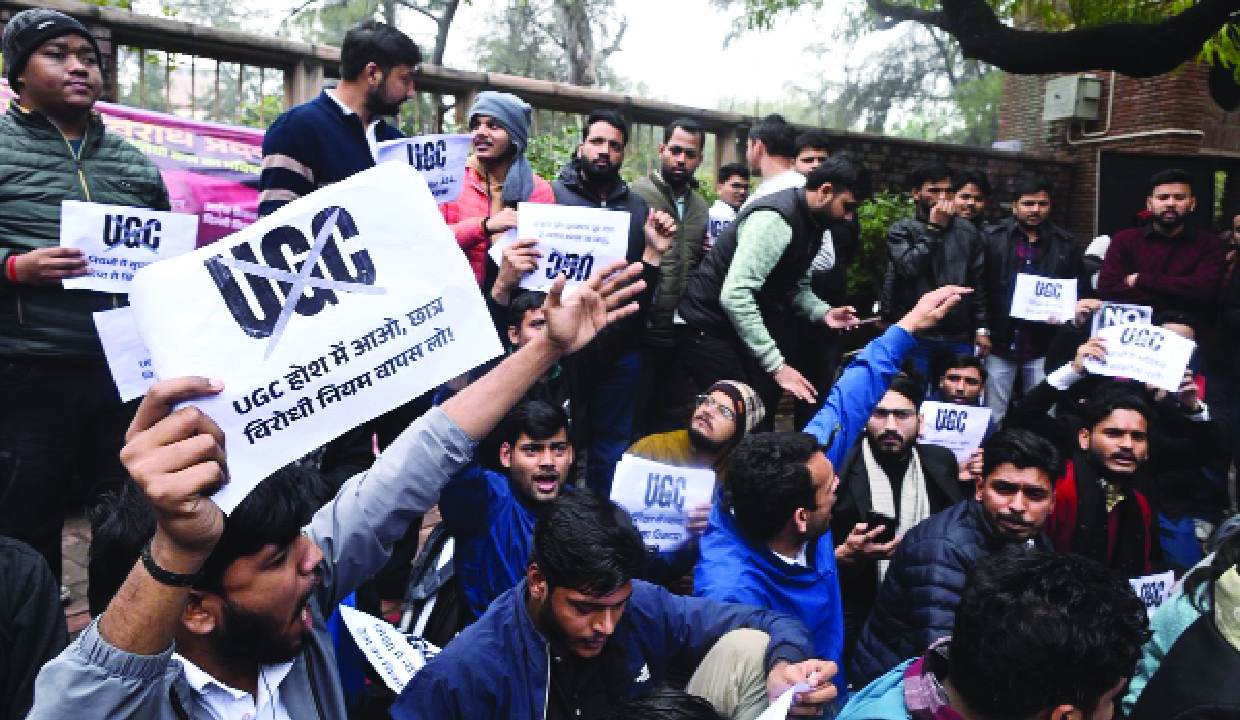
Days after clashes during a protest in support of University Grants Commission (UGC) equity rules, Delhi University (DU) has banned public meetings, processions, demonstrations and protests of any kind on campus for a month, citing concerns over obstruction of traffic, threats to safety and disturbance of public peace.
The university’s decision to shut down protests for a month is not an isolated administrative reflex but a response to a series of events that rocked mainly the North Campus over the past week.
In an order issued on February 17, DU Proctor Manoj Kumar Singh said, “This order is issued in view of information received indicating that unrestricted public gatherings, processions, or demonstrations on campus may lead to obstruction of traffic, threats to human life, and disturbance of public peace.”
It also referred to a prior direction by the assistant commissioner of police, Civil Lines, prohibiting public meetings, carrying torches or similar materials, slogan-shouting and speeches that may affect public tranquillity or traffic flow.
DU’s order cites “information received indicating that unrestricted public gatherings... may lead to obstruction of traffic, threats to human life, and disturbance of public peace.” The restriction prohibits the assembly of five or more persons, the shouting of slogans, and the carrying of hazardous materials like mashal or torches.
The activities which are banned from Tuesday include the following: Public meeting, rally, dharna, protest or agitation, Assembly of five or more persons, carrying of mashaals, beacons, torches or other “hazardous materials”, Doing anything that affects the general tranquillity of the public or the smooth flow of traffic, such as slogans and speeches. “The ban takes immediate effect and will remain in force for one month unless withdrawn earlier,” the order further stated.
Manoj Kumar, proctor, DU, in a statement, said that in the past, organisers often failed to control such protests, which escalated and spread widely, resulting in deterioration of law and order within the university campus. When the premier university issued an order banning all public meetings, processions, and demonstrations on the campus for a period of one month, it did not expressly mention the nub of the issue — the UGC’s rules against caste discrimination — but it underlined that recent protests had turned violent.
The university in the national capital finds itself at the epicentre of a storm over the University Grants Commission’s (UGC) anti-casteism regulations, which have been stayed for now by the Supreme Court.
The ban follows a protest on February 13 and 14 near the Arts Faculty and outside the Maurice Nagar Police Station in north Delhi over the proposed University Grants Commission (UGC) Equity Regulations 2026, which are aimed at addressing caste-based discrimination on campuses but have sparked sharp differences among student bodies.
What began as a demonstration in support of the regulations escalated into violent clashes between rival student groups, with reports of pushing, shouting, and scuffles outside the Arts Faculty gate. Videos of the confrontation circulated on social media, prompting police intervention. Police later registered cross-FIRs after complaints from both sides.
A YouTuber identifying herself as a Brahmin journalist alleged that she was assaulted and subjected to “rape threats by a mob of nearly 500 people”.
Videos shared by AISA members and others showed she made casteist remarks and shoved a woman to the ground too.
Student, teacher groups demand rollback of DU’s order
New Delhi: After Delhi University on Tuesday barred public meetings, processions and protests on campus for a month, several student and teachers’ groups demanded that the order be withdrawn, calling it unconstitutional and
anti-student. Students’ and teachers’ bodies said that the order stands in violation of constitutional rights and acts of violence against teachers, students and non-teaching staff by organised groups are being used by the university administration to impose collective punishment on the entire democratic movement.
The Delhi Teachers’ Front (DTF) said the prohibitory order “is a draconian measure designed not to maintain peace, but to stifle legitimate democratic expression,” and argued that it contravenes Article 19 (Freedom of Speech and Expression) of the Constitution.
The National Students’ Union of India (NSUI) termed the move authoritarian in a statement. Its national president Varun Choudhary said the decision was a “calculated attempt by the Government to crush the democratic spirit of campuses and silence SC, ST, and OBC students who are raising their voices for social justice and equitable implementation of UGC regulations.”