Decoding the politics of protests

Democracy gives citizens the right to protest. It does not confer the right to disrupt the nation’s institutional platforms. That distinction is not technical; it is civilisational. A republic survives not merely because dissent is permitted, but because institutions function with authority, continuity and public trust. When that order is deliberately breached, the issue is no longer only about grievance; it becomes a question of national responsibility. The shirtless protest staged by members of the Indian Youth Congress inside Bharat Mandapam during the recent AI summit in New Delhi was not an ordinary expression of dissent in a public square. It was a calculated disruption inside a secured international event designed to project India’s technological ambition before global delegates, investors and policymakers. The venue was chosen for impact. The optics were chosen for virality. The disruption was chosen for maximum visibility.
That choice demands scrutiny. India’s Constitution guarantees freedom of speech and peaceful assembly. These guarantees form the backbone of democratic life. The Opposition is fully entitled to question the government’s AI strategy, trade posture, economic direction or employment record. Dissent is not anti-national; it is intrinsic to democratic accountability. Yet constitutional freedoms operate within a framework of reasonable restraint. When the security perimeters of an international summit are breached and proceedings are interrupted from within, the character of protest changes. The debate shifts from policy substance to procedural violation. It ceases to be merely expressive and becomes obstructive.
A democracy must protect protest. It must also protect order. These principles are complementary. Without order, rights cannot be exercised meaningfully. Without rights, order degenerates into control. The strength of a republic lies in balancing both.
When India hosts a global summit on artificial intelligence, it is not organising a routine conference. It is signalling strategic intent. Artificial intelligence will shape industrial competitiveness, national security, governance models and economic power in the coming decades. Hosting such a summit asserts that India seeks to help shape technological norms, not merely adapt to them. Bharat Mandapam, in that moment, was more than architecture. It was a national stage. It reflected confidence in India’s capacity, ambition and stability. To stage a shirtless protest inside the arena converted that moment into spectacle. The imagery ensured headlines. Yet the clarity of argument was far less visible. If the objective was to highlight youth unemployment, technological displacement or inequality, those concerns required detailed articulation, structured alternatives and sustained engagement. A dramatic gesture cannot substitute for policy seriousness.
There is a decisive difference between protesting outside a venue and breaching proceedings within. Outside, dissent confronts power while respecting institutional space. Inside, it risks undermining the very platforms that represent the nation before the world.
Across established democracies, high-level summits attract protesters. In the United States and Europe, climate meetings, economic forums and global conventions draw vocal opposition. Authorities designate protest zones, negotiate boundaries and maintain firm security. Demonstrations occur — sometimes intensely — but secured proceedings continue.
The principle is clear: visibility without paralysis. Authoritarian systems respond differently. In 1989, at Tiananmen Square in Beijing, dissent was met with tanks. Debate was extinguished by force. That is how insecure regimes react.
India is not that system. The AI summit protest occurred. It was reported, debated and legally processed. That itself reflects democratic openness. But openness must not be confused with permissiveness. A state that cannot secure its international platforms signals fragility, not freedom. Order is not the enemy of liberty; it is its guardian.
Artificial intelligence raises profound national questions. Will automation displace workers faster than reskilling mechanisms can respond? How will India protect data sovereignty in a world dominated by global platforms? What regulatory architecture will ensure algorithmic accountability? How can technological growth remain inclusive rather than exclusionary? These questions deserve rigorous parliamentary debate, expert consultation and alternative policy frameworks. They demand persistence and intellectual seriousness. Democratic influence is built through argument, documentation and sustained mobilisation — not through fleeting spectacle. When protest becomes performative, it risks diminishing the gravity of the issue it claims to elevate. A viral moment may dominate one news cycle; it rarely shapes legislation or regulatory design.
India today stands at a pivotal moment. It seeks to position itself as a technological power and a responsible global actor. Investors assess stability. Diplomatic partners assess institutional coherence. Global perception carries economic and strategic consequences.
Disruption inside the arena of a global summit shifts attention from substance to theatrics. It hands critics an easy narrative. It distracts from national ambition. Political actors must ask whether such conduct strengthens India’s voice in the world or dilutes it. Democratic politics does not exist in isolation from national interest. In a competitive global environment, internal conduct influences external credibility.
There are moments in history when dramatic protest becomes morally imperative — when institutions close and avenues of accountability disappear. In such contexts, extraordinary tactics gain legitimacy because the system has failed. That is not India’s present reality. Parliament functions. Courts intervene. Media debates flourish. Opposition leaders campaign freely. Elections remain fiercely contested.
In such an environment, political capital is earned through persuasion, not provocation. Disruption of secured national platforms is neither necessary nor constructive. It confuses noise with influence and visibility with credibility.
A rising nation requires maturity from both government and Opposition. The government must act firmly yet proportionately. Overreach weakens democratic authority; indifference weakens institutional strength.
The Opposition must calibrate tactics to context. Passion is understandable. Accountability is essential. But seriousness is indispensable. Democracy is not measured by how dramatically proceedings are interrupted. It is measured by how effectively public opinion is shaped and policy is influenced.
The AI summit protest will pass. What must remain is a principled standard: protest is legitimate; breach of secured national platforms is not. India’s democratic space is expansive. Its global aspirations are rightful. Protecting both requires discipline as much as freedom, restraint as much as resolve.
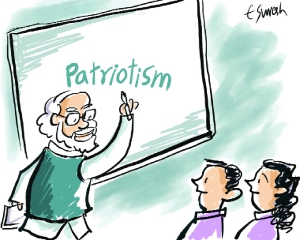
Patriotism and protest are not adversaries. But when protest diminishes national platforms without elevating democratic reasoning, it ceases to serve the republic.
A confident nation does not silence dissent. It expects dissent to rise to the level of the nation itself. India deserves politics that matches its stature — firm in conviction, responsible in conduct, and conscious that national dignity is not a partisan asset but a shared inheritance.
The writer is a Retired IAS officer; views are personal