Clever rabbit and the lion - Panchatantra Book 1, Mitra bheda
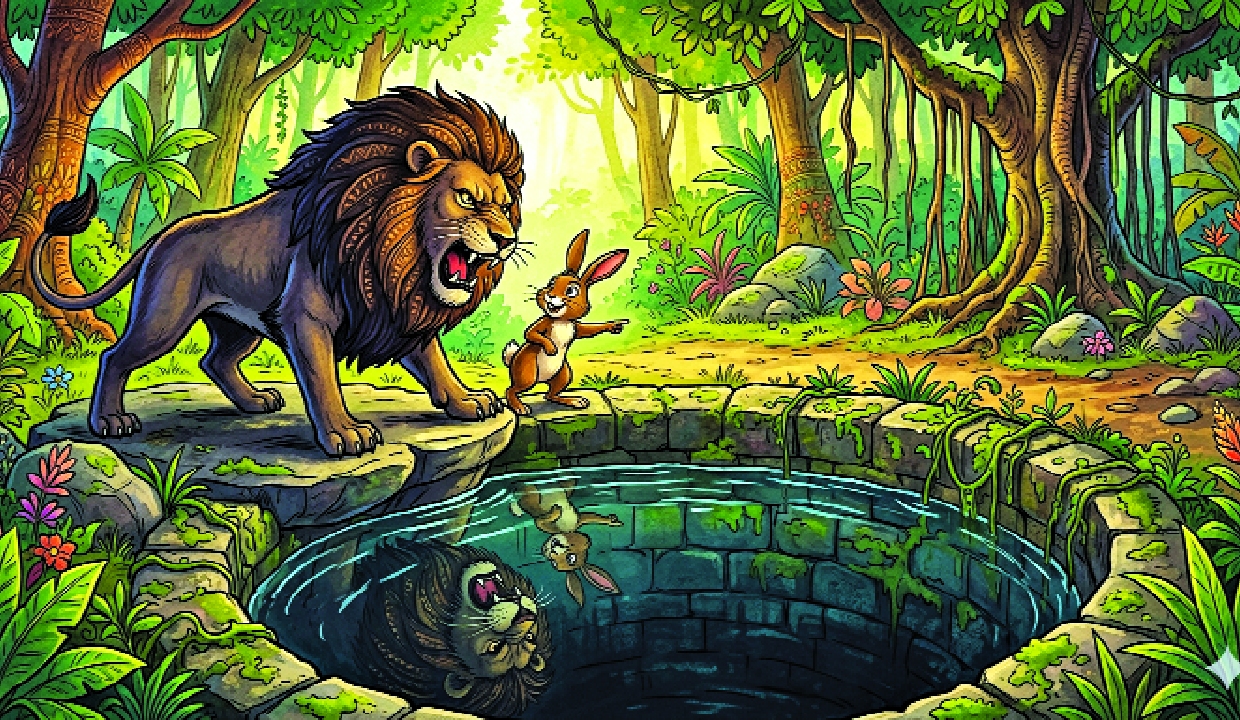
In a dense forest lived a lion named Bhasuraka. He was a tyrant who killed animals indiscriminately, even when not hungry. To prevent their complete extinction, the forest animals made a plan that they would send one animal to his den every day if he promised to stop his mass slaughter. The lion agreed to the proposition.
One day, it was the turn of an old, wise rabbit. Though small, he possessed a sharp intellect. He deliberately lingered along the way, arriving at the lion’s den long after the sun had peaked. Bhasuraka was famished and roared in a murderous rage, “Why are you late, you miserable creature? And why are you so small?”
The rabbit bowed low and said, “Lord, it is not my fault. Five other rabbits were sent with me, but we were stopped by another lion who claims to be the true king of this forest. He ate the others, but I escaped to warn you.”
Bhasuraka’s ego flared. He demanded to be shown this rival immediately. The rabbit led him to a deep, clear well. “He is hiding in his fortress there,” the rabbit whispered.
Bhasuraka peered over the edge. Seeing his own reflection in the still water, he mistook it for the rival king. When he roared, the well echoed back an even louder challenge. Blinded by fury, the lion leapt into the deep water to attack. Unable to climb the smooth stone walls, he drowned. The rabbit returned to the other animals, proving that wit is far more powerful than brute strength.
Moral of the Fable
Intellect is power. A small mind with a plan can defeat a giant akin to Kautilya’s principle relating to strategy over strength. The story demonstrates how a smaller, physically weaker state can neutralise a superior aggressor through intelligence and psychological manipulation.