Swarm river like a school of fish
Hunt for new sources of ‘green’ energy are on; here is one in Germany
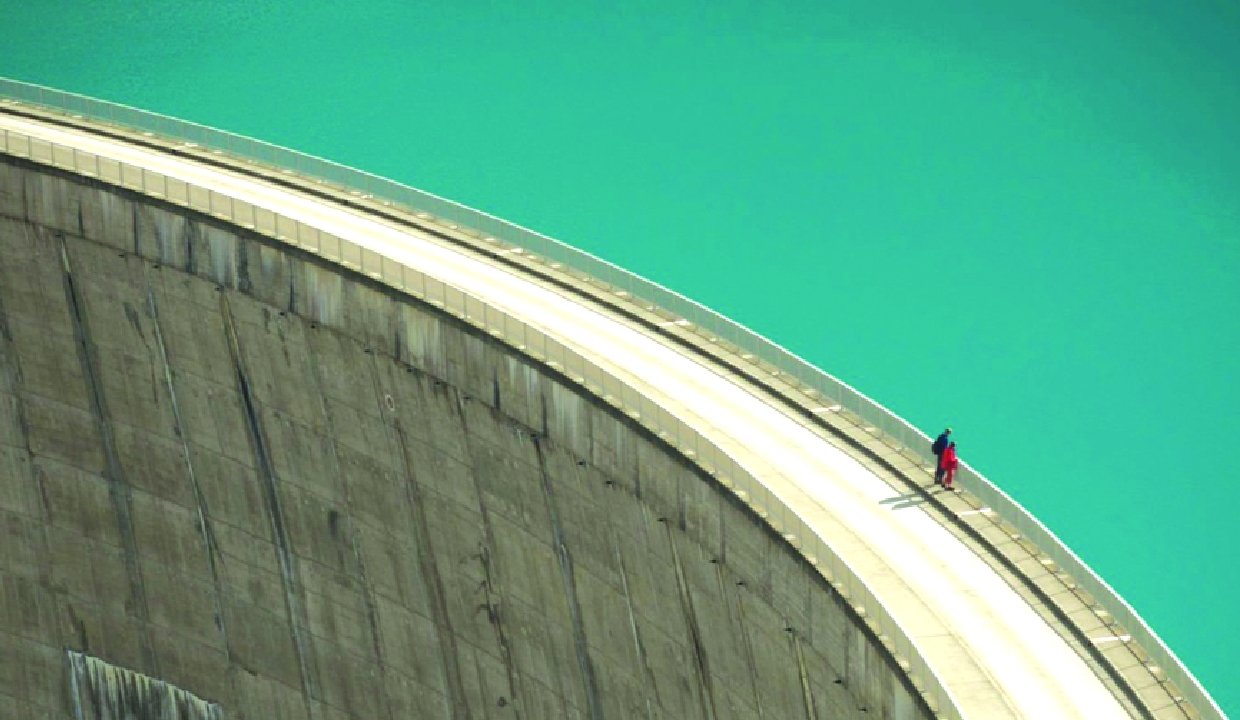
Forget a giant dam, as you see in the visual, which comes with exaggerated positives about power generation and irrigation, and equally inflated traps about climate, sustainability, and livelihoods. In Germany, they contend that the answer is not blowing in the winds, surfing the sky, but still rolling in the waters. Unlike a dam, which implies a “big wall across the river,” and a “large reservoir,” which drowns settlements and landscape, the solution lies in a “swarm power plant.” The latter is not a gigantic structure but a large group of small water turbines that work in unison, something like a school of fish which, despite several fish, moves as a singular entity.
A new project in Germany’s Middle Rhine, with its 124 units or turbines, may be the world’s first approved swarm plant. Officials say that the project will be built in phases, and each one will be monitored and tested to figure out the efficiency and efficacy. At the end of the day, literally, as work happens at night, when everything seems still, the “goal is to add up lots of modest outputs (from each turbine) into something meaningful for the local grid.” These so-called ‘invisible turbines’ continue to silently operate even after sunset, unlike solar, and when the wind dies down, unlike wind turbines.
According to a media report, “Each unit is called an EnergyFish, and it is closer in size to a small car than a traditional power station.” Each turbine measures approximately nine feet by eight feet by under-five feet, and weighs 175 pounds, with a maximum output of six kw, and an average output of 1.8 kw. According to the developer, “In the event of high water or ice formation, EnergyFish adapts to the situation by automatically sinking to the riverbed for safety while continuing to generate power.” This is required because the rivers are ‘impolite,’ or rather misbehave, both seasonally, and within seasons.
Of course, the experiment or the small car-like turbines cannot work in every river, or every nation. In the case of Rhine, for example, the river currents reach 3.4-5 miles an hour, “which is fast enough to keep the (turbine) rotors moving.” Local geography matters. “Narrow valleys can squeeze large volumes of water through tighter channels, making currents more consistent than you might see on a wide, slow river,” states a media report. In addition, there are the real-world limits, which work on a large scale in the case of dams, and which have nothing to do with physics or science. A site lives with habitats and logistics.
However, one wonders the science or belief behind 124 turbines. According to reports, this number is not important, and what is relevant is the energy over time, “since steady output is the whole point of using a river current.” German officials contend that 100 units can produce 1.5 GW-hours per day, which is 1.5 million kw-hours. In effect, this can supply power to 400-500 four-person households in a modern economy like Germany. One assumes that this implies that the electricity will be enough to run and manage modern gadgets, which are typically found in the urban households in developed economies.
Obviously, the taste of the pudding is in the eating, and the efficiency of electricity is in the making of the pudding. For one, the costs of the power generated by the smaller water turbines will be the same as the one via wind and solar, which means it will be expensive but only as expensive as the other alternatives to fossil fuels. But the main attraction is the Climate Change impact. The carbon footprint of the project may be more than 500 tons of avoidable carbon dioxide. So, in terms of environment, it is safer and better, hopefully.
However, the real test will be in the long-term operations. Most of such experimental projects either perform admirably in controlled pilot projects, or in the short run. For these small turbines to generate power, day in and day out, for years, as the river changes its currents, courses, and other features, will hold the key.
In addition, the quantum of power, especially on a regular basis, will matter because this will determine the electricity the project displaces on the local grid. If the project succeeds on both ends, it may herald a new era in hydro-power.
In the recent past, innovative experiments in ‘green’ energy are on the increase. In a recent scientific publication, there were a few notable mentions. One of them included floating solar farms, which avoid the expensive land, and use the surfaces of lakes, reservoirs, even oceans. “Countries like China, Japan, and Singapore are leading the way with massive floating solar arrays, proving that renewable energy can expand into unexpected spaces while also supporting water conservation,” states a report. In India, for example, policy-makers have used drain covers, roof tops, and empty spaces next to railway tracks for panels.
Imagine a wind turbine that does not revolve around the horizontal axis, as you see along the coastlines, but around the vertical one. New designs now explore vertical-axis models that are “smaller, quieter, and more versatile. These turbines can be installed in urban areas where space is limited, and wind directions change frequently. Some companies are even developing micro wind turbines that can be attached to buildings, turning city skylines into energy producers without the need of sprawling wind farms.” Imagine wind turbines on rooftops in cities, as opposed to telecom towers!
Take this thought further, and think of giant home windows, which double up as solar panels. Today, solar window technology “embeds transparent photovoltaic materials into glass.” The concept will be a huge hit in Mumbai, where space matters, and most windows are slidable ones. It will be a bigger hit in Delhi, Bangalore, and Chennai, which have large sprawling bungalows, and equally-big apartments. Solar windows “allow light to pass through while also converting part of it into electricity.” It can transform “cities into massive energy-harvesting ecosystems, reducing dependence on fossil fuels.”
Now, let us go another step further. Let us talk about the building materials for homes. An innovative solution to store solar energy, which is a huge challenge, is to use energy-storing concrete, which involves the mixing of “concrete with carbon nanomaterials… that can act as giant batteries.”
This may “allow homes, bridges, and even entire city blocks to store excess renewable energy during peak times, and release it when needed, turning infrastructure into part of the energy grid.”