Can non-devotees challenge customs: SC to Centre
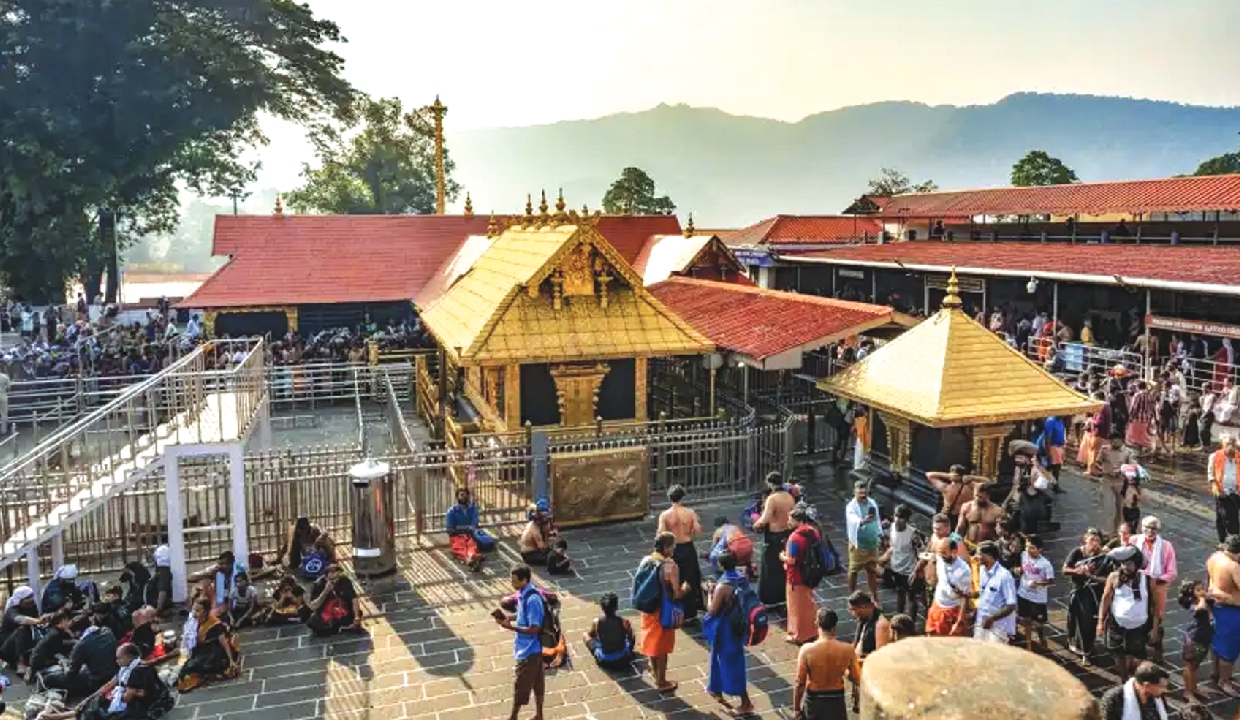
The Supreme Court on Wednesday asked the Centre how persons who are not devotees of Lord Ayyappa could challenge the customs of the Sabarimala temple in Kerala.
The remark was made by a nine-judge Constitution bench hearing petitions related to discrimination against women at religious places, including the Sabarimala temple in Kerala, and on the ambit and scope of religious freedom practised by multiple faiths.
The bench comprises Chief Justice of India Surya Kant, Justices BV Nagarathna, MM Sundresh, Ahsanuddin Amanullah, Aravind Kumar, Augustine George Masih, Prasanna B Varale, R Mahadevan and Joymalya Bagchi.
The top court has framed seven questions on the scope of religious freedom. One of the questions was whether a person not belonging to a religious denomination or religious group can question a practice of that “religious denomination or religious group” by filing a public interest litigation (PIL).
As the bench was about to rise for the day, Justice Nagarathna sought to know from Solicitor General Tushar Mehta as to who were the petitioners in the Sabarimala case.
“What follows from what you have just submitted is that the original petitioners are not devotees. No devotee has approached this court challenging this. Then, who are the writ petitioners who are assailing this?” she asked.
Mehta replied that the original petitioner is a lawyers’ body called the Indian Young Lawyers Association.
Justice Nagarathna said, “They are not devotees. But let us be clear. Can any devotee of Lord Ayyappa file a writ petition challenging this? If a non-devotee, a person who is not concerned with that temple, challenges it, can this court entertain such a writ petition?
“We have all been trained. We have all practised in trial courts. If a suit is filed by an association, the first question would be under Order VII Rule 11(a) of the Code of Civil Procedure. No cause of action, no causal connection, the plaint would be rejected.” The CJI said he has often used the term invisible victims of the judicial system for such petitioners.
Mehta termed it as a fight between the silent majority and the vocal minority.
“Your Lordships rarely sit in a Bench of nine. PIL jurisdiction was initiated in Bandhua Mukti Morcha v Union of India at a time when people had no means to approach the court. I have pointed out in my written submissions that today the judicial system has become far more transparent. By e-filing, even a letter can reach the court.
“Now, nobody needs representation through another for an unrepresented class. If someone has no means, they can approach the District Legal Services Authority and say: my fundamental rights are violated, advise me, or file a petition on my behalf before the Supreme Court or the High Court.
“Then why, my Lords, should such PILs be entertained? And we know that many PILs today are motivated PILs. Somebody else is behind them,” Mehta said.
The CJI said courts themselves have been very careful in entertaining PILs.
“We have laid down parameters to test them. Every day, we examine the real cause. There are several factors we now apply while testing a PIL. If you sit in Court No. 1, you would have seen how many PILs we actually entertain. Notices are issued only when there is substance.
“Perhaps from 2006 to now 2026, over these two decades, the situation has evolved, and the court has become more cautious. The point is this: on a general principle of PIL, we may not even need to hear you. We agree with you that the court has to be very cautious in entertaining PILs today, particularly when people come with different kinds of agendas,” the CJI said.
In September 2018, a five-judge Constitution bench, by a 4:1 majority verdict, had lifted the ban that prevented women between the ages of 10 and 50 from entering the Sabarimala Ayyappa temple in Kerala, and held that the centuries-old Hindu religious practice was illegal and unconstitutional.
Later, on November 14, 2019, another five-judge bench headed by the then CJI Ranjan Gogoi, by a majority of 3:2, referred the issue of discrimination against women at various places of worship to a larger bench.
The bench had then framed broad issues on freedom across religions, saying they cannot be decided without any facts of the particular case.