India, US signal reset in strained ties
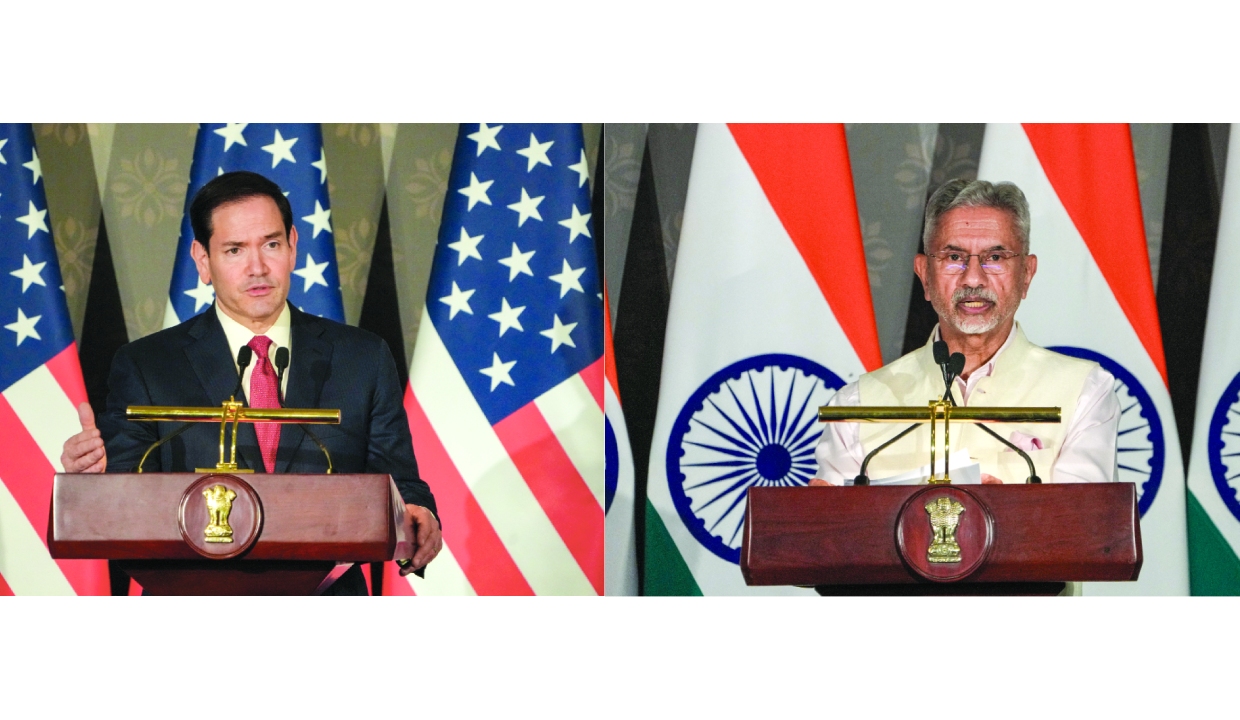
Jaishankar and Rubio address trade, energy and West Asia concerns
India and the US on Sunday sought to signal a reset in their strained ties as External Affairs Minister S Jaishankar and his American counterpart Marco Rubio held frank discussions on thorny issues such as trade, visas, energy security, cross-border terrorism and the implications of the West Asia conflict.
Rubio, who is on a four-day visit to the country, described New Delhi as a major power and dismissed observations that the US-India relationship has lost its two-decade momentum, firmly asserting that the engagement will grow much stronger by the end of the current administration’s tenure.
Simultaneously, both countries are also poised to soon firm up the much-awaited trade agreement that will be both “beneficial” and “sustainable” and will advance the mutual interests of both nations. Rubio asserted that the overall bilateral ties are set to witness an upward trajectory.
Rubio also met National Security Advisor (NSA) Ajit Doval. “The discussions focused on defence, security and strategic technology-related cooperation, including the TRUST initiative,” External Affairs Ministry spokesperson Randhir Jaiswal said.
“The two NSAs reiterated the high priority accorded to the bilateral Comprehensive Global Strategic Partnership. They also exchanged views on regional and global issues,” he said. Rubio also holds the post of National Security Advisor in the Trump administration.
In a statement of India’s foreign policy priorities, Jaishankar outlined a strategic five-point blueprint for global stability, asserting that India advocates dialogue and diplomacy to address conflicts, supports unimpeded maritime commerce, demands respect for international law and is against “weaponisation” of market shares and resources.
In their first comprehensive dialogue after the India-US ties witnessed a major downturn, the two sides primarily focused on vigorously bolstering cooperation in areas of defence, critical minerals, high technology and economic engagement.
“The US-India relationship has not lost any momentum. I understand why some people might say that. I don’t understand, but I understand some people say that. This is not about India. This is about the United States in terms of trade,” Rubio said.
Rubio called India an important strategic partner of the US and stressed that both sides are aligned on a range of key issues. The relations between the two countries witnessed a major downturn after Washington imposed punitive tariffs on India and President Donald Trump made controversial assertions regarding his role in de-escalating the India-Pakistan military clashes last May.
“Let me State India’s broad position... And I would make five points here. One, that we advocate dialogue and diplomacy to address conflicts. Two, we support safe and unimpeded maritime commerce,” Jaishankar said.
“Three, we demand scrupulous respect for international law. Fourth, we are against the weaponisation of market shares and resources. And five, we believe in the value of trusted partnerships and resilient supply chains to de-risk the global economy,” he said.
In the talks, Jaishankar forcefully mentioned how the West Asia crisis has significantly hit India’s energy security and brought economic woes, people familiar with the matter said.
The external affairs minister also underlined the importance for India to have multiple sources of energy, emphasising that the energy market should not be “distorted”.
Jaishankar said India is one of the very few countries that have very good relations with the United States, Israel, Iran and the Gulf countries. The external affairs minister said India is very much in favour of safe and unimpeded maritime commerce in the Strait of Hormuz.
Citing a fragile geopolitical situation, Jaishankar said India has very strong relations with the US, Russia, Europe, Ukraine and countries around the world. The external affairs minister also flagged India’s concerns with Rubio over the Trump administration’s changes to visa and immigration policies, saying legal mobility should not be adversely impacted by the new approach.
The US Secretary of State acknowledged that there could be “some bumps” and “friction points” in the period of transition as the US is trying to improve the immigration system, but ultimately, an “efficient” framework will be helpful to every stakeholder. The Secretary of State assured that the current process to reform the immigration system is not targeted at India at all.
Answering a question on economic ties, Rubio said India and the US are poised to soon firm up the much-awaited trade agreement that will be both “beneficial” and “sustainable” and would advance the mutual interests of both nations.
To a question on Washington’s increasingly warm ties with Pakistan and China, Rubio said: “As far as our relations with other countries are concerned, we have relations, and we work at the tactical level in many ways with countries all over the world, so does India, like every other responsible nation.”
The US-India relationship has not lost any momentum. This is not about India. This is about the United States in terms of trade - Marco Rubio, US counterpart
We believe in the value of trusted partnerships, DIALOGUE and resilient supply chains to de-risk the global economy - S Jaishankar, EAM