Delhi’s shopping problem just became a business
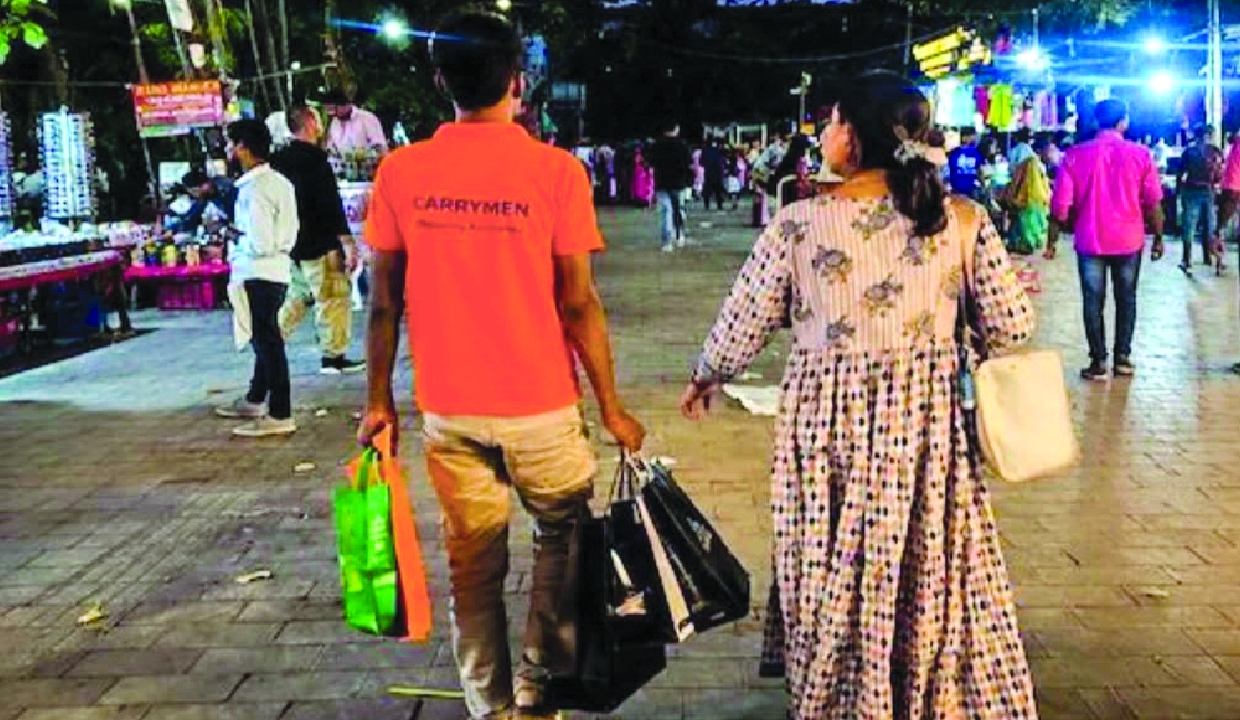
Stand in the middle of Lajpat Nagar on any Sunday afternoon and watch what happens. Women with four bags on each arm, threading through the crowd. Elderly shoppers stop every few minutes because there is nowhere to sit. Husbands standing outside trial rooms with the expression of men counting ceiling tiles. Toddlers require management precisely when no hand is free. This is not a shopping market. It is an endurance test. And a Delhi startup just decided to sell the solution.
CarryMen, which began operations in Lajpat Nagar in April, offers shoppers a trained assistant who accompanies them through the market, carries their bags, holds their spot in queues, helps them navigate stores, and walks them to the parking area or metro gate when they are done. The service costs Rs 149 per hour, with packages available for 2, 3, or 4 hours. Within its first month, the startup had completed over 50 bookings. It has not been spent on influencer campaigns. The bookings have come through word of mouth.
This correspondent visited Lajpat Nagar on the weekend, when the market was moving at a moderate pace, and the logic of the service was immediately visible. By 11 am, the lanes near the fabric shops were filling up. By noon, the narrow corridors between stalls were the kind of tight that makes bag-carrying a contact sport.
Priya Sharma, 67, was shopping for curtain fabric with her daughter when she stopped to rest against a pillar. “I love coming here, but my knees do not anymore,” she said. “If someone could carry the bags and find me a place to sit when I need it, I would come every week.” She had not heard of CarryMen yet. When told about it, she asked for the number immediately.
That is the precise customer the startup appears to have built itself around. According to the founders, the majority of bookings so far have come from elderly shoppers, particularly women shopping for clothes, curtains, and household items. Many are not looking for luxury. They are looking for small, practical relief: a bag carried, a queue joined, a chair produced when the legs give out.
The chair detail is one of the more striking features of the service. Assistants carry portable foldable camping chairs that can be set up anywhere in the market when a customer needs to rest. Alongside this, the package includes umbrellas for heat and rain, mobile charging support, power banks, and hydration assistance. “People love shopping, but they hate the physical exhaustion that comes with it,” a person associated with a startup said. “We wanted shoppers to enjoy the experience instead of worrying about ten bags while navigating a crowded market.”
The service has also found a specific use among customers who face particular physical challenges in a market environment. Pregnant women have booked the service to manage the difficulty of carrying weight while moving through crowds. Parents with toddlers have used it when managing both a stroller and shopping became unmanageable. The startup offers stroller rentals alongside the assistant service at an additional hourly charge.
The assistant carries a maximum of 12 kg. Beyond that, a second assistant can be hired.
For now, operations are limited to Lajpat Nagar. Expansion to Chandni Chowk is already in planning. The logic of extending to Chandni Chowk, one of Delhi’s oldest and most labyrinthine markets, is straightforward: if Lajpat Nagar is physically demanding, Chandni Chowk is another category entirely.
The social media response to CarryMen has been significant, split between those who see it as a practical urban solution and those who have raised questions about privilege and the ethics of paid physical labour in a market context. The debate has, if anything, accelerated the startup’s visibility.
What is harder to argue with is the gap it is filling. Delhi’s famous markets have not changed in any fundamental way. The bags are still heavy. The crowds are still dense. The heat in May is still brutal. Someone eventually had to notice that the exhaustion at the end of a shopping trip was itself a problem worth solving. They are charging Rs 149 an hour for the answer.