At 2.9 degrees Celsius, city records its coldest morning so far
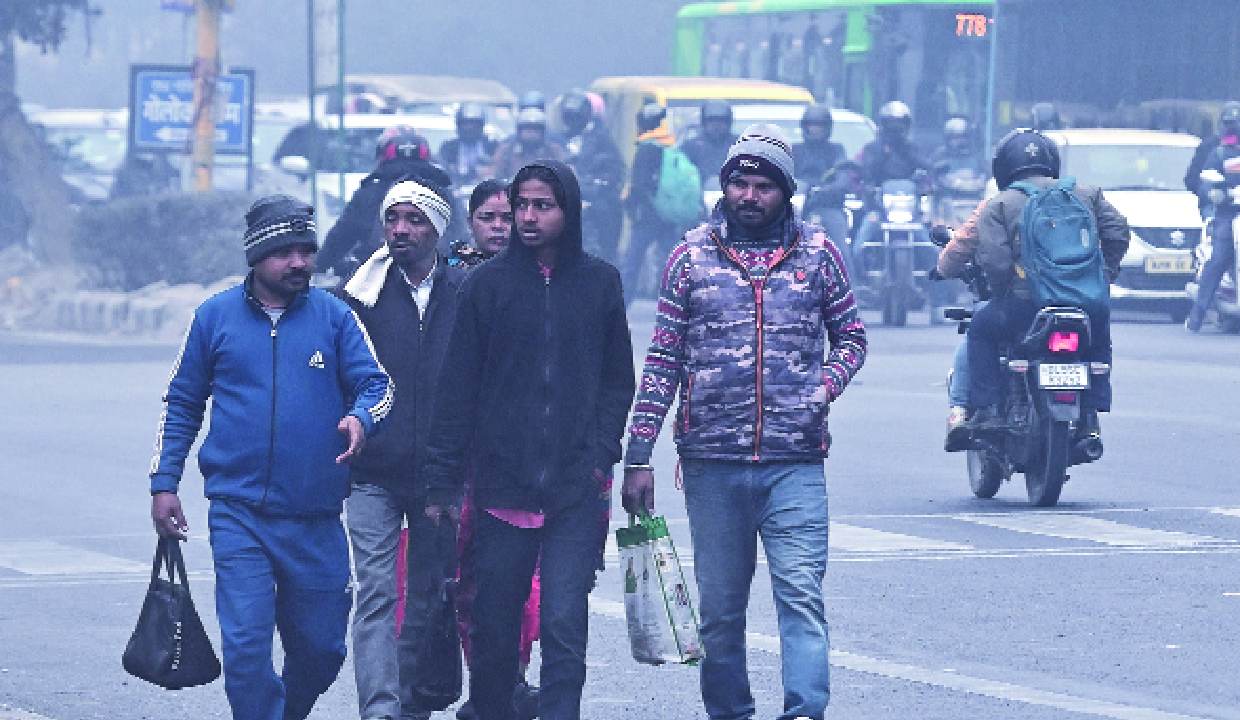
Delhi woke up to its coldest morning of the season on Thursday as a persistent cold wave continued to sweep across the capital for the fifth consecutive day.
The minimum temperature in the Capital plunged to 2.9 degrees Celsius, nearly five degrees below the seasonal average. This marked the coldest morning of the winter so far and the lowest January minimum recorded at the station since 2023, when the mercury had dipped to 1.4 degrees Celsius on January 16. The maximum temperature settled at 19.5 degrees Celsius, slightly below normal. The India Meteorological Department (IMD) said the cold conditions are likely to persist at least till Friday, with only marginal relief expected thereafter.
For residents, the biting cold has disrupted daily routines. “It feels colder than the numbers suggest,” said Manoj, a security guard in central Delhi. “Even during the day, the sun is weak. Early morning duty has become very difficult.” Meena Devi, a domestic worker in East Delhi, said she had added extra layers for her children. “They don’t want to get out of bed. The floor feels like ice,” she said.
Daytime temperatures remained suppressed across the city. Palam recorded a maximum of 16.2 degrees Celsius, around 3.5 degrees below average, while Lodhi Road logged 19.4 degrees Celsius. The Ridge recorded 19.0 degrees Celsius, and Ayanagar 19.4 degrees Celsius, IMD data showed.
Minimum temperatures stayed sharply below normal at all monitoring stations, underlining the intensity of the cold wave. Palam recorded a low of 2.3 degrees Celsius, its lowest January minimum since 2010. Lodhi Road reported 3.4 degrees Celsius, the Ridge 4.5 degrees Celsius and Ayanagar 2.7 degrees Celsius. “The cold wave conditions have prevailed over Delhi for the past four days and are likely to continue on Friday as well,” an IMD official said.
A yellow alert remains in force for the city. The department forecast a maximum temperature of around 21 degrees Celsius on Friday, with the minimum hovering near 4 degrees Celsius.
Adding to the discomfort, Delhi’s air quality remained a major concern. The city recorded a 24-hour average Air Quality Index (AQI) of 349, placing it firmly in the ‘very poor’ category, according to Central Pollution Control Board (CPCB) data. The average AQI across monitoring stations stood at 343.
As per CPCB’s SAMEER app, 34 stations reported ‘very poor’ air quality, while five stations were in the ‘poor’ category. Pusa recorded the worst air quality at an AQI of 386. An AQI between 301 and 400 is classified as ‘very poor’ and can cause respiratory illness on prolonged exposure.
Data from the Delhi Decision Support System showed that pollution sources within the city were led by transport emissions at 13.9 per cent, followed by industries in Delhi and surrounding areas at 11.4 per cent. Residential emissions contributed 3.3 per cent, construction dust 1.7 per cent and waste burning 1.2 per cent. Among NCR districts, Jhajjar contributed the highest share at 21.7 per cent.
The Air Quality Management System warned that air quality is likely to remain in the ‘very poor’ category on January 16 and 17 and may deteriorate further to ‘severe’ on January 18. “The outlook for the next six days suggests air quality fluctuating between very poor and severe,” officials said.
Weather experts, however, indicated slight relief in the coming days. “Minimum temperatures are expected to rise gradually between January 17 and January 20, with a possibility of light winter rainfall,” said Mahesh Palawat of Skymet Weather.
He cautioned that another cold spell is likely between January 23 and 26, when temperatures could dip sharply again.