Another solid growth year as GDP hits 7.8%
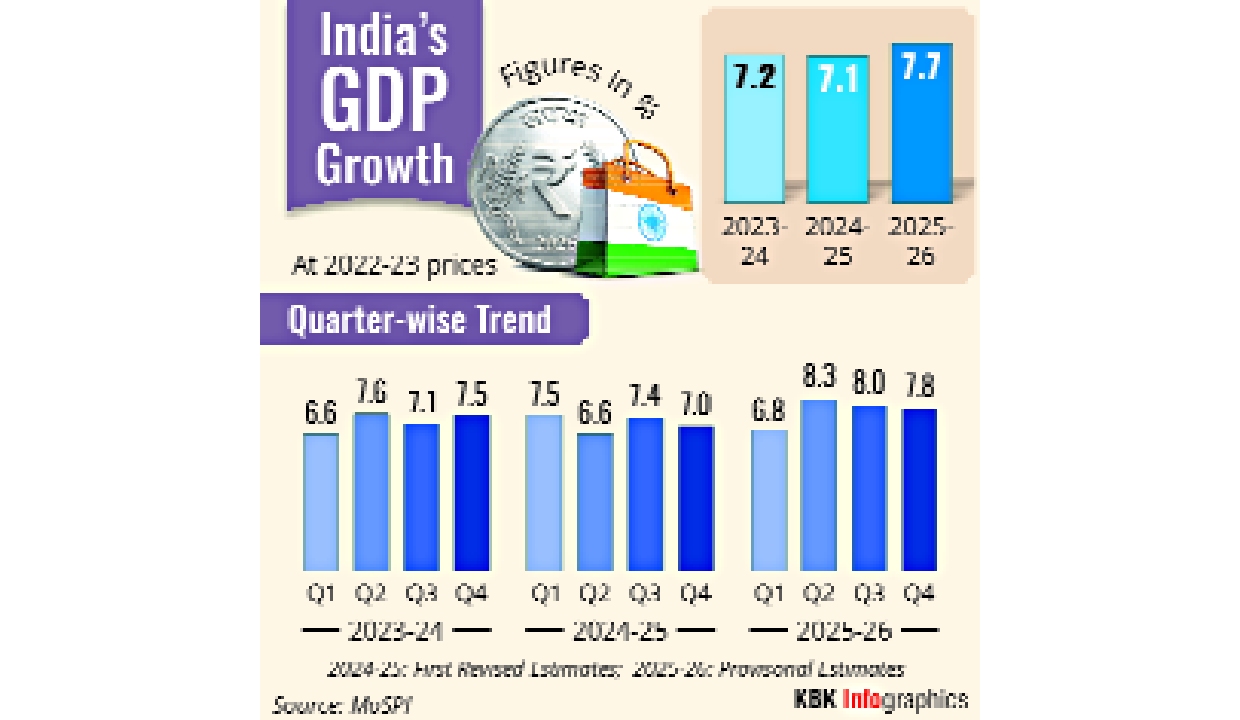
Despite witnessing the ongoing global uncertainty, geopolitical tensions and elevated energy prices, the Indian economy grew at a better-than-expected 7.8 per cent in the fourth quarter of the last financial year 2025-26. The GDP growth for the whole year stood at 7.7 per cent, marginally higher than the previous Government’s estimates of 7.6 per cent.
India’s economic growth has defied predictions, especially as experts had expected the adverse impact of the US-Iran conflict to reflect in the headline number. The January-March period accounted for just one month of disruptions caused by the war in Iran. The spike in oil prices and the disruption in supplies from the Middle East — a key source for India’s crude oil, natural gas and LPG — will be fully visible in the current April-June quarter.
Quarterly sector-wise data showed particularly strong growth in trade, hotels, transport, communication, broadcasting and storage-related services, which expanded 12.5 per cent year-on-year. Financial, real estate and professional services followed with a growth of 10.4%. Manufacturing registered an increase of 7.3%, while the construction sector grew by 8.4% during the quarter.
Notably, manufacturing, trade, repair, hotels, transport, communication & services related to broadcasting, storage and financial, real estate & professional services sectors have attained double-digit growth at both constant and current prices in FY26. Hailing the robust economic growth in the country, the government is hopeful that the Centre’s macro stability and supply measures can bring back India on a 7 per cent growth trajectory in the next fiscal year, also.
In a statement, the Ministry of Statistics and Programme Implementation (MoSPI) said that real GDP or GDP at Constant Prices is estimated to attain a level of Rs 323.12 lakh crore in the FY 2025-26, against the First Revised Estimate (FRE) of GDP for the year 2024-25 of Rs 299.89 lakh crore. The growth rate in Real GDP during 2025-26 is estimated at 7.7% as compared to 7.1 % in 2024-25. Nominal GDP or GDP at Current Prices is estimated to attain a level of Rs 346.36 lakh crore in the year 2025-26, against Rs 318.07 lakh crore in 2024-25, showing a growth rate of 8.9%. “Real GVA is estimated at Rs 294.91 lakh crore in the year 2025-26, against Rs 273.36 lakh crore in FY 2024-25, registering a growth rate of 7.9% as compared to 7.3% growth rate in 2024-25. Nominal GVA is estimated to attain a level of Rs 314.87 lakh crore during FY 2025-26, against Rs 288.54 lakh crore in 2024-25, showing a growth rate of 9.1%,” it said.
This is the second set of GDP data in the new series, with 2022-23 as the base year.
The Reserve Bank of India has already cut its 2026-27 (FY27) GDP growth forecast to 6.6 per cent from 6.9 per cent, citing elevated energy and commodity prices and persistent supply-chain disruptions linked to the conflict in West Asia.
Commenting on the data, Finance Minister Nirmala Sitharaman on Friday said the government is committed to further drive the ‘Reform Express’ with decisive policy measures to ensure positive economic momentum amid global challenges. “Our government, led by Hon’ble PM Shri @narendramodi, is committed to further drive the ‘Reform Express’ with decisive policy measures to ensure positive economic momentum amidst the global challenges,” Sitharaman said in a post on X.
Addressing a press conference after the release of the data, Chief Economic Advisor V Anantha Nageswaran said the GDP data reflects a balanced picture with respect to different components of the economy.
He also said India will return to a 7 per cent growth rate in the next fiscal year on the back of policy measures.
“We have no reason to second-guess them (RBI forecast) at this point, because there are both possibilities on the upside and on the downside with respect to the numbers that they have presented,” he said here. “So, even if the growth were to slip below 7 per cent as the RBI forecast suggests... macro stability measures and supply assurances will bring us back to a 7 per cent plus growth track in FY28 or as soon as external conditions improve,” Nageswaran said.
Gross value added, which strips out the volatile components such as indirect taxes and government subsidies to present a more accurate measure of underlying economic activity, grew 7.9 per cent during the January-March quarter, the data released by MoSPI showed.
NSO further said GDP at constant prices in the January-March quarter of 2025-26 is estimated at Rs 87.77 lakh crore, against Rs 81.40 lakh crore in the year-ago period, a growth of 7.8 per cent.
NSO said secondary and tertiary sectors have boosted the performance of the economy by registering growths of 8.8 per cent and 9.3 per cent, respectively, during FY26.
These sectors include construction, manufacturing, trade, hotels, transport, communication and services related to broadcasting, storage, and ‘financial, real estate, IT, professional services and ownership of dwelling’. The primary sector registered a 3.2 per cent growth rate, mainly driven by the performance of the agriculture and fishery sectors. “Agriculture, livestock, forestry and fishing” segment grew at 3.6 per cent in the fourth quarter compared to 4.6 per cent. During 2025-26, the growth was 3.1 per cent.
On the expenditure side, both private final consumption expenditure (PFCE) and gross fixed capital formation (GFCF) registered over 7.5 per cent expansion during 2025-26. The gross value added (GVA) has been estimated at Rs 294.91 lakh crore in 2025-26, against Rs 273.36 lakh crore in 2024-25, registering a growth rate of 7.9 per cent as against 7.3 per cent in the preceding year. The GVA in the fourth quarter of FY26 was Rs 80.18 lakh crore against Rs 74.32 lakh crore in the year-ago period, registering a growth of 7.9 per cent.