Amit Shah unveils BJP’s Sonar Bangla vision for West Bengal
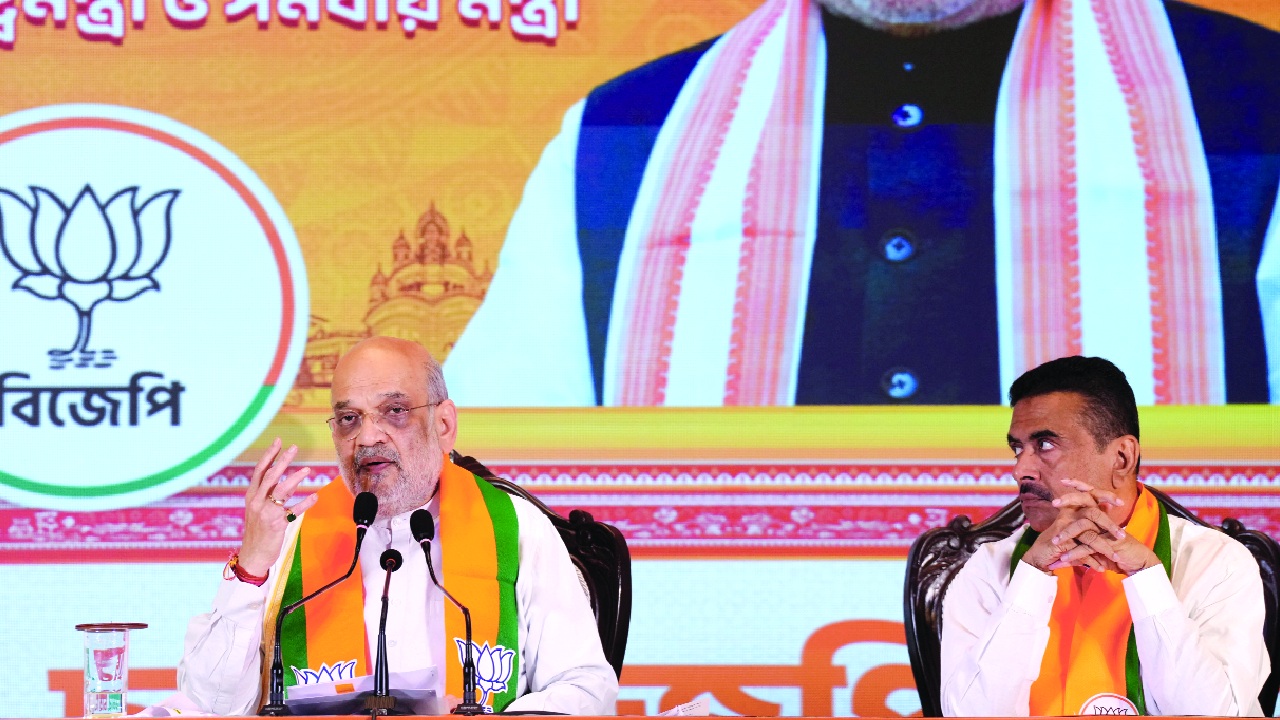
BJP on Friday unveiled its manifesto for the West Bengal Assembly polls, which promised to plug infiltration, implement Uniform Civil Code in six months if voted to power and proposed expansive welfare packages for women, youth, farmers and State Government employees if the party wins the electoral battle.
Releasing the manifesto — Sankalp Patra —, Union Home Minister Amit Shah described it as a roadmap for Sonar Bangla and launched a blistering attack on the Mamata Banerjee Government, alleging the last 15 years of the TMC’s rule had been a “nightmare” for the people of the State.
Shah announced that every woman in Bengal would receive INR 3,000 each month if the BJP came to power. He also promised 33 per cent reservation for women in all Government jobs, including the police, as well as free travel on public transport vehicles.
Last month, the TMC announced a INR 500 increase in Lakshmir Bhandar in its own manifesto, taking the monthly payout to INR 1,500 for general category women and INR 1,700 for SC and ST beneficiaries.
It promised unemployed youth a monthly allowance of INR 3,000 and an additional INR 15,000 to prepare for competitive examinations. Those who lost jobs because of the school recruitment scam and other corruption-related cases would be given an age relaxation of up to five years, the BJP promised.
The party promised to secure the State’s borders, stop cattle smuggling and clear Government land of “encroachers and infiltrators”, underscoring the BJP’s attempt to keep the campaign centred on the border belt stretching across North 24 Parganas, Nadia, Malda, Murshidabad and North Bengal. The promise is expected to resonate among sections of Matua and refugee Hindu voters — a section the BJP has assiduously cultivated for years through the Citizenship Amendment Act and repeated references to “infiltration”.
“The UCC has been implemented in several BJP-ruled states. We will implement it in Bengal within six months so that there is one law for every citizen. In Bengal, one law will be ensured for all citizens,” Shah said.
It also pledged transparent, merit-based recruitment and said deserving candidates would be given permanent jobs.
For farmers, the BJP promised to increase assistance under the PM-Kisan scheme to Rs 9,000 annually by adding Rs 3,000 from the state Government to the Centre’s existing Rs 6,000.
Shah announced that AIIMS, IIT, IIM and an institute of fashion designing would be set up in different districts of North Bengal, while a new cancer hospital with modern facilities would also come up in the region.
Four new townships would be developed across the state after suitable locations are identified, while special deep-sea ports would be built at Tajpur and Kulpi, and a separate development plan drawn up for the Haldia port, the manifesto promised. The BJP also promised a 10-year action plan for Kolkata, which Shah said would be projected globally as a “living city”.
Darjeeling would be developed as a heritage tourism destination, while the hill areas would be developed “keeping Bengal united”, a formulation apparently aimed at balancing the BJP’s support base in the hills with anxieties in the plains over any suggestion of division.
Alongside development came a heavy cultural layer. The BJP said it would develop a Chaitanya Mahaprabhu spiritual circuit, establish a cultural centre in the name of Rabindranath Tagore and set up a Vande Mataram museum.