Yes! Bail can be denied in cases concerning national security and integrity
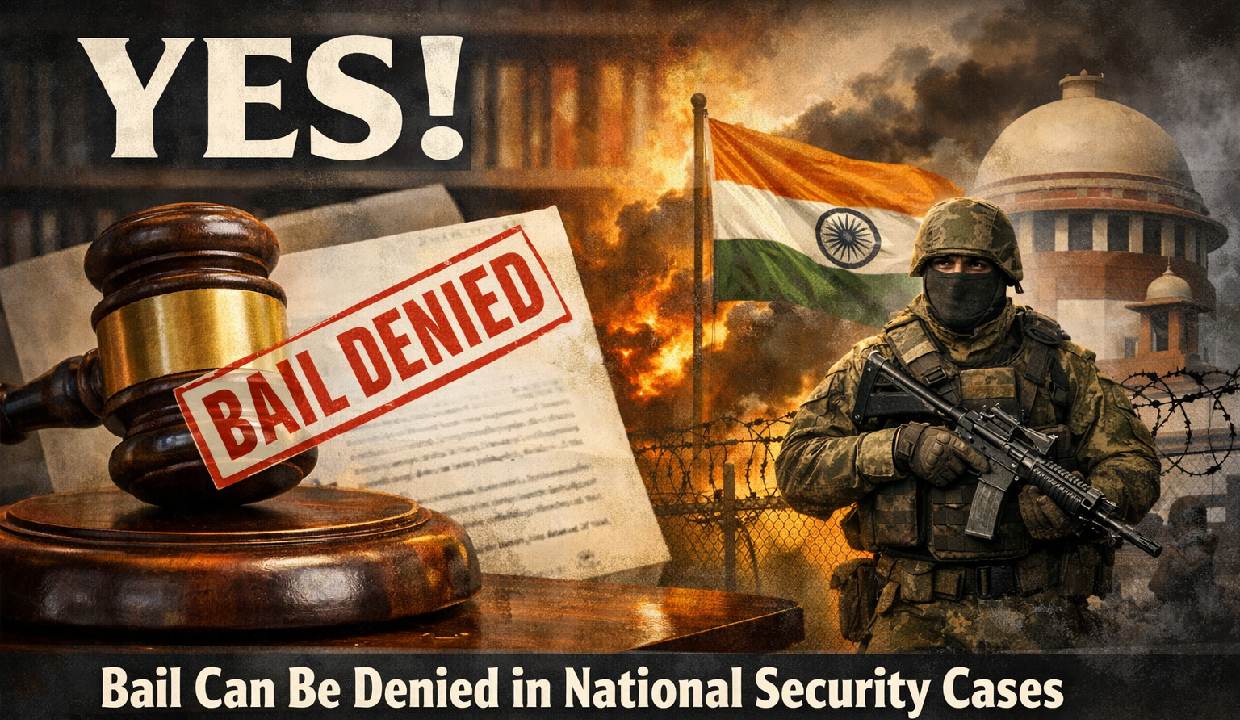
After the denial of Bail by the Supreme Court to Umar Khalid and Sharjeel Imam for being the key conspirator of the treacherous and deadly 2020 Delhi Riots, the jurisprudence of bail under the Unlawful Activities (Prevention) Act, 1967 (UAPA), is emerging as one of the most debated intersections between constitutional liberty and judicial discretion in the contemporary Indian legal system. In particular, Section 43D (5) — the provision which restricts the grant of bail where accusations appear prima facie true — has compelled courts to grapple with a deeply structural dilemma: how should a constitutional court balance Parliament’s legislative intent on national security with the constitutional guarantee of personal liberty enshrined in Article 21?
This question cannot be answered through mere rhetorical postures or political sentiment. It demands an exploration of the architecture of discretion, the limits of judicial review, and the role of the judiciary in a constitutional democracy when there is an exceptional threat to national integrity and public order. The bail petitions filed by the accused in the 2020 Delhi riots larger conspiracy case provided the Supreme Court with a particularly sensitive canvas to articulate this balance. The Court found itself navigating the delicate frontier between compassion and caution — ensuring that liberty remained meaningful, yet recognising that offences against the national security transform the very terrain upon which bail jurisprudence ordinarily operates.
Critiques should first understand that the bail is not an abstract or metaphysical right nor even a constitutional right! Denial of Bail in exceptional cases should not be debated on the anvils of constitutional principles. It flows entirely from the statutory design. Presumption of innocence until proven guilty and the right of speedy trial may be read in our Constitution but it doesn’t always necessarily mean that terrorists should also be released on Bail till the determination of their guilt. Parliament creates the offences, prescribes procedure, and structures the thresholds through which pre-trial liberty may be granted. Therefore, to examine bail under the UAPA while ignoring the statute’s special purpose would be to misunderstand the very moral and intent of the legislation.
Parliament, in framing Section 43D (5), departed from the general principle for granting Pre-Trial Bail, only after concluding that terrorism-related offences operate through covert networks, ideological influence, and decentralised conspiracy that make early release uniquely risky. The law accordingly places a statutory embargo: where the prosecution material discloses a prima facie case, discretion to grant bail narrows significantly. Therefore, Constitutional Courts, while interpreting Section 43D (5), must steer carefully between two opposing pitfalls. At one extreme lies a kind of romantic libertarianism that elevates personal liberty to such an absolute that any security-oriented legislative restraint is treated with instinctive suspicion.
At the other stands judicial abdication, in which the statute is applied as an inflexible command, leaving no room for judicial discretion. In the present case, the Supreme Court consciously avoided both errors. It neither dismantled the legislative framework nor surrendered its own evaluative role. Instead, it adopted a posture of disciplined fidelity: once the material on record disclosed reasonable grounds to regard the accusations as prima facie true, the Court accepted that its discretion must correspondingly narrow.
This reasoning is consistent with prior decisions such as National Investigation Agency v Zahoor Ahmad Shah Watali, Vernon v State of Maharashtra, Shoma Kanti Sen v State of Maharashtra, among others, which emphasise that bail under the UAPA is not the stage for a mini-trial, particularly where allegations concern coordinated and structured acts implicating national security. This approach reflects an understanding that fidelity to the Constitution also requires institutional deference to Parliament’s considered judgment in matters of exceptional public importance. UAPA and Terror offenses seldom resemble traditional criminal enterprises. In such a landscape, physical absence does not equate to non-participation, conceptualisation may precede implementation, and directive influence alone can set consequential events in motion. The allegations against Umar Khalid and Sharjeel Imam were examined within precisely this analytical frame. The prosecution characterised the case as a process-driven conspiracy involving coordinated calls for mobilisation, an organised protest infrastructure, deliberate expansion of agitation into mixed localities, preparatory arrangements, and synchronisation with a diplomatically sensitive international visit.
Whether these assertions ultimately withstand trial scrutiny is a separate question; at the bail stage, the Court’s obligation is confined to determining whether the material discloses a prima facie case, which the Supreme Court held that it did. To demand the level of evidentiary certainty reserved for final adjudication, at this preliminary stage, would be to neutralise Section 43D (5) entirely, collapsing Parliament’s carefully constructed threshold back into the logic of ordinary criminal procedure - a transformation that would amount to judicial overreach dressed up as liberalism.
Section 43D (5) is not a declaration of hostility to liberty. It is a recognition that liberty cannot ignore context. A society facing exceptional security challenges cannot constitutionally afford a naïve conception of freedom detached from the reality and its responsibility.
This is mirrored in other special legislation. The Supreme Court’s reasoning in Vijay Madanlal Choudhary v Union of India, upholding heightened bail conditions under the Prevention of Money Laundering Act, reflects a similar philosophy — that economic sovereignty and national security are constitutional interests warranting calibrated restraint. Liberty remains a core value. But liberty is not solitary. It coexists with public order, security, and democratic stability - all protected by the Constitution itself.
It is also important to note that Section 43D (5) of the Act is community-neutral. The statute neither targets nor protects any religion, region, or ideology. Its only lens is conduct and consequence. The Court consciously avoided identity-based reasoning. Bail was not denied because of who the accused are, but because of what the prosecution alleged they did and the seriousness legally attributed to that conduct. This is critical in preserving the moral legitimacy of national security law. The Court expressly reaffirmed that principle.
The coincidence of the Delhi riots unfolded during the heightened international attention due to the visit of then — US President Donald Trump, whether incidental or strategic — inevitably elevated the reputational stakes. Images of burning streets and communal unrest were transmitted globally at a time when India sought to project democratic stability. The prosecution alleged that this timing was not accidental. It argued that the architects of the conspiracy intended to leverage the event to amplify international embarrassment. Whether that assertion will ultimately withstand trial scrutiny remains to be seen, but its relevance at the bail stage lies in shaping the assessment of gravity and consequence.
The grant of bail to certain co-accused in the riot’s conspiracy case generated the apprehension of unfairness. But parity is not arithmetic — it is doctrinal. It operates only where roles and evidentiary material are substantially identical. Where the prosecution attributes greater ideological leadership, directive influence, or deeper structural involvement to a particular accused, the doctrine of parity naturally weakens. The Supreme Court recognised that the material against Khalid and Imam — treated as ideological pivots — could not be equated with those whose involvement appeared peripheral or supportive.
Further, the Court noted that the bail granted to some co-accused was often the product of equitable compassion due to prolonged incarceration, rather than a declaration that they satisfied the statutory threshold. Mercy cannot become a precedent.
The most profound element of the Supreme Court’s approach lies in its refusal to frame the interaction between Article 21 and special statutes like the UAPA as an inherent clash between liberty and State power. Article 21 safeguards the principle that personal freedom may only be curtailed through a procedure that is fair, just, and reasonable — and Section 43D (5) represents one such legislatively crafted procedure, operating under constitutional scrutiny and judicial interpretation. The task of the Court, therefore, is not to dismantle statutory restraint under the banner of liberty, but to ensure that such restraint is exercised with precision, proportionality, and complete neutrality, free from any identity-based bias. It is in this calibrated spirit of disciplined constitutionalism that the Supreme Court addressed the present case.
What finally emerges from the Supreme Court’s bail jurisprudence under the UAPA is a sense of institutional maturity. Where Parliament has consciously introduced strict safeguards in response to exceptional threats, judicial discretion must operate with sensitivity to that legislative scheme. This approach does not erode democracy; rather, it strengthens it. Courts are not designed to replace Parliament’s policy choices, but to ensure that those choices remain within constitutional limits.
The wider controversy surrounding the refusal of bail to Umar Khalid and Sharjeel Imam has often been reduced in public discourse to ideological contestation. Yet the real significance of the Court’s reasoning is jurisprudential rather than political. It acknowledges the centrality of personal liberty, recognises the legitimacy of Parliament’s concerns regarding national security, rejects identity-based stereotyping, respects statutory thresholds, and ensures that extraordinary offences are not evaluated through the lens of ordinary criminal law.
In doing so, the Court has reiterated an essential constitutional insight: liberty and security are not natural opponents, but complementary coordinates in the governance of a democratic State. Liberty preserves the humaneness of State power, while security preserves the stability and continuity of the State itself. Constitutionalism does not demand the sacrifice of one value at the altar of the other. Whatever one’s political perspective, the UAPA bail jurisprudence stands as a compelling example of this delicate yet indispensable constitutional balance.
Ayush Anand is an Advocate on Record at Supreme Court of India and Vishal Kumar practices in the High Court of Patna; views are personal