Yaksha Prashna from the Mahabharata and Fundamental Duties
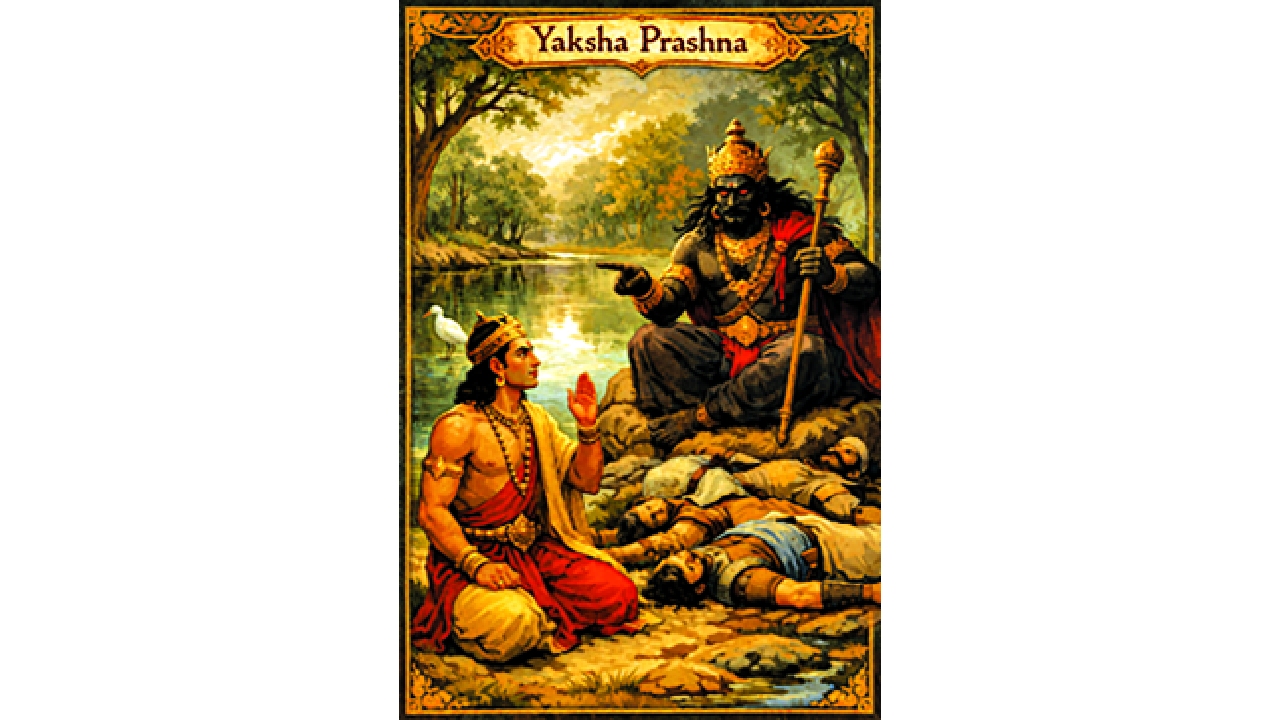
One day in the Kamyaka forest, as the Pandavas neared the end of their twelve-year exile the brothers became very exhausted due to heat. Yudhishthira sent Sahadeva to fetch water. At a serene lake, a celestial voice of the Yaksha cautioned Sahadeva,"This is my lake. Answer my questions before drinking." Sahadeva ignored it, and as he drank, he fell lifeless. Nakula, Arjuna, and Bhima followed, each neglecting the voice and perishing by the water's edge.
Looking for his brothers, the grief-stricken Yudhishthira arrived near the lake. Heeding the Yaksha's command, he engaged in a profound dialogue of over 125 questions on ethics, dharma, and human nature through which he proved his mastery of righteous conduct. The Yaksha probed, "What is happiness?" Yudhishthira replied, "proper conduct." This echoes our fundamental duty 51A(e): promoting harmony and brotherhood transcending religious, linguistic, or regional divides.
"Who makes one enlightened, birth, character, or learning?" "Character alone," said Yudhishthira, aligning with fundamental duty 51 A(j): striving for excellence in individual and collective life. The Yaksha asked, "What is the invincible enemy and the incurable disease?" Yudhishthira replied, "anger and greed." These vices undermine our fundamental duty pertaining to abjuring violence and safeguarding public property.
To Yaksha's question "what is the highest duty?", Yudhishthira asnswered "Ahimsa or non-violence." Yaksha asked, "what is the loftiest thing?" to which Dharmaraja replied "knowledge," tying with the fundamental duty 51A(k): parents' duty to educate children aged 6-14. ". To Yaksha's question regarding the friend of the dying?", Yudhishthira answered "charity." Impressed by Dharamaraja's responses and humility, the Yaksha revealed himself as Yama, God of Dharma and Yudhishthira's father.
He offered to revive only one brother. Yudhishthira chose Nakula, his stepbrother from Madri, so that both Kunti and Madri could have a living son for the sake of justice. This selflessness moved Yama to revive all. The episode underscores dharma's essence. Ethical conduct fosters societal harmony; character drives excellence, and non-violence ensures peace. These ancient truths mirror modern fundamental duties.