
- HOME
- INDIA
- WORLD
- BUSINESS
- STATES
- LAW & JUSTICE
- ENTERTAINMENT
- SPORTS
- VIEWPOINT
- LIFESTYLE
- TECH
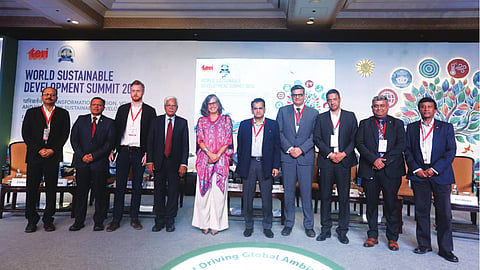
The 25th edition of the World Sustainable Development Summit (WSDS) 2026, organised by The Energy and Resources Institute (TERI), advanced the global conversation on sustainability by spotlighting nature-positive development, green industrial transformation, future technologies, and renewed multilateral cooperation.
During a high-level plenary, the minister for ports, shipping, and waterways, Sarbananda Sonowal, shared, “Over the past decade, India’s maritime sector has undergone a deep transformation under the leadership of the present Government, evolving from capacity expansion and efficiency gains to a strategy anchored in sustainability.
Guided by Prime Minister Narendra Modi’s vision of reform, performance, and transformation, maritime governance today places green growth at the centre of economic development. India is committing to renewable energy adoption at ports, carbon neutrality, green shipping corridors, and large-scale green hydrogen production, supported by institutional reform and international partnerships.”
The ministerial session titled “Multilateralism as a Force for Hope and Impact” reinforced the centrality of multilateral cooperation in navigating climate and development challenges, Minister of Environment, Sri Lanka, Dammika Patabendi said, “We are making strong progress; nearly 100 per cent of our population has access to electricity, and renewable energy accounts for approximately 50 per cent of our total electricity generation, with a target of 70 per cent by 2030.
Madhav Prasad Chaulagain, Minister, Ministry of Forests and Environment, Nepal, stated, “Multilater-alism is not merely a diplomatic concept for Nepal; it is a means to share responsibilities and collectively address regional and global issues. Dr Muaviyath Mohamed, Minister of State, Tourism and Environment, Maldives, remarked, “Multilateralism is not an abstract ideal for the Maldives but a matter of survival.”
As a low-lying nation with more than 99 per cent of our territory comprising oceans, rising sea levels threaten our very existence. Jochen Flasbarth, State Secretary, German Federal Ministry for the Environment, Nature Conservation, Nuclear Safety and Consumer Protection (BMUKN), observed, “What we cannot accept is when one country puts pressure on others to undermine collective action, as we saw at the IMO, where small island countries faced attacks for supporting decarbonisation of shipping lines.
This destroys the world community in its essence. Fact-based progress is also under threat.” Mattias Frumerie, Climate Ambassador & Head of Delegation to UNFCCC, Swedish Ministry of Climate and Enterprise, said, “For Sweden, multilateralism is in our DNA. It is through multilateralism and collaboration that we can jointly address common challenges and build prosperity globally. “
In her Global Leadership Address, Anacláudia Marinheiro Centeno Rossbach, Executive Director, UN-Habitat, said, “Rapid urbanisation, especially in South Asia and Africa, is placing further pressure on cities that already face gaps in infrastructure, basic services, mobility, and opportunities.” Dechen Tsering, Regional Director for Asia and the Pacific, United Nations Environment Programme (UNEP), remarked, “The real challenge today is not ambition, but finance.”
For every dollar invested in nature, far greater sums continue to flow into activities that degrade it. “. Supriya Sahu, Additional Chief Secretary to the Government, Department of Environment, Climate Change and Forests, stated, “Nature-based solutions must be treated as long-term public assets and not as commodities to be monetised at the cost of ecological integrity or community ownership.”
Ajay Kumar Bhalla, Governor of Manipur, observed, “Technology, data, and community participation must work together to strengthen resilience. There is also scope to explore a carefully regulated, community-centric carbon framework that balances opportunity with environmental integrity.”