Words trip Trump’s trade tariffs
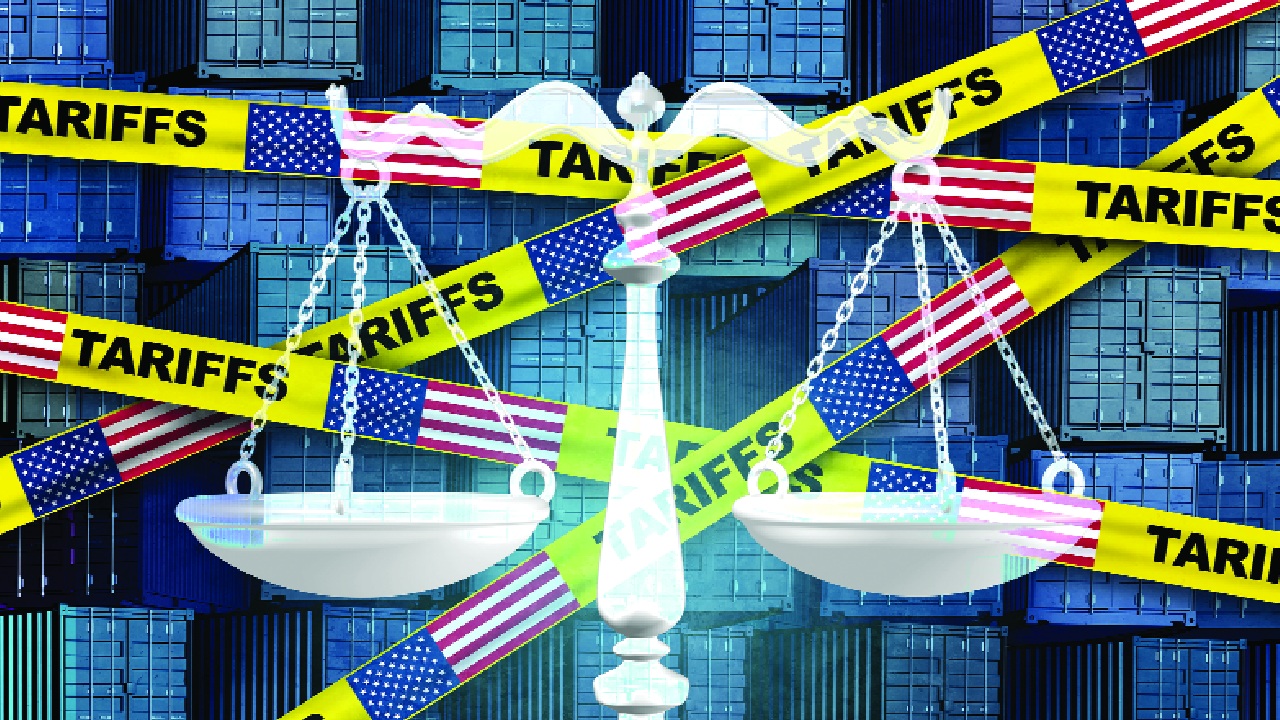
As mentioned in Wednesday’s column, the US Supreme Court established that the spirit of the constitution, and of the law that President Donald Trump used to impose tariffs do not allow the actions. The Court then went into specific words, or the letter, of the International Emergency Economic Powers Act (IEEPA). It said that after a president declares an emergency, he has powers under the Act. She or he can investigate, block, regulate, compel, nullify, prevent, and withhold, or use, transfer, withdraw, and transport, and deal with imports (importation) and exports (exportation) to act against a right, power, or privilege related to transactions and property of a foreign nation.
But the beauty is that the words tariffs or duties are absent from the nearly five-dozen words in the relevant part of the crucial sentence. So, while the law specifies several powers, there is no mention of the one to impose new tariffs. This “omission is notable,” and signifies that the Congress, which wrote the law, deliberately did not take the trouble to name it in any form, even as taxes or duties. If the legislature wanted to include tariffs, or the “distinct and extraordinary power to impose” them, “it would have done so expressly,” or in those many words.
This is exactly what the Congress did in the case of other laws, which explicitly mention tariffs, or duties, or taxes. However, as Trump lawyers, or the Department of Justice (DoJ) argued, the specific words like “regulate,” and “importation (imports),” which are separated by 16 other words, implicitly embed the powers to impose tariffs. The assertion was that they give the president “independent power” to do so on goods “from any country, of any product, at any rate, for any amount of time.” The Court felt that the two words do not fill the legal void, and vacuum. The two words “cannot bear such weight” of the claim.
According to Black’s law dictionary, which is used by most courts across the globe, including in India, the term regulate means to “fix, establish, or control; to adjust by rule, method, or established mode, to direct by rule or restriction; to subject to governing principles of law.” This does not indicate the fixing of tariffs. Indeed, if 'regulate' was as expansive as the DoJ or president claimed, the other verbs included in the pertinent sentence in IEEPA “are simply wasted ink.” There was no need to use words like investigate, compel, nullify, prevent, and others.
Based on the dictionary definition, and other examples, despite the breadth of the word regulate, there is a strong hint of what it does not usually include, i.e., taxation. According to the Court, even the government lawyers could not identify a single law in which the power to regulate included the power to tax. In the case of the Securities and Exchange Commission, for example, it can regulate securities, but cannot tax the trading of securities. This distinction explains why when the Congress wishes to include both regulate and tax, it does so “separately and expressly,” as is the case with the other laws. There is no ambiguity, or the need to second-guess, and interpret the intentions.
Not to give up so easily, the DoJ and president’s lawyers insisted that the word regulate lies next to importation and exportation. In effect, IEEPA allows the president to “regulate… importation.” But the Court stated that there were other words between regulate and importation, which suggest that such a reading was not what the Congress implied. Regulate is one of nine verbs in the relevant part of the sentence in IEEPA, and each authorises a different and distinct action. She or he can block imports, or prohibit transactions, for instance. But none of the verbs allow the president to raise revenues. This power does not exist.
In legal terms, the power to regulate commerce is not the same, and does not include the power to levy a tax. In any case, the Supreme Court felt that it is irrelevant whether “tariffs can ever be a means of regulating commerce.” The real question is whether the Congress meant to give the president the power to impose tariffs at “his sole discretion,” without the involvement of the legislature. The pattern from the other laws is clear: When the Congress means it, it does so clearly, and with careful constraints.” In the case of IEEPA, it does neither.
Another logic that the president used was within the relevant part of the sentence in the Act, the word, regulate, lies between two extreme poles of compel, which is on the affirmative end, and prohibit, which is on the negative one. Hence, 'regulate' includes the “‘less extreme, more flexible’ tool of tariffs.” The Court countered that unlike compel, prohibit, and regulate, tariffs raise revenues for the government. Taxes may be “less extreme,” as claimed, but this does not “follow that tariffs lie on the spectrum between those two poles (compel and prohibit).”
Historically, before IEEPA, an American court interpreted the earlier law differently. In an earlier incarnation, a lower court ruled that the powers under “regulate… importation” did allow President Richard Nixon to impose “limited tariffs.” Hence, Trump’s lawyers maintained that when the Congress enacted the IEEPA two years after this order, it kept the powers intact, and expanded them to “without the limits.” This is evident from the IEEPA House Committee Report, which helped the making of the new law. The wordings prove that the Congress “indisputably knew of” the lower court’s interpretation.
Of course, the Supreme Court agreed that sometimes it “assumes” that the Congress includes earlier interpretations into new laws. But this happens “only when (the) term’s meaning was ‘well-settled’ before the adoption.” A single order, exception, or interpretation is not enough. In addition, the IEEPA Committee Report explains that “successive Presidents have seized upon the open-endedness of (the then pre-IEEPA Act) to turn… (it) into something quite different from what was envisioned in 1917 (when the earlier law was made).” As the Supreme Court caustically noted, “This is not exactly a stamp of approval.”
So, while the pre-IEEPA Act, as interpreted by a single lower court in a single order, may be said to give tariff-setting powers to the president, they were limited, as per the order. The House Committee, which set the standards and benchmarks for the new IEEPA, was worried about the misuse of these tariff-setting powers. One can logically argue that if the Congress did not mention the words like tariff, taxes, and duties in the new law, it did not intend to give such powers to the president.