Why India’s 2047 roadmap must begin with a child’s safety
Stakeholders discuss trafficking, early marriage, forced labour
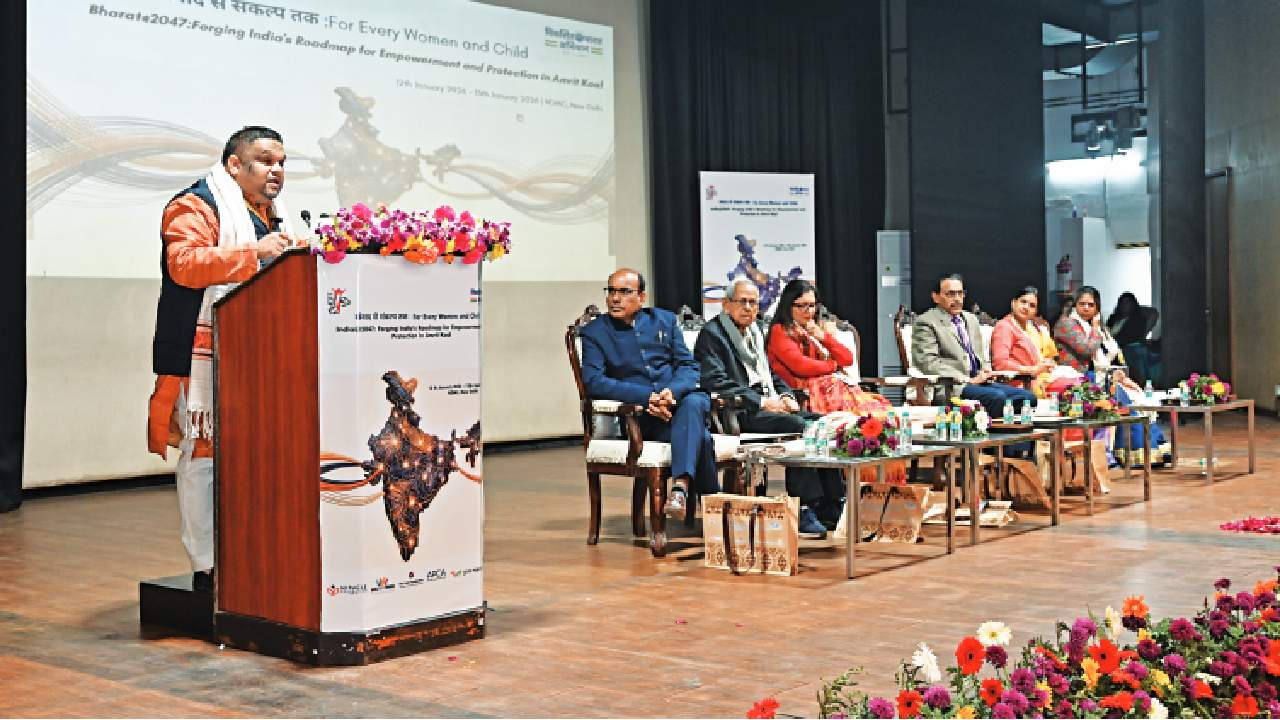
There is a specific kind of silence that falls when the conversation moves from economic statistics to the safety of a child. It is a silence shaped by shared responsibility and quiet unease. That moment was felt on Monday where ATSEC India, in collaboration with Bal Kalyan Sangh, Miracle Foundation India, Girls Not Brides, The Asia Foundation, and Yuva Manthan, came together for a national symposium that reflected lived realities rather than formal protocol.
The theme, “Viksit Bharat@2047: For Every Woman and Child,” posed a challenging question: can a nation truly be described as developed if its women and children continue to look over their shoulders? More than 150 participants had travelled from different parts of the country- individuals who work directly with children and families affected by trafficking, early marriage, and forced labour.
Many of them brought stories from the field, grounded in daily encounters with vulnerability and resilience. When the discussion turned to India’s goals for 2047, the unity of thought remained consistent. As the country approaches its centenary, participants agreed that economic development remains incomplete without the safety and empowerment of women and children. The symposium was inaugurated by Priyank Kanoongo, Member, National Human Rights Commission.
Acknowledging the shared responsibility of Government institutions and civil society organisations, he stressed that laws such as the Protection of Children from Sexual Offences Act hold value only when enforced seriously on the ground. His remarks reflected the challenges faced by those working in remote and vulnerable regions, where policies must be translated into protection with limited resources and infrastructure.
Sanjay Mishra, National Coordinator of ATSEC India, brought an emotional note to the opening session. Reflecting on years of field engagement, he spoke about how numbers often hide individual lives. “We are not here to draft policies alone. We are fighting to ensure that no mother is left searching for a child lost to trafficking, because there is no heavier burden on a nation than a child’s tears,” he said. Nandita Baruah, Country Representative of The Asia Foundation, spoke about progress achieved so far while drawing attention to the growing threat of digital sexual exploitation. She underlined the need for safeguards that evolve alongside technology.
Shreya Ghosh, representing Girls Not Brides, emphasised the importance of an effective declaration that brings together youth, Government bodies, and civil society organisations, noting that young voices must remain central to long-term change. PM Nair, former Director General of the National Disaster Response Force and a veteran human rights advocate, spoke plainly about moral boundaries that cannot be crossed, stating that no woman or child should ever be treated as a commodity. MN Mandal highlighted positive shifts seen at the grassroots over time, while stressing that sustained effort is still required to close long-standing gaps.
As the symposium concluded, one message remained clear. India’s journey towards 2047 will not be measured only in economic milestones or policy frameworks. It will be judged by everyday freedoms-by whether a woman can walk without fear, and whether a child is allowed the simple right to a safe and unbroken childhood. (L-R) Priyank Kanoongo, member NHRC, New Delhi; Sanjay Mishra, National Coordinator, ATSEC India, MN Mandal, ATSEC India; Nandita Baruah, Country Head the Asia foundation; PM Nair, IPS, Former DG NDRF; Aishwarya Singh, Advisor, Yuva Manthan; Shreya Ghosh, Asia Head, Girls Not Brides.