Wealth, GDP, PPP, per capita
Last week, a cousin visited us. She is a professional settled in New Jersey (US), and is a happy American, along with her husband and children. Together, the couple earns more than $200,000 a year, or nearly INR 2,00,00,000, which is fantastic by Indian standards. Of course, their lifestyle is better than most Indians. Yet, my cousin was amazed that her sister, and brother-in-law together earn close to INR 4,00,000 a month, or nearly INR 50,00,000 a year, while being professors in a college in a small town in Odisha.
More importantly, the sister hired a full-time driver, a full-time maid, a part-time cook, and a weekly gardener. The cousin was unable to do any of these things in the US. Hence, she popped the question to me, given that I am a trained economist. Why do analysts, experts, and others call India a poor country, and say that apart from a few rich capitalists, most Indians live in poverty? It is an interesting question, and a difficult one to answer. For, it requires an insightful understanding of the economic meaning of the terms such as per capita incomes, individual and corporate wealth, living standards, GDP, inequalities, and purchasing power parity.
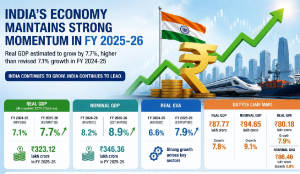
Let me put this another way. A social media post by a renowned publication, hoping to shock and stun readers, wondered how India was a $4-trillion economy, and $2 trillion was owned by two capitalists, Mukesh Ambani, and Gautam Adani. Of course, there is no link, correlation, cause-and-effect, and proportionality between the two numbers. The first related to GDP, or the combined annual produce of the country, which changes every year. The second is about wealth, which is the sum of physical assets (real estate, bullion, commodities, art, etc.) and paper ones (shares, mutual funds) owned by the two individuals. The twain do not meet directly.
It is like the income you earn every month, and the assets you own. The incomes may give rise to the wealth, and vice-versa, but it does not mean that if Ambani-Adani wealth is $2 trillion, it accounts for half of the country’s GDP, or annual income. Their wealth is largely based on the market cap of the equity that they own in their group firms, and the value of the equity can go up sky high, and crash. Check out the Forbes real-time list of dollar-billionaires, and watch how the wealth and fortune of the rich falls and goes up by a few billion dollars, yes, a few billion dollars, every day.
So, what exactly do we mean when we talk and write about, and discuss the economy. Let me start with three things. The first is income, second is wealth, and the third is a largely-ignored thing called purchasing power parity (PPP). When it comes to wealth, India is not wealthy by any yardsticks. According to some estimates, the nation’s wealth is just under $20 trillion, or $12,500 per person, if we take the population as 1.6 billion. More importantly, there are vast inequalities, as the top one per cent owns 60 per cent. The 99 per cent own $8 trillion, or just $5,000 per person, or less than INR 5,00,000.
Remember, this is the amount that a person has saved or invested. This is the reserve that she has for emergencies (health, loss of earning member), and crucial expenses (marriage, education). In today’s world, INR 5,00,000 is not enough for a critical illness, marriage, or higher education. Let us turn to incomes. It varies as per a person’s education, professional skills, and ability to perform in the markets. At present, millions of Indians do earn up to, or even more than, INR 2,00,000 rupees a month because they are either highly-educated, or run their own enterprises.
But there are huge disparities in incomes, as is the case with wealth. But they exist everywhere in the world. In recent times, a new superstar of socialism, French economist Thomas Piketty, has made inequalities, disparities, and socialism sexy and attractive again. Despite the disparities, the Indian economy grew at a healthy pace over the last three-and-a-half decades. It was not deemed possible when it became independent. The second important thing is that the quality of life has improved for most households. The family of a driver, or maid in Delhi or Mumbai can buy a two-wheeler, compared to the 1970s, when a bicycle was tough to own.
Now, we come to the most important economic pointer, PPP. India's purchasing power GDP is about $20 trillion, compared to $30 trillion for the US, and a higher $40 trillion for China. PPP, or purchasing power parity, essentially means that if one earns INR 100 a day, what is it that one can buy with it? Obviously, it depends on the prices, and cost of living in the respective nations. In this sense, as the earlier example of my cousin shows, the top 250 million or so Indians are better in terms of finances, and living standards compared to their counterparts in Europe and North America.
The only difference is that the urban municipal governance, red tape, omniscient and rampant corruption, and poor overall governance push Indians to lead a difficult life despite some amenities. They can buy a car, but cannot ride them on proper roads. They can fine-dine at the best places, but not get clean drinking water in the kitchens. My cousin cannot think of a driver, domestic servant and, of course, a gardener. But what she enjoys is excellent infrastructure, civic services, access, and freedom from the drudgery. In India, you bear the bad things with headaches, stress, and bribes.
If you look at nations like South Korea and China, their per capita income, or income per person, may never reach the levels in the US ($80,000 a year). China’s per capita income is $12,000. But this does not mean that China is poor compared to the US. Maybe $12,000 in China can buy more products and amenities than in the US, which depends on PPP. Maybe the South Koreans have better all-round access to excellent infrastructure, which is skewed in some American cities, including New York. Maybe, the happiness levels are the highest in Bhutan which, with a per capita of around $4,000, cannot even compare with the US. What is important is not just economic growth, but better (maybe unequal) distribution of wealth and incomes, affordability in terms of PPP, and good governance.
The author has worked for leading media houses, authored two books, and is now Executive Director, C Voter Foundation; views are personal