Viksit Bharat: Secretariat and CRF host policy dialogue on Mission 2047
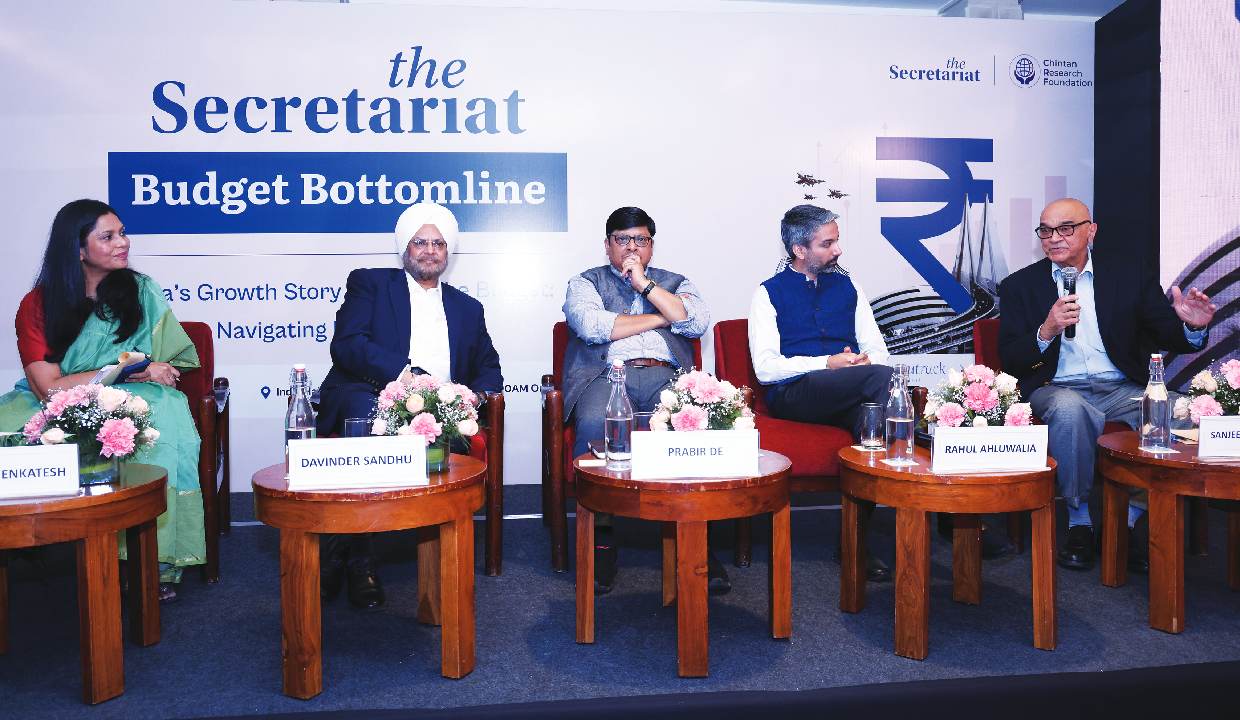
The Secretariat, in collaboration with Chintan Research Foundation (CRF), conducted a high-level policy discussion on India’s Growth Story Beyond the Budget: Navigating Mission 2047, at Juniper Hall, India Habitat Centre, on February 18. The policy dialogue brought together senior industry leaders, policymakers, and experts from across sectors.
The first session of the two-part discussion was on Opportunities, Institutions, and Structural Reform, which saw policy leaders deliberating on what is shaping India’s growth trajectory — from inclusive growth to citizen-centric development and the recent flurry of free trade agreements (FTAs).
The panellists for the first session included Davinder Sandhu, Chairman, Primus Partners; Prabir De, Professor, Research and Information System for Developing Countries (RIS); Rahul Ahluwalia, Founder-Director, Foundation for Economic Development; and Sanjeev Ahluwalia, Distinguished Fellow, CRF.
“We’ve reached a plateau, and that plateau is 6.5%. What we do from here is not dependent on either macro or fiscal policies,” Davinder Sandhu, Chairman, Primus Partners, said.
According to him, India needs a 25-year cross-party consensus to anchor Mission 2047, not annual budget recalibrations. Without long-term policy continuity, investors will remain cautious. He also warned that regional and intra-state inequality threatens social and investment stability. “Inequality stares us in the face,” he said.
On navigating global volatility, Prabir De, Professor, Research and Information System for Developing Countries (RIS), said that India must deepen its integration into global value chains as export expansion, not inward focus, will determine long-term success.
Growth cannot be national if it is uneven. States must converge in capability and competitiveness, he argued, warning that without stronger state-level reform momentum and coordination to make “Viksit Rajya”, the 2047 vision risks remaining a Delhi-centric aspiration.
Rahul Ahluwalia, Founder-Director, Foundation for Economic Development, challenged a common assumption that India’s large population automatically makes it a large market.
“We are a big market only because we have 1.4 billion people. On a per capita basis, we are one of the smallest markets in the world,” he said. On inclusion, he said that growth has helped reduce poverty, asserting that “truly inclusive growth is faster growth”. Sanjeev Ahluwalia, Distinguished Fellow, CRF, underscored the significance of shared responsibility, MSME freedom, and acceptance of tough trade-offs in sustaining the growth momentum. While the first session shed light on the fundamental aspects to leverage the growth curve, diplomats and industry experts set down the macroeconomic policy framework that will define India’s position in the global order. “Economics is now defined by geopolitics. Economics is now defined by sanctions, the weaponisation of the dollar, trade policies, and tariffs,” Bala Bhaskar, former Ambassador and economist, said.
He identified 2012 as a turning point in the global order - from the US shale revolution that reshaped energy geopolitics, to China’s pivot towards high-tech competition, to material innovation that altered manufacturing geography. AI, he added, could permanently redefine production patterns.
In the context of globalisation of the 1990s and the protectionist turn of the present, Vaibhav Dange, CEO, Build India Foundation, argued that India’s resilience in navigating global crises, including the pandemic and recent geopolitical disruptions, rested heavily on infrastructure, stressing the importance of scaling infrastructure development.
The world remains deeply integrated into global finance and trade, but the rules are no longer stable, said Bidisha Bhattacharya, Associate Fellow, CRF. “It’s high time that we move from volume to value,” she said, calling for a shift from export expansion to export promotion.
The focus must move from how much India exports to what it exports. Climbing the economic complexity ladder from low-complexity commodities like rice and wheat to pharmaceuticals, engineered goods, and electronics will create deeper production ecosystems, employment linkages, and resilience, Bhattacharya added.
Participants also stressed that raising female labour force participation and integrating women more fully into the economy is essential to sustaining high growth under Mission 2047.
From inclusive growth to market diversification, and by adopting cutting-edge technology and leveraging macroeconomic credibility, India’s long-term goals would become analogous to a sustainable, citizen-centric approach, redefining its status in a global order shaped by volatility and growing uncertainty.