Two sides of NCERT fiasco
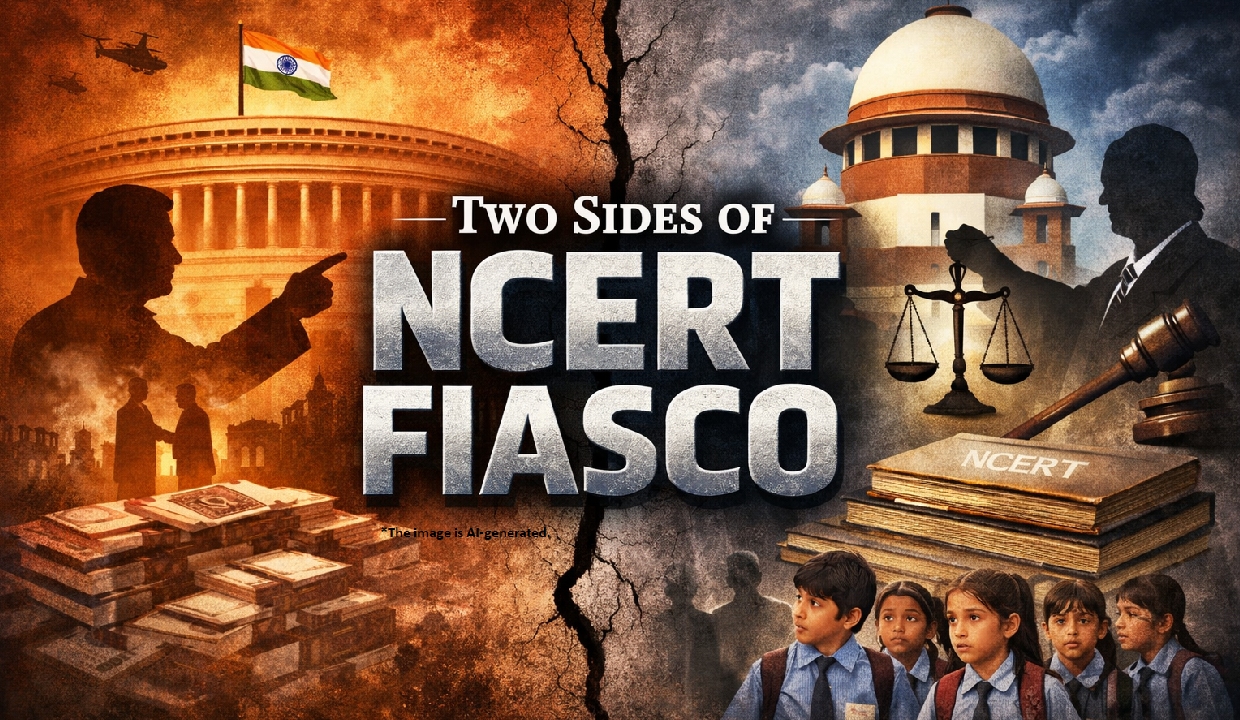
The Government and judiciary are in open war now. In the revised NCERT syllabus, a new section, “corruption in the judiciary,” has been added in the chapter “The role of the judiciary in our society” in the 8th class social studies book. The content targets the judiciary for corruption at various levels and large arrears of cases in courts at different hierarchy.
While the old content talked about independence of judiciary, access to justice, etc., the new content is a direct attack on the judiciary in a systemic manner never seen before in our Independence History.
The Supreme Court has taken note of it without a blink and the CJI Surya Kant has ordered a suomoto case on this, saying “it seems to be a very calculated and deep-rooted measure”. After the backlash on it, NCERT has withdrawn the books and even the PM had to “regret” it. Such is the gravity of the matter. While there’s no denial that the judicial system has many serious questions to answer and challenges to meet, exposing 8th class students to this kind of content is no less than “scandalous” to court and the country in whole, as it sows seeds of scepticism in the minds of children of an age who are not capable of understanding the complexity of the matter.
Corruption in the judiciary and backlogs are half-truths and without giving the children the other half-truth, it’s a fraud played on these young minds.
The debate needs to be contextualised with Govts wanting a committed judiciary and bureaucracy against the Constitutional provision of the Separation of Powers. The Govt doesn’t speak of deep-rooted corruption in bureaucracy, politicians and their nexus with corporates in a systemic way, it has done with the judiciary. This is a very dangerous feet achieved by the Govt. Anarchy starts with the erosion of faith in the judicial system.
This move of the Govt is not without its past. In the past, then Vice President Jagdeep Dhankhar continuously targeted the judiciary in a consistent and calculative manner which was aided by BJP MP Nishikant Dubey who said the then CJI Sanjeev Khanna was to be blamed for all the civil wars in the country, in the backdrop of a matter pertaining to the Waqf (Amendment) Act and the TN Governors case, setting timelines for assent to Bills.
There have been systemic efforts to build a public narrative against the judiciary to bring back the National Judicial Appointments Act, 2014 (NJAC), which the Supreme Court struck down in 2015 as unconstitutional. NJAC was brought by the NDA Govt in August 2014.
Undoubtedly, such propaganda against the judiciary must be checked, but at the same time, the judiciary must put its house in order. It would be disastrous to have Govt domination in the appointment of higher judiciary, but the collegium system has a lot to improve.
It needs to have more transparency in the In-House Mechanism of inquiry against judges. Then CJI Sanjeev Khanna did wield some transparency, albeit at a later stage, in dealing with the alleged cash burn scam of Justice Yashwant Verma but withholding the indictment report from the public was two steps back.
The office of CJI was held to be a Public Authority for the purposes for RTI only in 2019 after a long legal battle, with many guardrails. As of May 2025, only 21 out of then 33 judges in the Supreme Court declared their assets on the Court’s website it being a resolution in place since 1997. The High Courts still haven’t taken a leaf out of the Supreme Court’s move.
In the end, a reminder to the Govt, the impeachment proceedings against Justice Yashwant Verma are yet to be started in the Parliament. Further, the Govt must bring a law banishing post-retirement appointments of judges and bureaucrats as it leads to committed judiciary and bureaucracy, but that’s one thing neither the Govt not the judiciary touches.
All said and done, Govt targeting the judiciary for corruption is like the pot calling the kettle black. At the same time, the judiciary must reflect on this on a war footing now and put its house in order because the power of the judiciary is in its credibility and not in bare Constitutional provisions.
The writer is practicing lawyer at Supreme Court; Views presented are personal.