The speech that exposed the global fault lines
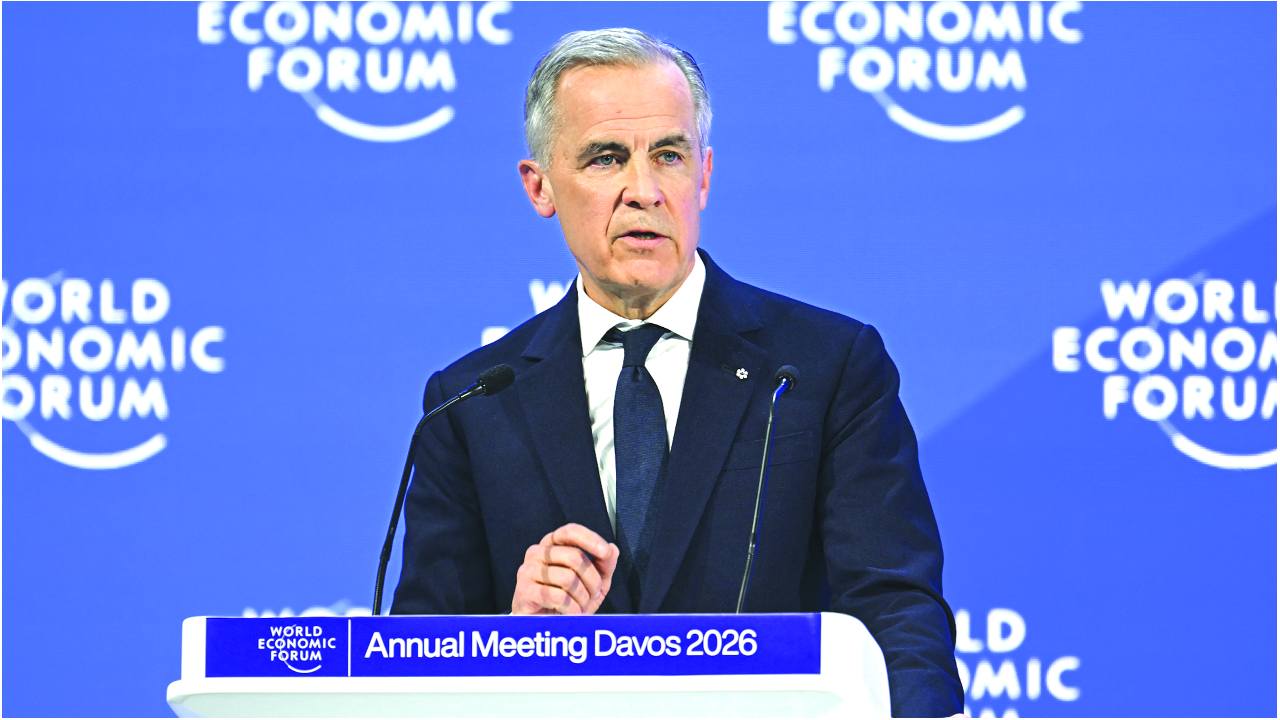
Carney’s speech at Davos is a defining moment in the currently evolving transformative world order, not just because it signaled a challenge to Trumpian norms but also because it augured a dependency reflective of China’s rise to the top of the ladder. It clearly demonstrated the shift in the power center of the world that balances stability, peace and growth in the contemporary world.
It would be apt to juxtapose the situation with a rare moment in history when an old era ends and humanity steps out of the old to embrace a new dawn’ and PM carney’s speech at the World Economic Forum in Davos symbolises this moment. It reflected the split amongst the loyalists and the revisionists as far as the US was concerned, simultaneously calling upon China to seriously take up the mantle of standing up for the oppressed. While the US tried to justify its policies on coercive use of tariffs and transactional approach to geopolitics, the countries affected by its ostensible ruthlessness hurried to embrace the rise of China as a ‘responsible power’. Carney’s attitude reflected his shaking faith in the rules-based international order and outlined Canada’s strategy to adapt to the changing geopolitical scenario by building its strategic autonomy reinforcing values like human rights and sovereignty.
For the Chinese diplomacy it reflected a huge success. When the world stood divided between the antagonistic forces of unilateralism, protectionism and might makes right, vis-a-vis multilateralism, openness and cooperation, Canada’s tilt to China made a substantive footprint on the canvas of a New World Order. It was a candid recognition of the need to reign in the decadent normsof the US which was trying all arms out to retrieve its dominion.
Carney was not merely speaking truth to power but telling one and all where the power center ought to shift. Carney’s reference to China’s communist system and how it came to be sustained through the — “workers of world Unite” axiom reflected a basic logic of the international relations, that sustains itself not on violence or might but on blind compliance of the state dictats, rituals and hierarchy. And also Carney pointed out in no less words how its fragility comes from the same source.
It is then perceptible that while India is still fighting for a strategic space, China seems to have already secured the throne. The speech is also indicative of how political national choices, be it communism or democracy is not the yardstick anymore, rather the distinction of political alignment between democratic blocs or autocracies isbecoming increasingly blurred. The intermediate powers like Canada and EU are cognisant of the unpredictability and the rupture in the rules-based international order and now seek to navigate a far less reliable reliable global order on the Noah’s ark; this time obviously steered by China.
The US hegemony that sustained a network of collective security and frameworks for resolving disputesis now under threat. However, one must admit that there will be no absolute downfall of the US power, what is likely to emerge is a re-negotiated space in terms of the shift of authority and power-centers. Will the world be more symmetric under China led institutions or the same asymmetries will prevail is the bigger question. Is Carney not being a utopian in believing that that the ‘survival of the fittest’ where the strongest would exempt themselves according to their convenience, and the superstructures oftrade would change for better under the Chinese rule.
What Carney’s actions reflect is fear! The fear of a slipping into the tentacles of a declining hegemon that has become a rogue. It reflected the anxiety amongst global elites and Governments arising from the viewpoint that their interest would be subdued if the US continued with its ‘might is right’ attitude. Meanwhile, as the US continues to strengthen its resolve of ‘denying non-Hemispheric competitors’ and prioritises attention to threats to the US in the Western Hemisphere, including a commitment to reduce the influence of China in the region as reiteratedin its NSS document over the last few years, the power defining structures of the globe are already under threat. The shift in the economic practices across the globe, from the discussions on free trade, globalisation and open markets to de-coupling, de-risking, supply chain security and formation of economic blocs is demonstrative of a response to the ‘reign of terror’ unleashed by Trump 2.0.
Simultaneously, Macron’s speechalso seemed indicative of a shift in the narrative from purely economic discussion to the talk on hard security in such Forums. He outlined how the world was in a crisis from growing instability and this conflict was actually being normalised. He defined the new reign of instability and aggression as a ‘world without rules’, where international law is trampled under foot and institutions are under pressure.
One statement that stood out starkly was “we do prefer respect to bullies and we do prefer the rule of law to brutality” reflecting that there was an immediate need to pull back support from unilateral actions of aggression and reinstate power structures governed by rationalism and norms sustainability. How countries tried to leverage their territorial and economic sovereignty and their national interests vis-à-vis China was a more interesting and rather dangerous trend. The choice after all seemed betweenbeing ‘vassal states’to the East or the West. Consistent demands on curbing the fragility of the global ecosystem demonstrated a global ethos in transition. China for its part, has definitely been actively pursuing a narrative that prioritises norms based structures instead of neo-colonialist ascent and has tried to assuage global concerns in this regard. China’s deep economic penetration has attracted the attention of many western countries that have been forced by necessity and the hidden forces of the market to accept China’s suzerainty.
Overall it signals the return of power politics under a new Sino-Centric world order in which India also hopes to share power and responsibility by promoting itself as the voice of the global South and emphasises strategic autonomy. If one looks from the lens of the power transition theory, it is evident that there is a decline of the liberal order and security competition is emerging from the shadows of covert loyalties which are under stress, and despite the atmosphere of fear and anxiety hope to reach a new consensus on the future of the world. While technology holds the key to reassertion of supremacy, the world finds itself more fragmented, competitive and driven by selfish pursuits of geo-strategic and geo-political concerns, which pushes them to seek protection elsewhere, vindicating notions of China’s manifest destiny.
The writer is a Visiting fellow at the Chintan Research Foundation (CRF). She is the author of China’s Discursive Nationalism: Contending in Softer Realms (2012) and has edited two volumes on China, last being — ‘The BRI and the Indo-Pacific: Reinventing Traditions’ (2025); views are personal