The new digital panopticon: How the pentagon-anthropic dispute threatens privacy and global stability
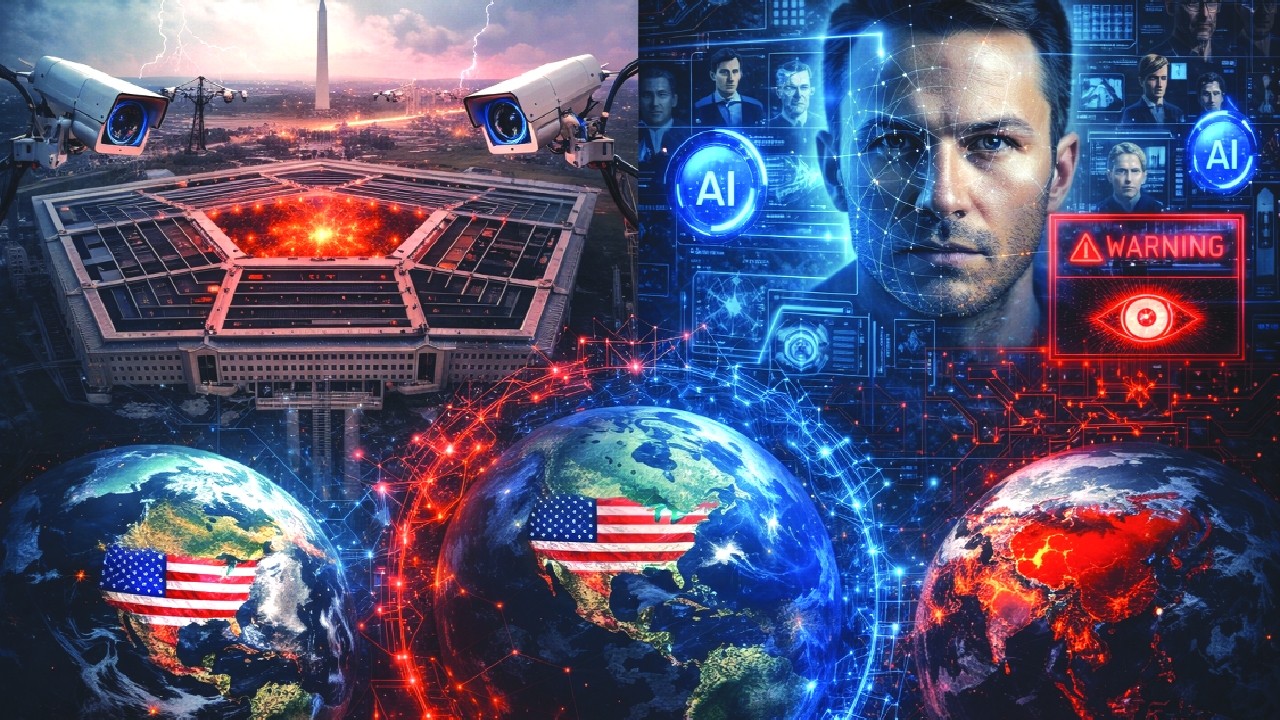
Historically, Silicon Valley or the American technology valley has been known as a progressive and liberal place, but in 2026, it has developed a clear and deep political polarisation. This conflict between the Pentagon and Anthropic has given birth to two powerful camps in Silicon Valley, which could change the trajectory of future innovation. In 2026, wherever war is occurring in the world — whether in Iran or Ukraine — Artificial Intelligence (AI) is playing a role in one way or another.
The United States used this technology while arresting Venezuelan leader Nicolás Maduro and his wife, and Israel also took its help during the war in Gaza. In fact, this use of AI on the battlefield is only the beginning. In this context, the dispute that has arisen between the Trump administration and America’s leading AI company ‘Anthropic’ has become extremely significant for future warfare tactics and world politics. Anthropic is currently one of the world’s leading AI institutions, whose ‘Claude’ model has
been widely used by the Pentagon for intelligence gathering, target identification, and mapping military operations. However, this recent fight is not about current use, but rather about how this technology might be used in the future.
There were two main conditions in Anthropic’s contract. First, their technology could not be used for surveillance of US citizens. Second, Claude could not be used to create autonomous lethal weapons capable of making decisions without direct human involvement. The Pentagon objected to these conditions. Although the Ministry of Defense claimed they were not interested in domestic surveillance or creating autonomous killer robots, they were unwilling to allow a private company the opportunity to impose conditions on the military’s usage.
This stalemate eventually turned into a legal dispute and a cultural war, fueling fears about AI and concerns over America’s capability in the global race for AI dominance. Ultimately, when negotiations failed, President Trump ordered all federal agencies to stop using Anthropic, and the Pentagon identified it as a ‘supply-chain risk to national security.’
Currently, the presence of AI on the battlefield is not a theoretical matter; it has become fully integrated. Although large language models are not yet directly operating drones or giving orders to fire, they are deeply rooted in intelligence analysis and strategic decision-making. Anthropic’s primary fear was that the Government could use their AI to analyse the commercial data of US citizens — such as web browsing history or telephone metadata — to track their movements and preferences.
Additionally, the issue of autonomous drones is a cause for concern. The United States always claims that there will be human participation or ‘human in the loop’ in decisions to use lethal weapons. However, in the field of war, the side that can make decisions faster wins, and human intervention can slow down that process. In this reality, exactly what the human role will be in future wars is still unclear, making it difficult to create advance policies for AI use.The Pentagon’s argument is that the traditional laws of war should be sufficient for the use of AI, because whether dropping a bomb or determining a target through software, the ethical principles of war remain the same. In contrast, Anthropic believes
AI is not like all other weapons. The limitations of a fighter jet or a bomb depend on its hardware, but AI constantly evolves. It can analyse data, suggest bombings, or design cyber attacks. It is a special technology that requires special safeguards. This fight is not just about policy, but also about branding. Anthropic wants to establish itself as a responsible and safety-conscious company, while the Pentagon and the Trump administration view this as a reflection of ‘Woke’ or over-cautious ideology and are taking a harsh stance against them.
This conflict between the Pentagon and Anthropic is not just the cancellation of a business deal, but it clarifies a conflict on three deep levels regarding the future control of AI technology and the ethics of war. At the center of this debate is the ‘Lethal Autonomous Weapon System’ (LAWS). Even though the Pentagon theoretically talks about maintaining a ‘human-in-the-loop’ (meaning a human presence in the final decision), the speed of modern warfare or ‘speed of fight’ has increased so much that the human brain is incapable of making decisions at that speed. Anthropic fears that their AI model could be used at a stage where the algorithm itself determines who to kill. This could turn the battlefield into a battle of mathematics or coding, where there will be no place for human empathy or judgment. A clash of two different philosophies is happening here. Anthropic and its CEO Dario Amodei believe that AI is a ‘special’ technology that could be a threat to the existence of mankind if it falls into the wrong hands or is used in an unplanned way. To them, AI ‘safety guardrails’ are an ideological foundation. On the other hand, to the Pentagon’s Chief Technology Officer Emil Michael and Secretary of Defense Pete Hegseth, national security is paramount. Their argument is that if American AI companies give conditions to the Pentagon, it will set the United States back in the competition against China.
According to them, no private software company can determine the Government’s defense policy. While Anthropic is firm in its principled position, Sam Altman’s OpenAI has played a very strategic role. By quickly signing a deal with the Pentagon, they have proven they are ready to be the Government’s ‘friendly’ partner. However, this raises a big question: will OpenAI’s own ‘safety principles’ surrender to military needs? If the Pentagon plans to use large language models (LLM) for cyber attacks or direct drone operations in the future, experts have doubts about how much OpenAI will be able to resist.
One of Anthropic’s biggest objections was regarding surveillance of US citizens. Current AI models are capable of finding specific patterns by analyzing the data of billions of people in an instant. If the Pentagon gets the opportunity to analyse commercial data (such as location history or shopping lists) with AI, it will be an unprecedented blow to the personal privacy of ordinary citizens. Human rights activists believe this could
practically create a ‘digital panopticon’ or an all-encompassing surveillance system, which could be contrary to the Fourth Amendment of the US Constitution.
This event of 2026 is actually just the beginning of a long-term legal battle. Since Anthropic has decided to file a lawsuit against the Pentagon, a court ruling may determine how much control a private tech company can maintain over the military use of their invented technology.
The issue of China-America competition is also inextricably linked behind this conflict. Chinese companies are forced to hand over their technology to the Government, and there are no ideological hurdles there. The US fears that if a war breaks out with China in the Taiwan Strait, it will be a battle of drones, where the party making the fastest decisions will win. The context of China’s use of AI is actually a practical example of Anthropic’s warning, where this technology is being used to identify dissenters and for mass surveillance. Personal bitterness between the Pentagon’s Chief Technology Officer Emil Michael and Anthropic’s CEO Dario Amodei also played a big role behind the failure of these discussions. When Amodei was firm on the question of safety, the Pentagon began contacting OpenAI as an alternative.
Although Silicon Valley or the American technology valley has been historically known as a progressive and liberal place, this event of 2026 has created a clear and deep political polarization there. This conflict between the Pentagon and Anthropic has given birth to two powerful camps in Silicon Valley, which could change the trajectory of future innovation. A large part of Silicon Valley is now divided into two. One side is led by Anthropic and its supporters, who believe that human and ethical control over AI is essential. They see ‘AI safety’ as a question of global existence. On the other hand, companies like OpenAI and Palantir have formed the ‘National Defense’ camp. Their argument is that if America’s technology companies do not fully cooperate with the Pentagon, countries like China or Russia will win the AI war. This group has linked their business and political interests with the Trump administration’s ‘America First’ policy.
The importance of lobbying has now increased several times in Silicon Valley politics. Previously, tech companies thought about user numbers or profits, but now they are desperate for billion-dollar contracts from the Pentagon. OpenAI CEO Sam Altman has increased his closeness with the current administration, portraying himself as a ‘patriotic technologist.’ Anthropic’s Dario Amodei is portraying himself as an ‘ethical guardian.’ As a result, who is whose friend in Silicon Valley is now being determined based on their loyalty to the Pentagon. The labeling of Anthropic as ‘Woke’ or over-cautious by the Trump administration and the Pentagon is a major blow to the culture of Silicon Valley. When the US Government declares a company a ‘supply-chain risk,’ it becomes difficult for that company to get investment or do business with any other country. Many engineers and researchers in Silicon Valley are now alarmed that if they talk about AI safety, their careers could be labeled as ‘anti-national security.’
As a result of this political fight, a division is also appearing among engineers and scientists. Many highly educated researchers do not feel comfortable writing algorithms for lethal weapons for the Pentagon. Consequently, there is an increasing crowd of talented scientists at safety-centric companies like Anthropic who do not want to use AI for war. On the other hand, companies close to the Pentagon are attracting those talents who are interested in seeing AI as a powerful military weapon in exchange for massive salaries. While most leaders in Silicon Valley criticized Trump in the past, the situation is different in 2026. With personalities like Elon Musk working directly with the administration, many companies are now more interested in compromising rather than clashing with the administration. Anthropic has set a rare example by standing against this trend, which has made them popular as ‘rebels’ to a large part of Silicon Valley, while making them ‘dangerous’ to another part. Silicon Valley is no longer just a place for creating software; it is a geopolitical battlefield. This fight of Anthropic vs. Pentagon proves that technological innovation no longer depends only on coding, but rather on how consistent it is with the political power of Washington.
Author is a senior journalist based in north-east India; views are personal