The fire next door in Burma: Strategic clarity required amid chaos
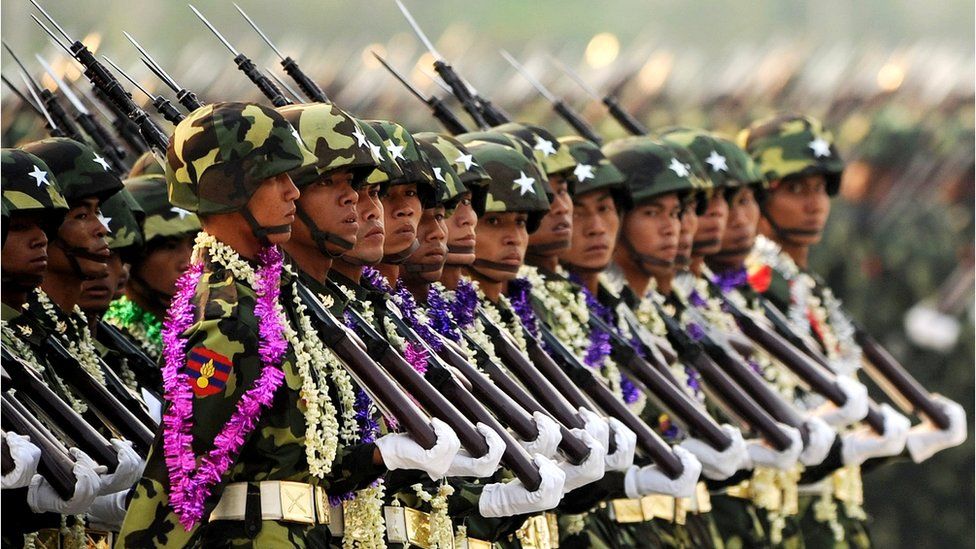
Some news does not merely inform, it sounds a warning bell. The recent words of Kim Aris about his mother, Aung San Suu Kyi, "For all I know, she could be dead," do more than capture a family’s anguish. For those of us who have served on India’s northeastern frontier, they mark something far graver, the final collapse of state authority in Myanmar. History and physics are unforgiving. When a state disintegrates, its shockwaves do not respect borders. Today, those shockwaves are no longer approaching, they are already breaking against India’s eastern flank.
While global attention may be drawn to the junta’s announcement of elections, but from the vantage point of Itanagar, Guwahati, Aizawl, or Imphal, as it should be for New Delhi, this is a sideshow. Elections conducted amid civil war are not a pathway to legitimacy, they are a tactical ruse by a regime losing territorial control. The real story is the vacuum of power and in conflict zones, vacuums fill quickly and violently. The emergence of new power centres along our border has transformed Myanmar from a troubled neighbour into Northeast India’s most serious security challenge.
At the heart of this transformation lies the rise of the Arakan Army (AA). Once dismissed in New Delhi as a peripheral insurgent outfit, the AA has evolved into a disciplined, territorially entrenched force exercising de facto governance over large swathes of Rakhine and Chin states. This is not a marginal shift, it is a strategic rupture. The AA now controls key approaches to India’s border, dismantling the junta’s writ where it matters most to us, on the ground.
Nowhere is this predicament more evident than in the Kaladan Multi-Modal Transit Transport Project. Conceived to bypass the vulnerability of the Siliguri Corridor and enhance India’s eastern connectivity, Kaladan was premised on a stable partner in Naypyidaw. That assumption has collapsed. The roads from Sittwe to Zorinpui now pass through territory controlled not by the Tatmadaw, but by the Arakan Army. The paradox is inescapable. A strategic project meant to secure Indian interests is beholden to an actor with whom we have no formal engagement.
This exposes a deeper problem, not of intent, but of strategic inertia. For years, Indian agencies have advocated pragmatic engagement with the AA to secure India’s logistical and security equities. Yet policy hesitation has prevailed, rooted in a rigid adherence to dealing only with the "recognised" central authority. That authority, however, is no longer sovereign along our borders. Diplomacy that ignores ground reality does not preserve principles; it courts irrelevance.
Here, China’s approach offers a master class in pragmatic realpolitik. While diplomatically shielding the junta from international sanctions, Beijing maintains robust channels with major ethnic armed organisations (EAOs), including the AA and the United Wa State Army. China’s objective is clear and amoral: to ensure the stability of its infrastructure projects, like the China-Myanmar Economic Corridor, and access to the Indian Ocean, irrespective of who controls the territory. This dual-track diplomacy guarantees that Chinese interests are secured regardless of the conflict’s outcome. India’s continued reliance on a weakening junta, while refusing to engage those who hold the ground, leaves us strategically exposed.
The consequences of this collapse extend well beyond stalled infrastructure. The most corrosive spillover is narcotics. Myanmar’s civil war has turned the drug economy into a war-sustaining ecosystem. The synthetic drug laboratories of the Golden Triangle are operating at an industrial scale, funding both the junta and multiple armed groups. The trafficking routes cut directly through India’s borders.
This is a national security threat, destroying lives, corroding social cohesion, and financing insurgencies and organised crime. Operational successes, record seizures, arrests, and interdictions, are necessary but insufficient. They are tactical containment measures in the absence of strategic disruption. As long as production, financing, and protection networks thrive across a collapsed border, enforcement will remain reactive. The poison will keep flowing.
This instability also forces a hard reassessment of our border management philosophy. The Free Movement Regime (FMR) was conceived with wisdom and empathy, recognising deep ethnic and familial ties that predate modern borders. In peacetime, it fostered trust and economic exchange.
In the context of an active civil war next door, however, it has become a structural vulnerability. This is not an argument for abandoning humanitarian responsibility, but for recalibration. Enhanced biometric registration, layered surveillance, and controlled transit must now overlay the FMR. Compassion cannot come at the cost of security. Refugees deserve protection; traffickers, arms smugglers, and insurgents do not.
The path forward demands a decisive break from strategic hesitation. First, India must embrace pragmatic engagement. This means authorising structured, calibrated channels with dominant EAOs that control territory affecting our national interests. Ground assessments must shape national policy, not be subordinated to outdated diplomatic canons. Second, border management must shift from normative idealism to conflict-adapted regulation, balancing humanitarian obligations with uncompromising enforcement.
Third, narcotics must be elevated to a core national security priority, requiring coordinated action across intelligence, financial, and enforcement agencies to dismantle the war economy itself, not merely seize its products. The uncomfortable truth is that the Myanmar we once knew no longer exists.
In its place stands a fragmented landscape of militias, war economies, and external manipulation. India’s long-term aspiration for a stable, unified neighbour remains valid. However, our immediate strategy must be flexible and rooted in present realities rather than nostalgic assumptions.
This brings us to the most dangerous illusion of all. For too long, the celebrated "resilience" of us Northeastern people has functioned as an unspoken shock absorber for national policy calculus. I have witnessed that resilience firsthand. It is extraordinary. But resilience is a human virtue, not a strategic doctrine. It cannot intercept a heroin shipment, dismantle a narco-militia, or secure a strategic corridor.
We are standing at the edge of a precipice, already smelling the smoke from the fire next door. Strategic clarity is no longer optional. The moment demands realism, resolve, and ruthless pragmatism. If we fail to act now, we should not be surprised when the flames reach our own walls.
The author is a former DGP of Assam and presently the General Secretary of the Think Tank Society to Harmonise Aspirations for Responsible Engagement-SHARE