The Constitutional Mismatch
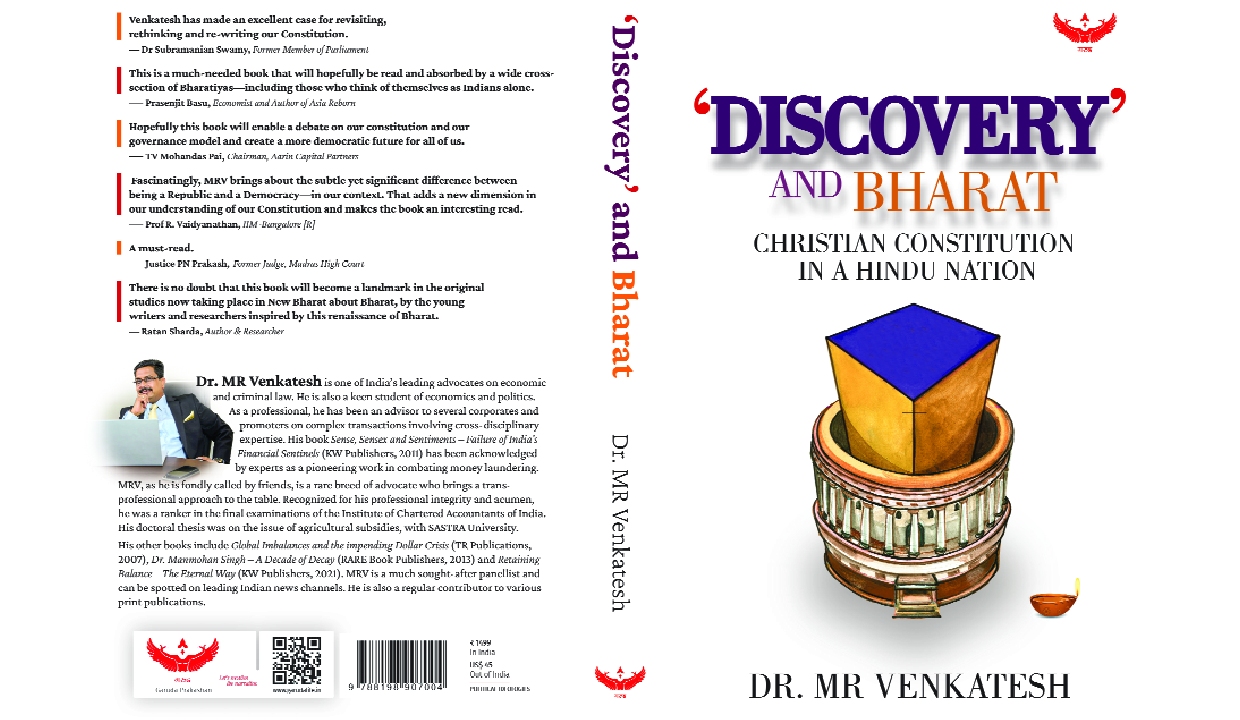
A Review of MR Venkatesh’s Discovery and Bharat
In the annals of modern Indian history, scarcely any speeches hold a candle to Jawaharlal Nehru’s address on the eve of India’s Independence, for the celebrated “Tryst with Destiny” heralded a historic shift. Interestingly, though, on the surface, it may appear to be another innocuous, flowery discourse, characteristic, of course, of Nehru’s usual idiolect. Upon closer review, however, one sees that there is more to it than meets the eye. Nehru proclaimed in his monologue, with a sense of the propitious gravitas of the hour, that a moment had arrived when “the soul of a nation, long suppressed,” would find “utterance.”
This statement is remarkable, to say the least, for it essentially admits that the “freedom at midnight” marked not a birth of a nation but rather emancipation of a pre-existing, long-standing nation. And that is the marrow of Discovery and Bharat, an undoubtable magnum opus by Dr MR Venkatesh.
Does the Constitution of India, deemed as a “Holy Book” by several illustrious politicians of India, acknowledge modern India as but a continuation of this pre-existing nation? And is the Constitution “independent” enough to take a leaf out of the ancient Indian jurisprudence and political system? Most importantly, as we will celebrate the 80th Independence Day this month, Dr. Venkatesh poses a more fundamental question: did the constitutional edifice raised, so to speak, in Delhi in 1950 truly allow the “soul of a nation” to find its natural “utterance”?
It is fair to say that perhaps every major treatise on constitutional law carries a distinct fountainhead. Interestingly, it seems that for Dr. Venkatesh, a lawyer and chartered accountant, the catalyst was the landmark 2018 Sabarimala Verdict. On that fateful day, while millions helplessly watched the Indian Supreme Court rule 4:1 against long-standing temple traditions on the grounds of “constitutional morality,” Venkatesh recounts what can only be termed a profound personal shift. It must be noted that his displeasure lies not with the judiciary but the foundational instrument that the judges were sworn to interpret: the Constitution of India itself. His central thesis, in fact, holds that the framers of the Constitution, presumably operating under the pressing exigencies of the Partition and administrative panic, essentially performed a copy-paste exercise upon several documents, the chief amongst those being the colonial Government of India Act of 1935.
Venkatesh starts by showing, with examples, how the Indian freedom struggle was propelled by Swaraj and how, post-Independence, when it came to actually implementing the ideas of Swaraj, the Constituent Assembly, by adopting the Government of India Act 1935 almost wholesale, prioritised superficial administrative convenience over Swaraj and Swatantrata. In addition, he traces the roots of the modern apparatus of the Indian State to Christendom, particularly the Magna Carta and the Catholic-Protestant conflict that triggered the Thirty Years’ War post Protestant Reformation.
Venkatesh further demonstrates how the English Puritan thought process inspired “the reformation of the world.” And most importantly, he examines the constant friction between Protestant Individualism and Catholic Collectivism and how we, in spite of their mutual incompatibility, muddled the conflicting ideas in the Indian Constitution. It is no surprise then that, in Venkatesh’s words, “every limb of the Constitution begins to act as a reformist champion.” The end result being, we are saddled with an atomised, individualised society on one hand and a highly centralised state on the other.
Venkatesh sees folly in this. At its core, his thesis posits that decentralisation cannot be at the cost of national unity and centralisation cannot be at the cost of the diversity of traditions and customs: local autonomy should not threaten national cohesion, and central authority should not crush our cultural diversity. Imposing the Western individualist, rights-based paradigms onto a society built on duty-based local autonomy, Venkatesh argues, sets up an ongoing conflict.
The title of the book, Discovery, is interesting; it is both quotidian and unique. The run-of-the-mill explanation is, of course, the Doctrine of Discovery, the religious-legal concept tracing its roots to Papal Bulls such as Inter caetera (1493) issued by the Vatican. The doctrine sanctioned colonisation of non-Christian lands. The more nonpareil justification of the title, I feel, is that, during and post-colonisation, we “discovered” the common cliché of “universal values,” which arguably feels good but means little. One is reminded thus of Thomas More’s Utopia, which is also analysed and discussed at length in Venkatesh’s book.
All in all, if one were to summarise the fundamental contention of the book, it is to examine how Indian the Indian Constitution truly is. The book meticulously traces how this constitutional structure plays out in modern Indian jurisprudence, citing high-profile judicial interventions as evidence of an inherent conflict between Western legalism and ancient civilisational traditions.
Irrespective of whether one agrees or disagrees with this proposition, there is no gainsaying the painstaking research and intellectual vigour on display here. It is a provocative, deeply earnest volume that will hopefully stir spirited debate amongst lawyers, parliamentarians, students of Indian statecraft, but most importantly ordinary Indians who are unfortunately oblivious of the foreignness of the modern Indian polity.
The writer is mechanical engineer and student of Indian history; Views presented are personal.