The Aravallis Through People’s Eyes
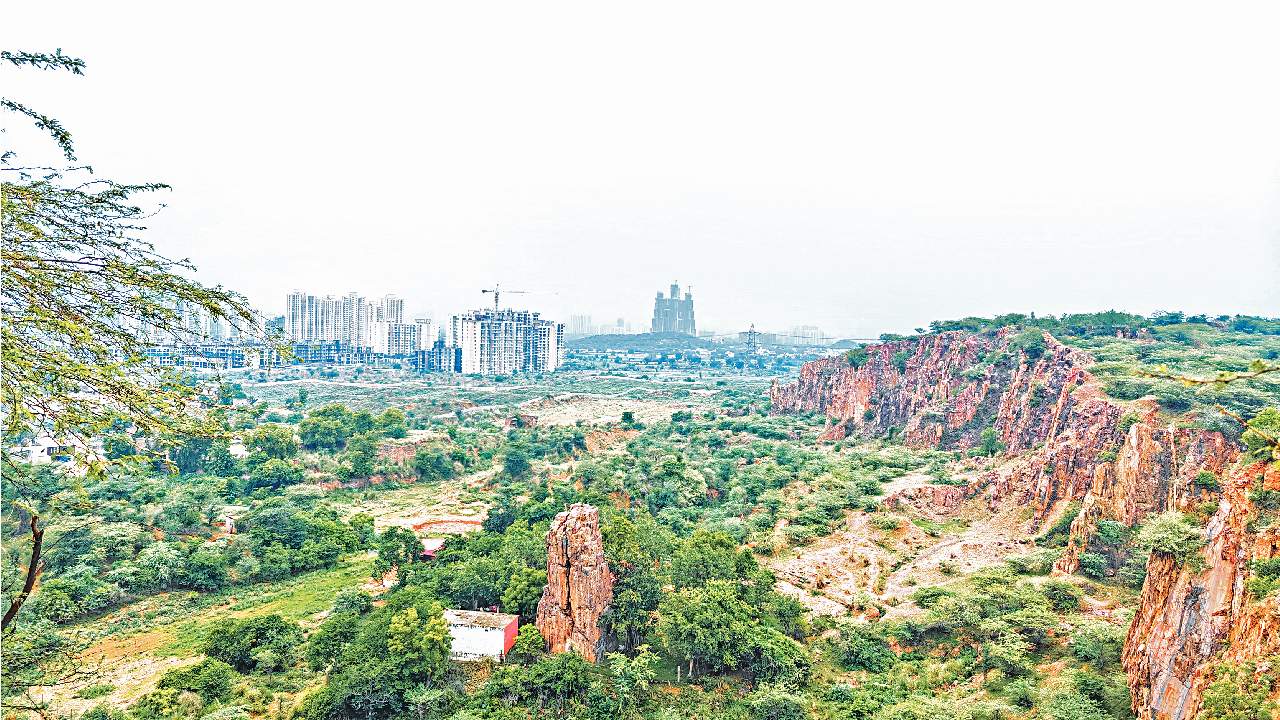
The Aravalli Range has shaped the cultural life of north-western India in ways that are subtle, layered, and deeply enduring. Stretching nearly 700 kilometres across Gujarat, Rajasthan, Haryana, and Delhi, these ancient hills have long acted as both a physical and cultural divide, giving rise to distinct regions suchas Marwar (western Rajasthan) and Mewar (south-central Rajasthan) and identities such as the Marwari and Mewari communities.
Long before modern borders and infrastructure, the Aravallis guided where people settled, how they travelled, and how they farmed. Villages emerged along slopes and seasonal streams where rainwater could be slowed and stored, while the hills offered shelter from hot desert winds and shaped grazing routes, trade paths, and pilgrimage trails. Even today,names of places, local festivals, and oral histories across Rajasthan and Haryana refer to specific ridges, rocks, nalas, and springs, revealing how geography became inseparable from memory, language, and identity.Pushkar’s lake, Raisina Hill, and Surajkund are clear examples of how terrain and water influenced settlement and ritual life.
Now under stress due to mining, urban expansion, and infrastructure development that are fragmenting both the hills and the social systems that once protected them. If this finely balanced relationship between culture, community, land, and landscape is to be restored, it would require a holistic approach that is data-driven, community-anchored, and multi-disciplinary. Isolated interventions are no longer adequate.
This perspective finds strong support in a recent eco-restoration study conducted by the Sankala Foundation, a Delhi-based non-profit, which examined degraded stretches of the Aravalli landscape through a scientific yet community-anchored lens. Based on detailed fieldwork in four villages in Haryana’s Aravalli region-Gairatpur Bas, Naurangpur, Sakatpur, and Shikohpur-the study approaches the Aravallisnot as fragmented forest patches, but as an
interconnected system of forests, commons, agricultural land, water bodies, and habitation areas. This report on `Eco-restoration of the Aravalli Landscape’provides a scientific, community-driven, and scalable framework for strengthening the Aravalli Green Wall Project (AGWP) of the Ministry of Environment, Forest and Climate Change (MoEFCC)as part of the National Action Plan to Combat Desertification and Land Degradation through forestry intervention.
The report offers a replicable eco-restoration framework by adopting an integrated landscape-based restoration approach to enhance biodiversity, ecosystem services, and the climate resilience of the Aravalli landscape. Historically, the relationship between land and culture is most visible in the belief systems that evolved around the Aravallis.
Hills, forests, and water sources were never treated as inert resources, but as living spaces infused with meaning. Sacred groves, known as orans in Rajasthan, are among the clearest expressions of this worldview.
Dedicated to local deities, ancestors, or village spirits, orans functioned as community-managed reserves long before the language of conservation entered public discourse. Cutting trees or hunting within them was socially forbidden, enforced not by written law but by shared belief and collective sanction. This idea of landscape as culture also extends to the region’sbuilt heritage.
Several UNESCO World Heritage Sites within the Aravalli range, including Chittorgarh and Kumbhalgarh forts and the Dilwara Jain Temples at Mount Abu, are best understood as cultural spaces shaped by the hills themselves rather than as isolated monuments. Their location, design, and continued relevance reflect a long dialogue between terrain, defence, faith, and settlement.
Cultural life in the Aravallis has also been closely tied to seasonal change. Fairs, folk songs, and village rituals often mark the arrival of monsoon clouds over specific hill ranges, the filling of tanks and ponds, or the gradual drying of streams in summer. Environmental signals were interpreted
collectively and embedded in social practice. In this way, ecological change was not experienced as an abstract phenomenon, but as something felt, discussed, and responded to together. The landscape shaped culture, and culture in turn shaped how the landscape was used and protected.
Livelihoods across the Aravallis reflect a long tradition of adjustment rather than extraction. Pastoral communities moved livestock seasonally to avoid stressing fragile grasslands, while farmers relied on mixed cropping and hardy local varieties suited to shallow soils and uncertain rainfall. Water, always scarce, was treated as a shared responsibility. Johads, stepwells, and village ponds were built and maintained through collective labour, reinforcing cooperation and local governance.
In parts of Alwar district, the revival of johads in recent decades not only restored groundwater and seasonal rivers but also strengthened community institutions that regulated water use. Knowledge of edible fruits, medicinal plants, and forest produce remained practical and place-based, passed through everyday use and observation rather than written texts. Hence, if restoration is to succeed, it must engage with the Aravallis as a living cultural landscape rather than a collection of degraded land parcels.
The findings of the Sankala Foundation report present a picture of extensive and long-term ecological decline. Ecological assessments reveal habitat fragmentation and declining vegetation quality, while geospatial analysis points to rapid land-use change, falling soil moisture, and growing hydrological stress.
Nearly one-fifth of water bodies in the pilot landscape have disappeared over recent decades, and many remaining ponds are silted or only seasonally functional, severely limiting groundwater recharge. These trends mirror what communities have long reported through lived experience: worsening water scarcity, rising heat stress, and shrinking tree cover.
Equally significant are the socio-economic insights. Household surveys and focus group discussions show that communities remain heavily dependent on forests and common lands for fodder, fuelwood, and grazing, with limited livelihood diversification. In times of stress, this dependence intensifies, increasing pressure on already degraded ecosystems. Yet the study also records a strong willingness among villagers to participate in restoration efforts, provided
these are technically sound, institutionally supported, and sustained over time. Local governance bodies and frontline agencies, however, often operate in silos, highlighting the need for coordinated, landscape-scale approaches.
Crucially, the study does not treat communities as beneficiaries alone, but as stewards and knowledge holders. Traditional ecological knowledge relating to native species, soil-binding shrubs, water pathways, and seasonal rhythms is consciously integrated into restoration planning. Women’s groups, grazing collectives, and village institutions are positioned at the centre of decision-making,
monitoring, and upkeep. This approach echoes the cultural systems of the Aravallis themselves, where conservation historically emerged from shared norms and collective responsibility rather than external enforcement.
The studyoffers a model for translating national policy into local practice.It demonstrates that restoration cannot rely solely on plantation targets or technical mapping. Instead, it must rebuild ecological processes alongside social institutions, ensuring that forests, water bodies, commons, and livelihoods.
The future of the Aravallis will depend not only on how they are defined in law or mapped on paper, but on whether restoration efforts can recover the cultural and institutional relationships that once sustained these hills. Treating the Aravallis as a living landscape shaped by people, memory, and care is not a romantic ideal; it is a practical necessity. Without this perspective, even the most ambitious restoration plans risk becoming temporary fixes on an ancient and fragile terrain.
Dr Dibyendu Mandal is the Programme Lead (Forest & Wildlife), Sankala Foundation
Ravina Yadav is a Research Associate, Sankala Foundation and was part of the field research in the Aravalli landscape.